
Table of Content
- AI for Travel Industry: Where to Actually Keep It?
- Travel Tech AI: The Boundaries Nobody Mentions
- What Real Implementation Looks Like
- Architecture Considerations for Travel Tech AI
- he Risks You're Not Thinking About
- How to Choose Your First AI Feature
Let`s evaluate the AI possibility for your travel product
Book a callEvery travel tech founder has the same question on their mind: “Should we be doing something with AI?” But the answer is frustrating. It’s not yes or no. It’s “it depends on what you’re trying to solve.” The reality is that AI has become table stakes in travel software – not because it’s magic, but because it handles certain problems remarkably well. Problems that used to require armies of support agents or manual oversight just don’t scale anymore. But the thing that is as important as AI’s advantages is its disadvantages: AI is also really, really good at wasting your engineering budget when applied to the wrong problems. So let’s talk about what actually works.
AI for Travel Industry: Where to Actually Keep It?
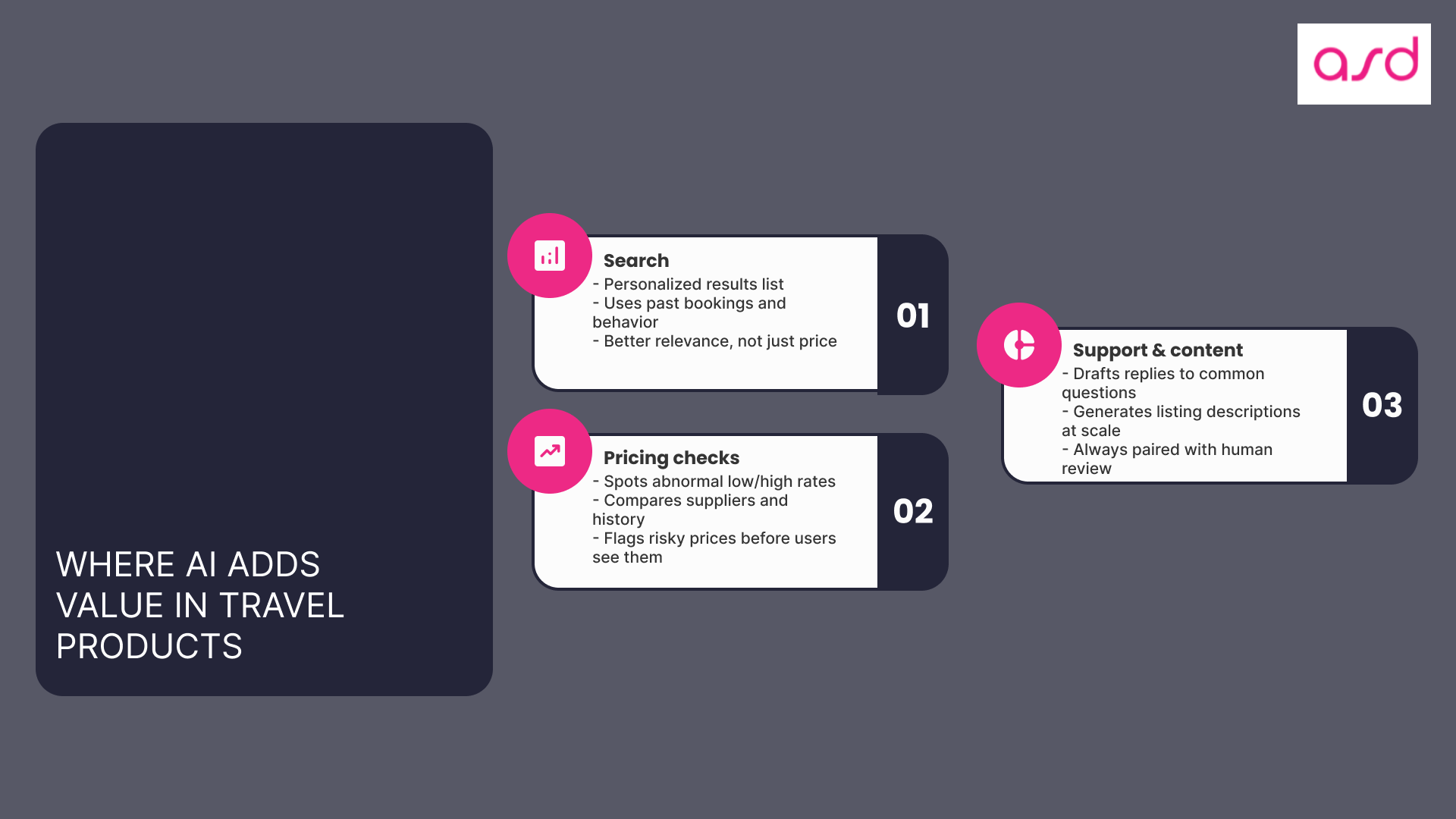
Think of AI as a really talented intern. It’s brilliant at pattern recognition, tireless with repetitive tasks, but not very good at understanding complex context. So, naturally, you wouldn’t put an intern in charge of signing contracts or making final calls on pricing strategy.
Nevertheless, the is a places where the “intern” shines in travel and hospitality software development:
Search That Actually Understands Intent
Your hotel API returns results ordered by commission rates and partner deals. That’s great for your suppliers, terrible for your users. A business traveler searching for accommodation gets the same ranking as a family planning a vacation.
AI reranking changes this. You feed it user signals – previous bookings, search patterns, device type, time to departure – and it reorders results based on what this specific person actually wants. Not rocket science, but shockingly effective.
We’ve seen implementations go live in 3-4 weeks, and the conversion impact is measurable almost immediately. So, you don’t need to rebuild your entire search infrastructure. The reranking layer sits on top of your existing search, takes the first 50-100 results, and reshuffles them based on learned user preferences.
One booking platform we worked with saw a decent increase in conversion just by implementing basic collaborative filtering. Users got results that matched their actual preferences, not just what paid the highest commissions.
Validate your AI feature Share your product goals, and we’ll map which AI use cases make sense now, and what to postpone until your platform is ready.
Catching Pricing Disasters Before They Happen
Here’s a scenario that will sound familiar: You aggregate inventory from multiple wholesalers. One API returns a rate 40% below market, usually due to a caching error or stale data. Customer books it. Confirmation fails. The customer is furious. You eat the difference or lose the customer.
AI anomaly detection is like having someone who’s memorized your pricing history watch every incoming rate. It compares against historical averages, checks other suppliers, and flags anything suspicious before it reaches customers. It`s pattern recognition, in which AI is good at, but, of course, you still need a human to double-check results, not a whole dataset.
The travel platform implemented this with an Isolation Forest model. Processing time: about 50 milliseconds. Development time: 2-3 weeks. Savings from prevented failed confirmations: significant enough that they wondered why they hadn’t done it sooner.
The model catches more than just obvious errors. It learns seasonal patterns, destination-specific variations, and detects when a supplier’s entire feed shifts unexpectedly.
Support That Helps
Nobody goes into travel tech because they love answering the same questions about cancellation policies a hundred times a day. AI handles this beautifully – auto-classification routes tickets to the right teams instantly, and automated responses resolve 40-50% of typical queries without human intervention. But, we cannot stress how important for you to still have on-site managers, who can help to deal with sensitive or complex requests.
The multilingual angle matters here, too. If you’re serving international travelers, maintaining service quality across 15 languages without proportional staff increases isn’t just nice – it’s the difference between viable unit economics and burning cash.
Example: Customer emails arrive in Spanish asking about refund policies. The system classifies it, translates it, and if it matches known patterns, drafts a response. Your agent reviews, maybe tweaks a sentence, and sends. What used to take 15 minutes now takes 2. Works great for generic staff, which is a large percentage of requests.
This simply allows you to save money on new hires, keep your workers from burning out, and deal with your clients’ requests faster.
Making Bad Listings Bookable
Marketplaces aggregating properties from multiple sources hit the same wall: listings arrive with minimal descriptions. Room size, amenity list, location – and that’s it. These don’t convert well because travelers can’t envision the experience.
GPT-4 turns structured data into compelling descriptions well enough. Feed it amenities and location, tell it to emphasize travel benefits, and you get 150-200 words that actually help someone imagine staying there.
One property management platform development project started auto-generating these and saw measurable conversion improvement on listings that previously had bare-bones content. Properties that just listed “WiFi, Kitchen, Parking” got transformed into descriptions highlighting how the kitchen lets families save on dining out, how the WiFi supports remote work, and how free parking makes road trips easier.
The key is giving the model enough context about the property type and target audience. A studio apartment in a city center gets described differently than a lakeside cabin, even if they have similar amenity lists. The AI picks up on these patterns from high-performing listings and applies them to underperforming ones.
AI Plus Human Review, Not AI Instead of Humans
Crucially, this doesn’t remove humans from the loop. The model highlights patterns, clusters, reviews, and suggests where to look – but a human still checks the insights, prioritizes what to fix, and decides how to respond. If the system shows a sudden spike in “noise” complaints, it’s a manager who verifies what’s going on and coordinates real‑world changes.
This is the pattern you want for most AI in travel:
- AI does the repetitive analysis at scale.
- Humans review what it surfaces, correct edge cases, and decide actions.
Used this way, AI becomes a force multiplier for your team instead of a risky black box that quietly makes decisions you can’t explain.
Travel Tech AI: The Boundaries Nobody Mentions
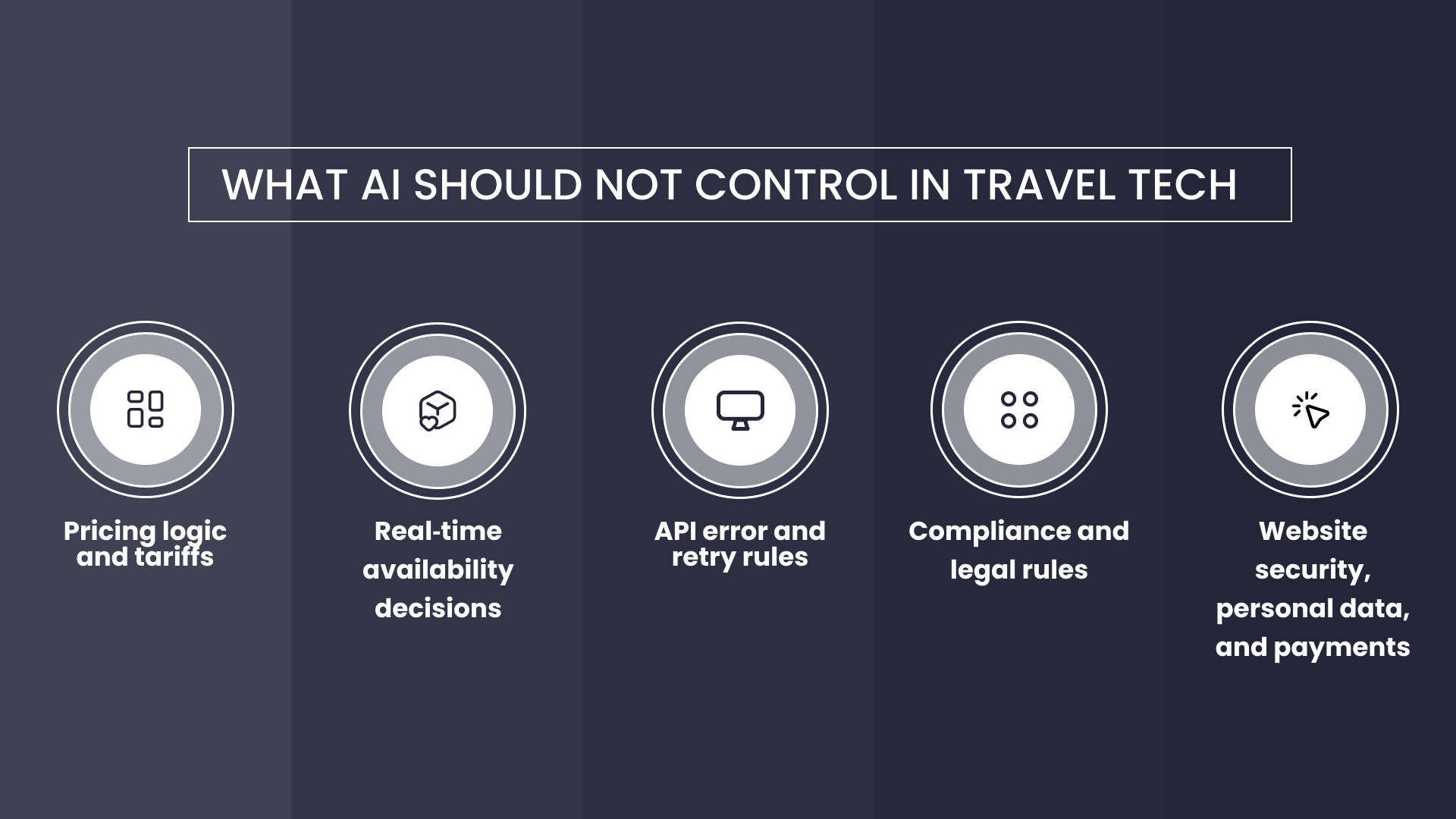
Knowing what AI can’t do is worth more than knowing what it can, and this statement should become your approach. Without more fuss, here is what AI should not be trusted with:
- Pricing logic and tariffs: Travel pricing involves complex business rules – child policies, cancellation windows, seasonal adjustments. These are contractual obligations, not patterns to recognize. Don’t use AI for this.
- Real-time availability: AI can estimate likelihood, but travel platforms require certainty. You can’t tell a customer “probably available.”
- Integration-specific logic: Each API has unique authentication, rate limiting, and error handling. LLMs can help prototype, but human developers must review and test everything.
- Compliance decisions: GDPR, PCI DSS, regional consumer protection – these demand explicit rules, not learned approximations.
- Security‑sensitive decisions: Website security, personal data handling, and payment or banking flows must remain under strict, deterministic control. AI can assist (for example, by helping detect suspicious patterns or triaging security logs), but it should never be the final authority on what to block, what to store, or how to handle cardholder and identity data.
AI augments human decisions and automates pattern recognition, but it doesn’t replace clear business logic or sound architecture. Use it where it provides clear value.
What Real Implementation Looks Like
Let us show you something concrete. One property management platform we built handles vacation rentals listed across Airbnb, Booking.com, and VRBO. Property managers were drowning in reviews – dozens coming in each week across multiple channels. (Here you can read the full case: AI-Powered Sentiment Analytics Tool Development)
We built a pipeline that pulls reviews from all platforms, translates non-English ones, runs sentiment analysis, extracts specific topics (cleanliness, location, amenities, communication), and generates summaries highlighting what guests love and what needs fixing.
Property managers now spend a fraction of the time they used to on review analysis, and they actually catch issues faster because the system surfaces patterns they’d miss reading reviews one by one.
Here’s what made this work:
- Narrow scope: We didn’t try to build a general-purpose review analyzer. We focused specifically on vacation rental reviews with known patterns.
- Clear success metrics: Time spent on review management and speed of identifying actionable feedback. Both measurable, both improved.
- Graceful failure: When sentiment analysis confidence is low, the system flags the review for manual reading instead of making a guess.
- Non-critical path: Review analysis happens asynchronously. If the AI pipeline has issues, it doesn’t affect bookings, availability updates, or any core property management functions.
- Development took about 3-4 weeks for the complete pipeline. This is personalization at the operational level – using AI to give property managers insights about their specific properties.
Architecture Considerations for Travel Tech AI
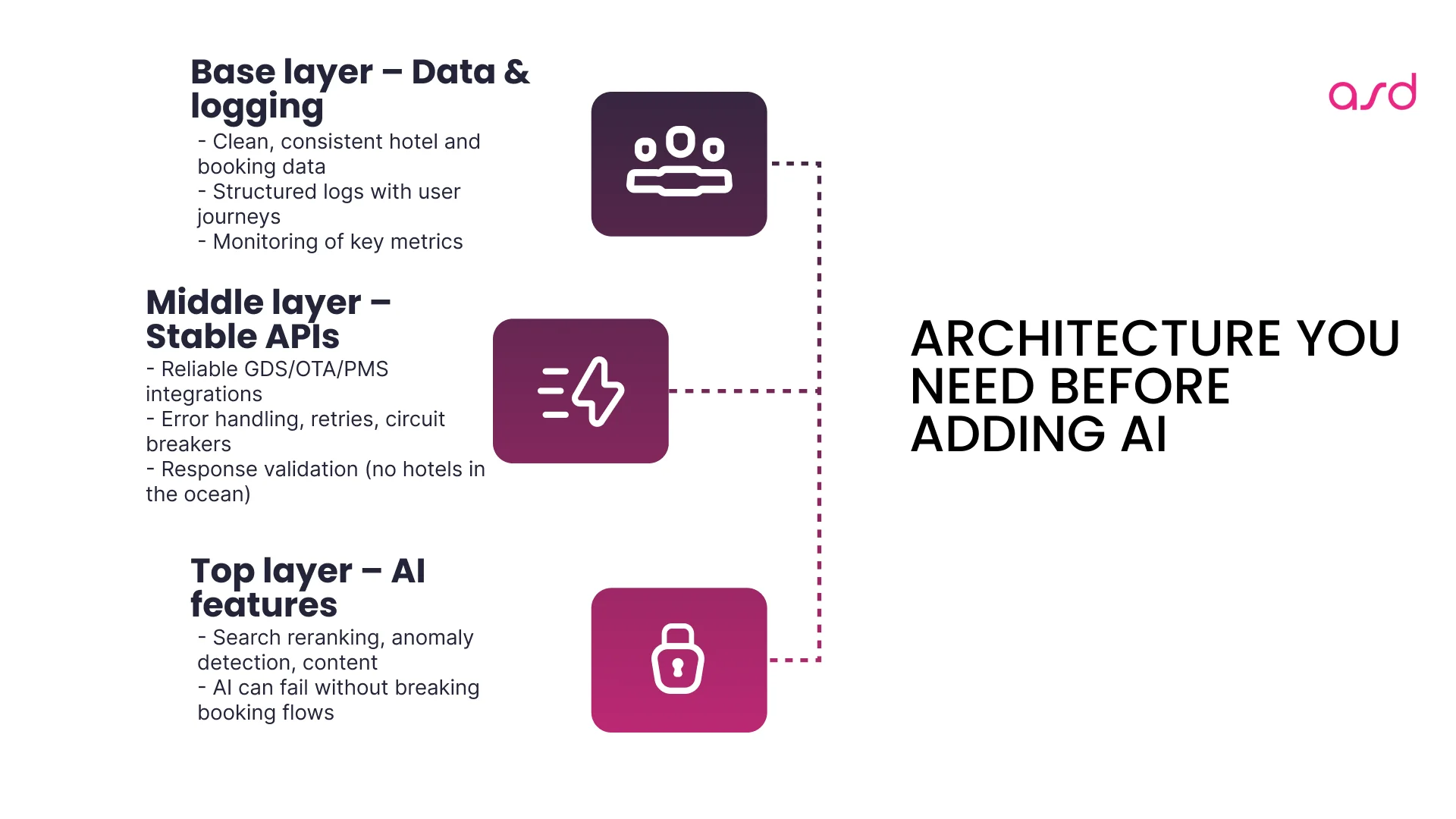
Implementation matters as much as intent. Here’s what separates production-ready AI features from science experiments:
Isolation and fault tolerance: Your AI features should fail gracefully. If your recommendation engine goes down, users should still be able to search and book. Design systems where AI enhances the experience but doesn’t block core functionality.
We always build a fallback mechanism. If the AI reranking service times out, fall back to default sorting. If the description generator fails, show the structured data. Users barely notice when AI features degrade, but they definitely notice when core functionality breaks.
Latency budgets: Search reranking that takes 3 seconds defeats the purpose. Set hard latency limits – typically 200-500ms for synchronous features. Always load test with realistic data volumes.
Model versioning and rollback: You need the ability to roll back when new deployments underperform. We typically run new model versions at 10% traffic for 48 hours, watching key metrics. If anything drops significantly, automatic rollback kicks in.
Data pipelines and monitoring: Track input data quality, model prediction confidence, and actual outcomes. When a model starts degrading, you want to know before your users do.
For a deeper dive into generative AI in travel tech, we’ve documented five proven use cases we’ve delivered.
The Risks You’re Not Thinking About
Data leakage and privacy: Travel platforms handle sensitive information. When you feed this into AI models, you need to be careful about what gets logged and where models are hosted. We worked with one platform that wanted to use OpenAI for personalization, but their legal team shut it down because it meant sending customer data to third-party servers.
Bias amplification: If your historical data shows patterns in how certain properties get booked, your AI will learn and reinforce them. This can lead to discriminatory outcomes. Testing for bias is hard and ongoing – you can’t just check once at launch.
Vendor lock-in: Build abstraction layers and keep your data in formats that transfer to other providers. What seems cheap in testing can become expensive at scale.
Cost spirals: AI APIs price by usage. We’ve seen platforms hit with $50,000 monthly bills because they didn’t think through the cost of running every search query through an AI model. Set hard budget limits and use caching aggressively.
Talk through your AI ideas with travel tech engineers
How to Choose Your First AI Feature
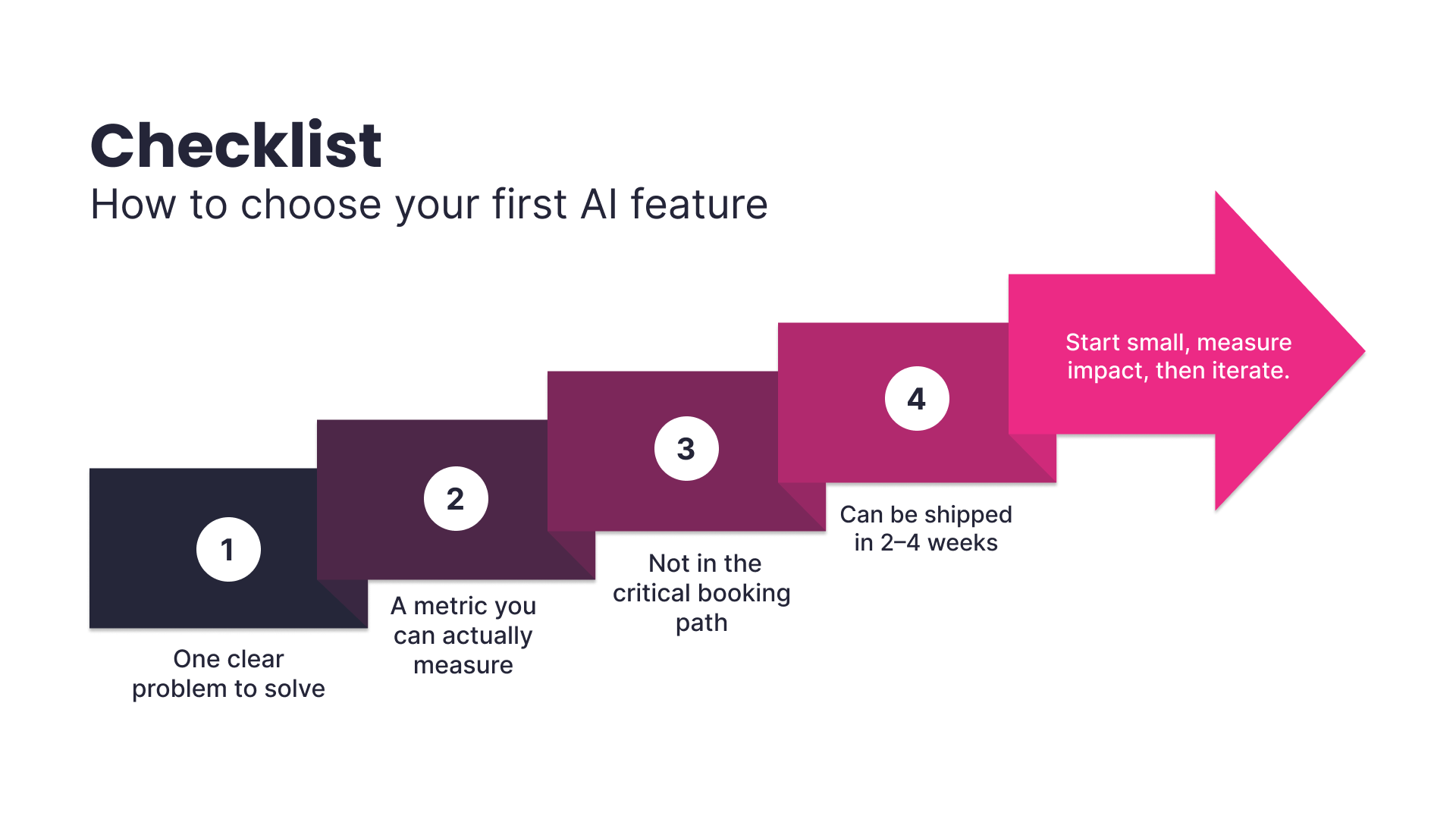
So You Want to Start Somewhere… If you’re evaluating where to begin, look for these characteristics in your first AI feature:
- One specific problem, not a vague improvement. “Make search better” is too broad. “Rerank search results based on user history” is actionable.
- Measurable impact. If you can’t track whether the AI feature improved something, you won’t know if it’s working or just adding complexity. Define your success metric before you write a line of code.
- Non-critical path. Keep AI out of your core booking confirmation flow until you’ve built confidence. Let it enhance rather than block.
- Deployable in weeks, not months. Most of the examples I mentioned – search reranking, anomaly detection, ticket classification, description generation – are 2-4 week implementations. If someone’s telling you it’ll take six months, the scope is too big.
- Start small. Measure everything. Ship fast. Iterate based on real user behavior, not assumptions about what AI “should” do.
The travel and hospitality sector is perfect for practical AI because the problems are well-defined, the data exists, and the ROI is measurable. You don’t need to bet the company on some grand AI transformation. You need to pick one annoying problem, solve it with AI, measure the results, and move to the next one.
That’s the playbook. Everything else is hype.
Questions? Answers!
Where should I start with AI in a mid-stage travel platform?
Start where you already have decent data and a clear metric: search reranking, ticket auto-classification, or review summarization are typical first wins that avoid touching core booking flows. These features are low-risk, fast to implement, and give you experience working with AI in production before tackling more complex challenges. The key is picking something where you can measure improvement in a metric that actually matters to your business – conversion rate, support costs, or user engagement.
How much data do I need before AI personalization travel makes sense?
For meaningful personalization and ranking, aim for at least tens of thousands of sessions or historical interactions so models can see real patterns instead of noise. If you’re just starting out with limited data, focus on simpler rule-based personalization first – things like adjusting results based on explicit user selections (dates, destination, number of guests) rather than trying to infer preferences from behavior. You can always upgrade to more sophisticated AI models as your data grows.
Can AI fix my messy GDS/OTA/PMS integrations?
No, AI will usually amplify bad data and inconsistent responses. Fix integration reliability and normalization first, then use AI on top to enrich, validate, or prioritize. We’ve seen teams try to use AI to “clean up” unreliable supplier data, and it always makes things worse. The AI learns to work around issues instead of surfacing them, which means problems persist and compound. Get your data pipeline solid, then add AI enhancement layers.
How do I avoid vendor lock-in with external AI APIs?
Keep an internal abstraction layer for model calls, log inputs and outputs, and design features so you can swap providers or move to self-hosted models later without rewriting the whole product. The abstraction layer might feel like unnecessary overhead initially, but it’s insurance. We’ve helped platforms migrate from OpenAI to Anthropic to self-hosted models, and the ones with good abstractions made the switch in days instead of months. Also, regularly export and store the training data you’re generating – it’s yours, and you might need it to train custom models later.
When should I call in a specialist team instead of building in-house?
If your main bottlenecks are travel domain complexity (rates, availability, mapping) plus missing data infrastructure, it’s usually faster to bring in a team that already ships AI in travel software, then let your own team own iteration afterward. The ROI calculation is straightforward: if building the capability internally would take your team six months and delay other features, versus bringing in specialists who can ship in 4-6 weeks, the opportunity cost usually favors the specialist team. You still own the code, you still learn the system, but you get to market faster and with less risk.


Related Articles:

AI Risks in Travel Tech: Hallucinations, Accuracy, Vendor Lock-in

AI Architecture Requirements for Travel Software

Generative AI in Travel Tech: 5 Proven Use Cases We Delivered

How to Build a Booking System: An Online Guide with Must-Have Features
We use cookies to personalize our services and improve your experience on this website. We may use certain personal data for analytics and marketing purposes.
Fill out the form to schedule a 30-minute call, where we’ll discuss your project requirements and explore the best solutions for your needs.