
Vibe coding means prompting AI to generate code without deeply understanding what it produces. AI-assisted development means engineers using AI to work faster – while staying responsible for architecture, correctness, and production reliability. Both have legitimate uses. The difference is what’s at stake if the output is wrong.
What Is Vibe Coding?
Vibe coding is building software by describing what you want to an AI tool and accepting the output without fully understanding the code it generates. The developer – or non-developer – writes prompts, reviews results at a functional level (“does it work?”), and iterates until the output behaves as expected.
The term was coined by Andrej Karpathy in early 2025 to describe a mode of development where the programmer “vibes” with the AI – staying at the level of intent and outcome rather than implementation. It’s fast, low-friction, and genuinely useful for specific contexts.
What vibe coding is not: a replacement for software engineering on production systems. The AI generates code based on patterns in its training data. It doesn’t know your architecture, your data model, your security requirements, or the edge cases that will appear under real load. Someone has to – and in vibe coding, often nobody does.
Vibe coding not cutting it?
ASD Team builds production systems with AI-assisted development – engineered for correctness, not just demos.
Let’s talk
What Is AI-Assisted Development?
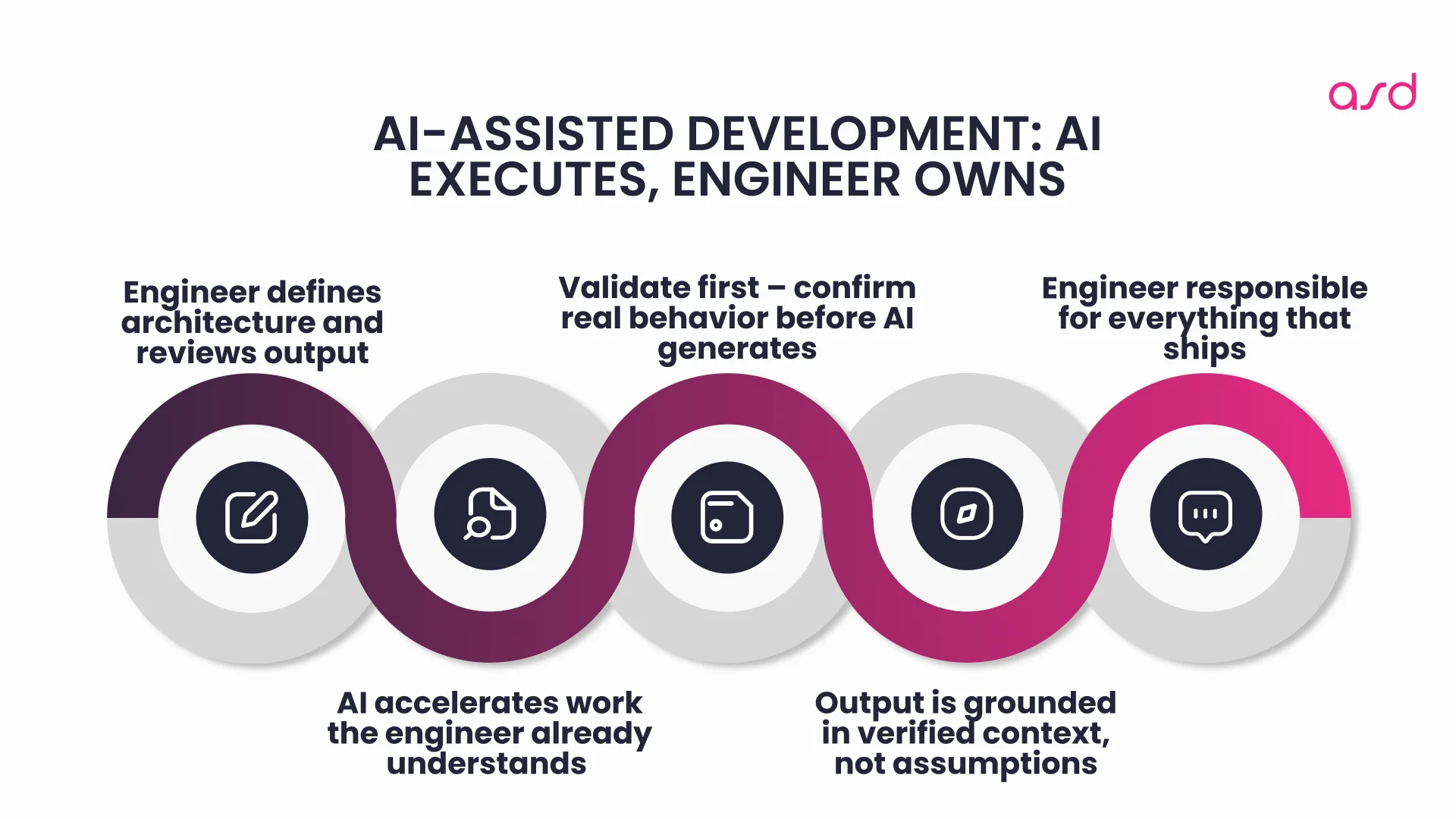
AI-assisted development is engineers using AI tools – code completion, generation, review, documentation – as part of a professional development workflow. The engineer remains in control: they define the architecture, review AI output critically, test against real behavior, and take responsibility for what ships.
The AI accelerates work the engineer already understands. It doesn’t replace the understanding.
In practice, AI-assisted development looks like:
- Using AI to port an existing integration pattern to a new provider – faster than rewriting manually
- Generating boilerplate from verified API documentation and API integration services instead of writing it by hand
- Using AI to draft a first pass at a complex function, then reviewing and refining it
- Connecting AI to verified context – a working sandbox, real API responses – so output is grounded in actual behavior rather than assumptions
The key distinction from vibe coding: the engineer can read, understand, and take responsibility for every line that ships. AI output that they can’t verify doesn’t go into production.
Key Differences
| Vibe Coding | AI-Assisted Development | |
| Who’s in control | AI generates, human approves at outcome level | Engineer directs, AI executes |
| Code understanding | Not required | Required |
| Review process | Functional (“does it work?”) | Technical (“is it correct, safe, and maintainable?”) |
| Architecture decisions | Made by AI or skipped | Made by engineer |
| Error handling | Often missing or generic | Explicitly designed |
| Edge cases | Discovered in production | Anticipated in development |
| Best for | Prototypes, personal tools, low-stakes experiments | Production systems, business-critical workflows |
| Risk level | High for anything that affects users or data | Managed – engineer owns the risk |
When Vibe Coding Is Enough
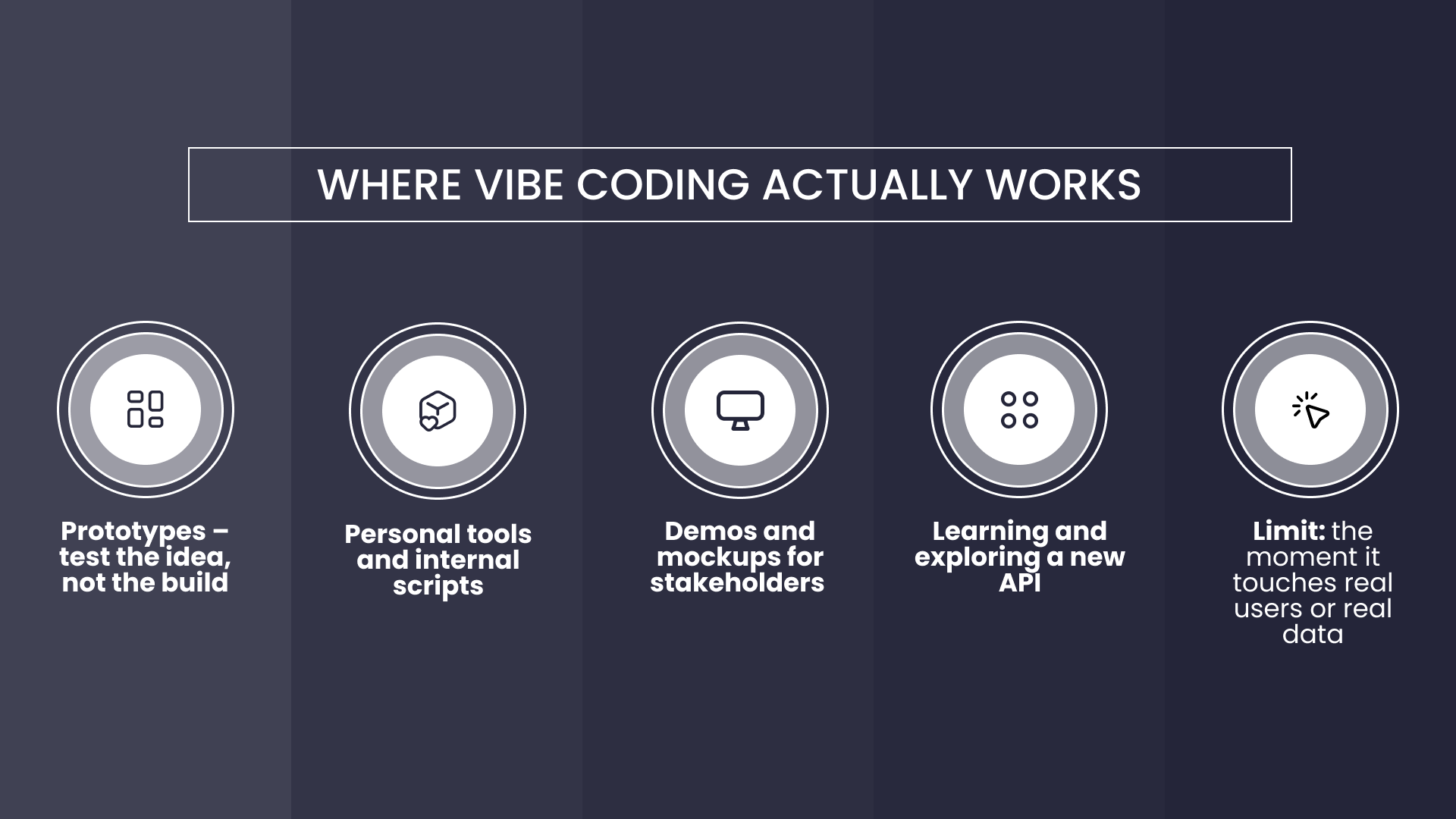
Vibe coding works when the cost of being wrong is low.
Prototypes and proof of concepts
You need to test whether an idea is worth building – not build the thing itself. Speed matters. Correctness is secondary. A vibe-coded prototype that demonstrates the concept is exactly right for this.
Personal tools and internal scripts
A script that processes a local file, a personal automation, a one-off data transformation. If it breaks, you fix it. Nobody else is affected.
Demos and mockups
Showing a stakeholder how something could work – not shipping it to users. Vibe coding gets you there fast. What you build in the demo doesn’t have to survive production.
Learning and exploration
Understanding a new API, exploring a library, trying an approach before committing to it. Vibe coding is a fast way to explore – as long as you don’t ship the exploration.
The honest limit
The moment something vibe-coded touches real users, real data, real payments, or real bookings – the assumption of correctness that vibe coding skips becomes the thing that costs you.
When You Need AI-Assisted Development
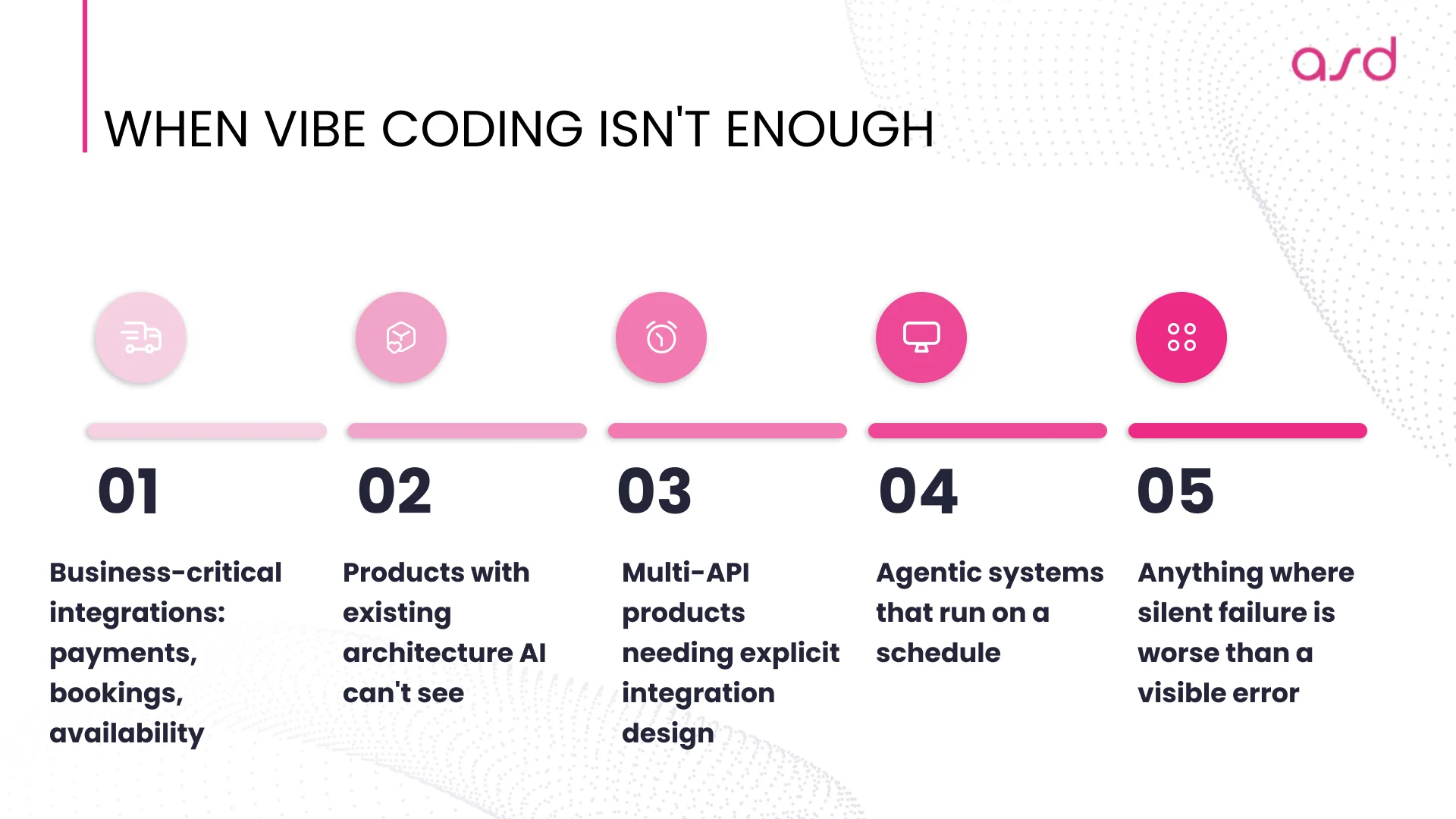
AI-assisted development is the right approach when the output has to be correct – not just functional in a demo.
Business-critical integrations
Payment flows, booking systems, availability sync, transaction reconciliation. A vibe-coded payment integration that invents API endpoints it hasn’t validated will fail in production. In financial workflows, that’s not a bug to fix – it’s money that doesn’t reconcile and transactions that can’t be recovered.
On a recent payment API integration, the team tested what happens when AI generates code for a niche, poorly documented processor with no preparation. The output looked clean. It called endpoints that don’t exist. Finding that in a sandbox took days. Finding it in production would have cost weeks – and financial consequences. Read the full case →
Products with existing architecture
Any codebase that already exists has decisions baked in – authentication patterns, data models, error handling conventions, internal dependencies. Vibe coding doesn’t see any of that. AI-assisted development, in the hands of an engineer who understands the existing system, adapts to it. Vibe coding overrides it.
Multi-API products
When adding multiple API providers to a product, the integration layer needs to be explicitly designed. Each provider has its own data format, rate limits, authentication requirements, and failure modes. An engineer has to map how they interact. AI can help build it – but can’t replace the mapping.
Agentic and multi-step AI systems
Building AI agents that run on a schedule, coordinate across tools, and operate without constant human monitoring requires orchestration, reliability engineering, and defined failure behavior. Vibe coding produces something that works once. AI-assisted development produces something that runs reliably.
Anything where silent failure is worse than visible failure
Vibe-coded systems tend to fail silently under edge cases – they handle the happy path and stop there. In booking systems, payment flows, and availability sync, a silent failure means a user has a confirmation that doesn’t correspond to anything real. That’s worse than an error message.
Not sure which approach your project needs? We scope the work and tell you what AI can handle safely.
 Pavlo Boiko
CEO
Pavlo Boiko
CEO
How to Combine Both Approaches
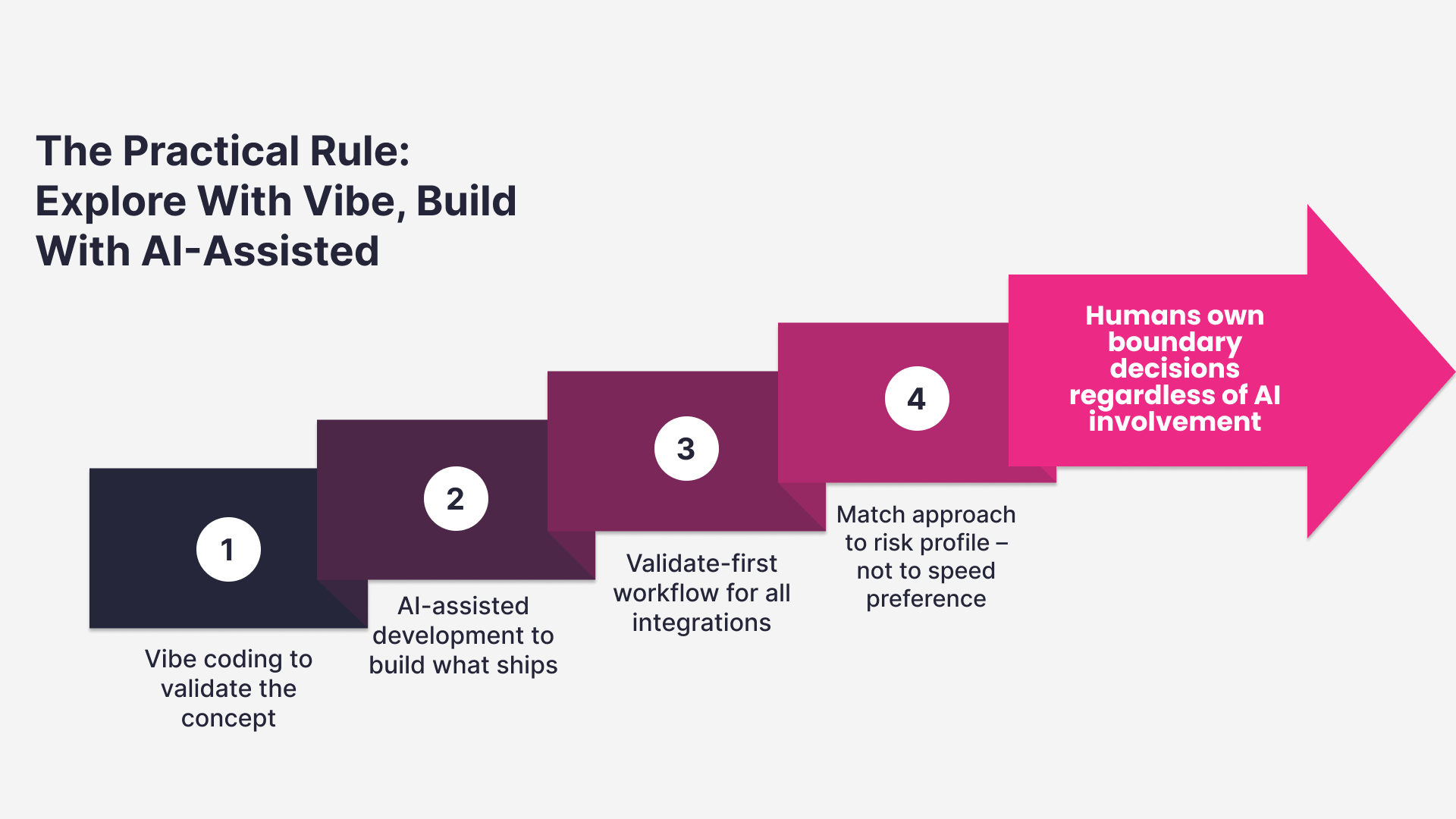
The most practical approach for most development teams is not a choice between vibe coding and AI-assisted development – it’s knowing which mode applies at which stage.
Use vibe coding to explore, use AI-assisted development to build
Start with vibe coding to validate the concept, test an approach, or demonstrate a direction quickly. Once the exploration produces something worth building properly, switch to AI-assisted development – bring in engineering judgment, verify the architecture, test against real behavior, and build what ships.
Use AI-assisted development with a validate-first workflow
The most effective AI-assisted coding workflow for integrations follows a consistent sequence: understand the real behavior first (sandbox, direct API testing, reviewing actual responses), then give AI verified context to work from. AI output from assumptions fails on niche systems. AI output from verified behavior is fast and reliable.
This applies directly to API integration best practices – the validate-first principle isn’t specific to AI, but AI makes skipping it much more costly.
We diagnose why your integration layer is fragile, what's creating business risk, and what to fix first. You get a clear map and roadmap – not a list of opinions.
Special Offer · Integration Stability Review
$2,500 → Free
Your integrations are live,
but you don't trust them
5–10 working days
Fixed scope
No commitment
Free integrations stability Audit
Tell us what's breaking.
We'll get back within 1 working day with next steps and a calendar slot.
Request received
Thanks — we've got it.
Keep humans responsible for the boundary decisions
Regardless of how much AI is involved, someone has to own: where error handling lives, what happens when an integration fails, how data is stored, and where the system’s security boundaries are. These decisions can be informed by AI output – they can’t be delegated to it.
Match the approach to the risk profile
| Situation | Right approach |
| Testing an idea | Vibe coding |
| Building a prototype | Vibe coding |
| Personal or internal tool | Vibe coding |
| Production feature | AI-assisted development |
| Business-critical integration | AI-assisted development, validate-first |
| Existing product with real users | AI-assisted development |
| Multi-API or agentic system | AI-assisted development |
The risk profile of what you’re building should determine the approach – not the speed of delivery. Vibe coding is fast. AI-assisted development is fast and safe. The difference is whether someone is responsible for what the AI produced.
ASD Team uses AI-assisted development on production integrations – payment systems, travel APIs, multi-agent workflows – with a validate-first process that keeps AI output grounded in real system behavior.
What is vibe coding?
Vibe coding is building software by prompting AI to generate code and accepting the output without fully understanding the implementation. It’s fast and useful for prototypes, personal tools, and exploration – and risky for anything that affects real users, data, or business-critical workflows.
What is AI-assisted development?
AI-assisted development is professional software development where engineers use AI tools to work faster – generating boilerplate, porting patterns, drafting implementations – while remaining responsible for architecture, correctness, and production reliability. The engineer directs; the AI executes.
What is the main difference between vibe coding and AI-assisted development?
In vibe coding, the human approves output at the outcome level – does it work? In AI-assisted development, the engineer reviews at the technical level – is it correct, safe, and maintainable? The difference is who takes responsibility for what ships.
Is vibe coding bad?
No – it’s appropriate for its context. Vibe coding is the right tool for prototypes, demos, personal scripts, and learning. It becomes a problem when it’s used for production systems, business-critical integrations, or anything where silent failures have real consequences.
Can AI-assisted development replace a software engineer?
No. AI-assisted development makes engineers faster on the work they already understand. It doesn’t replace the understanding. Architecture decisions, error handling design, production validation, and responsibility for correctness still require an engineer.
What are the best practices for AI-assisted coding?
Validate before generating – confirm real API behavior before asking AI to write integration code. Give AI verified context – accurate documentation, working examples, real response structures – rather than letting it work from assumptions. Review output technically, not just functionally. Keep engineers responsible for architecture decisions and anything that affects correctness in production.
When should I use AI-assisted development instead of vibe coding?
When the output has to be correct rather than just functional. Production features, business-critical integrations, existing codebases with real users, multi-API systems, and anything where a silent failure has real consequences – these require AI-assisted development with engineering judgment in the loop. Get a free project estimation → to know what will work best for you!
Show more


