
Table of Content
- Why AI Helps in Integration
- Why AI Alone Is Risky
- The Right Workflow
- What AI Should Handle
- What Developers Still Own
- Why the Second Integration Is Faster
- How ASD Team Can Help
- What This Means for Travel APIs
Ready to speed up your next API integration?
Book a callAI speeds up travel API integration by handling repetitive, pattern-based work – porting logic, generating boilerplate, adapting existing code to a new provider. It fails when asked to work from incomplete information. The right sequence: validate the API first, give AI verified context, let it handle the repetitive parts, keep developers responsible for everything that affects correctness.
Why AI Is Useful in Travel API Integration
API integration has a lot of repetitive work: reading documentation, mapping fields, porting patterns, writing boilerplate, and adapting one provider’s logic to another. That is exactly where AI saves time – especially when a team already has a working integration in the same category and needs to add a second provider.
AI is most effective when the task is pattern-based. If a developer already knows how the system should behave, AI can translate that structure into new code faster and with less manual repetition. For travel products specifically – where booking flows, availability logic, and payment handling follow recognizable patterns across providers – this compounds quickly. Managing multiple API integrations without a shared approach gets expensive fast. AI is one of the tools that makes the second, third, and fourth integration cheaper than the first.
Why AI Alone Is Risky on Travel APIs
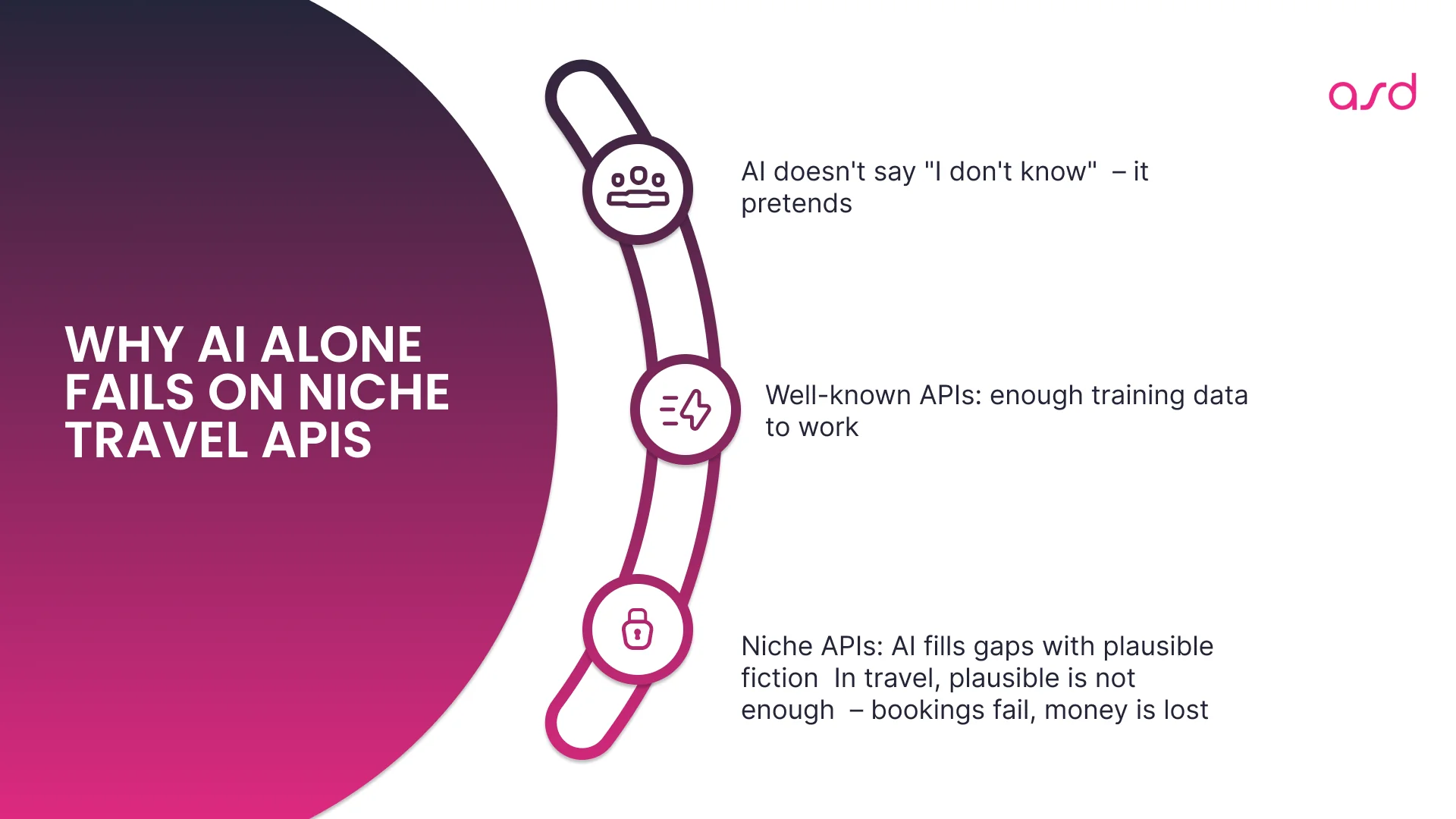
The problem starts when AI is asked to work from incomplete or unreliable information.
On well-known APIs like Stripe or PayPal, AI usually performs adequately – there is enough documentation, public discussion, and training data for it to produce reasonable output. On niche or poorly documented APIs, it confidently invents behavior that does not exist. It doesn’t say “I don’t know.” It fills the gap with something plausible.
In travel, plausible is not enough. A booking that confirms on your side but not on the provider’s side is not a UX problem – it’s a customer showing up somewhere with no reservation. A payment that appears to succeed but doesn’t reconcile correctly isn’t a bug to fix later – it’s money that can’t be recovered.
This is the failure mode that matters most in travel API integration. And it’s the reason AI needs to be used with structure around it, not as a shortcut past the engineering work.
Travel and Booking APIs: Сonnectivity Landscape
The Right Workflow: Validate First, Use AI Second
The safest and fastest approach is to test the API before relying on AI to generate production code.
Step 1: Build a minimal sandbox and confirm real API behavior
Before AI touches the integration, run real API calls against the provider and document what actually happens – not what the documentation says should happen. This is where undocumented fields, unexpected response formats, and sandbox-vs-production differences surface. Finding these early takes days. Finding them after weeks of AI-generated production code takes much longer. This is also the foundation of what to check before integrating a travel API into an existing product.
Step 2: Give AI verified context to work from
Once the API’s actual behavior is confirmed, connect that verified documentation and the working sandbox to the AI environment. The model is now working from reality instead of assumptions. The same AI tool that invents endpoints when given no context produces accurate, working code when given a verified sandbox and real documentation. The model doesn’t change – the input does.
Step 3: Let AI handle the pattern-based work
With verified context and an existing codebase available, AI can port logic from one provider to another, adapt existing architecture to the new API, and generate first drafts of integration code significantly faster than manual writing. This is where the time savings compound.
Step 4: Keep engineering judgment for what AI cannot see
Undocumented API behaviors that only surface through direct testing. Production validation. Architecture decisions. Error handling in edge cases. Simplifying over-engineered output. These belong to the developer – always.
Want AI-assisted travel API integration? We validate first, use AI second – and deliver faster without the risk.
 Pavlo Boiko
CEO
Pavlo Boiko
CEO
What AI Should Handle in Travel API Integration
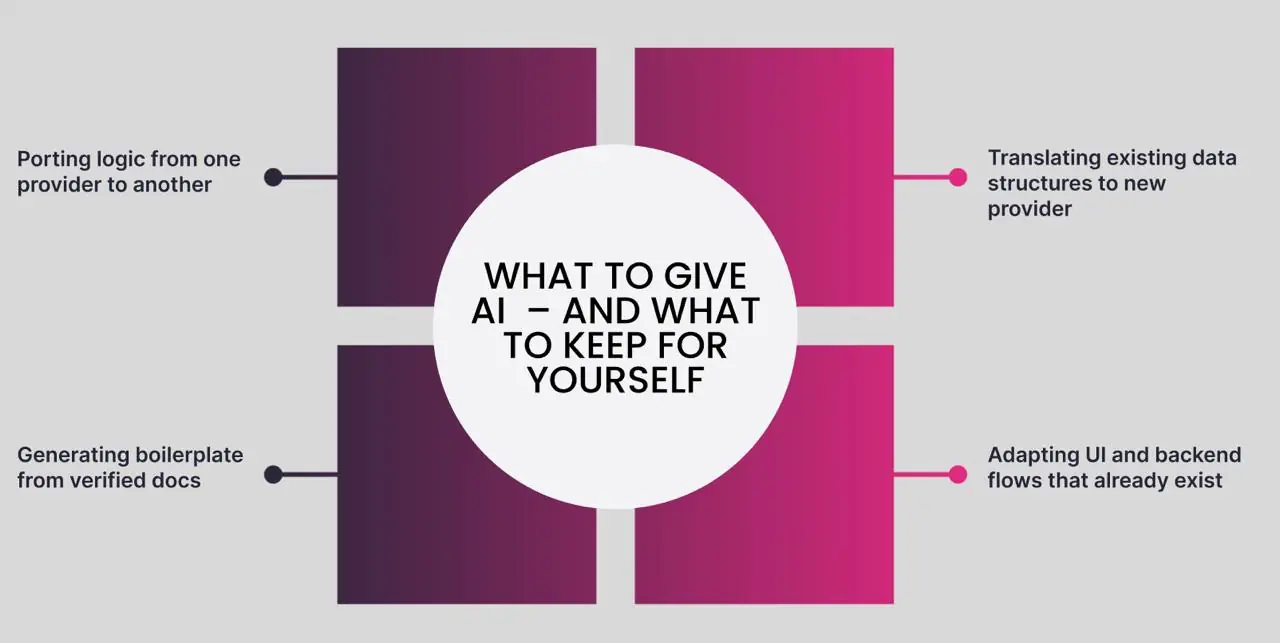
AI works best on work that follows clear patterns. In a travel API integration project, that typically includes:
- Porting logic from one provider to another when an existing integration already exists
- Generating boilerplate API calls from verified documentation
- Creating first drafts of request and response handling
- Translating existing data structures into a new provider’s format
- Adapting UI and backend flows that already exist in the codebase
This is where AI becomes a real accelerator – reducing manual rewriting and freeing developers to spend time on the parts that require reasoning, judgment, and direct API exploration.
Discover what the API-first approach is and how it can help you
What Developers Still Have to Own
A competent developer is essential – especially when the API is niche, undocumented, or business-critical. AI can generate code, but it cannot take responsibility for correctness. That still belongs to the team.
Specifically, developers need to handle:
- Undocumented fields and behaviors that only surface through direct API exploration
- Reconciliation logic – matching records across systems when providers don’t link IDs automatically
- Architecture decisions that affect how the integration fits into the existing product
- Error handling in edge cases that AI doesn’t anticipate because they aren’t in any documentation
- Simplifying over-engineered output – AI frequently produces more complexity than the problem requires
- Production validation – confirming that sandbox behavior holds under real conditions
In travel specifically, the developer also needs to understand the domain: booking state machines, cancellation logic, PMS sync behavior, and how failures propagate through a live booking flow. AI doesn’t have that context unless you give it – and even then, it can’t replace the judgment that comes from having built these systems before.
For a full breakdown of the engineering discipline that makes AI-assisted travel integration work safely, see travel API integration services.
Integration taking too long?
We use AI to accelerate travel API integration – with a sandbox-first process that keeps the output grounded in real API behavior.
Let’s talk
Why the Second Integration Is Always Faster
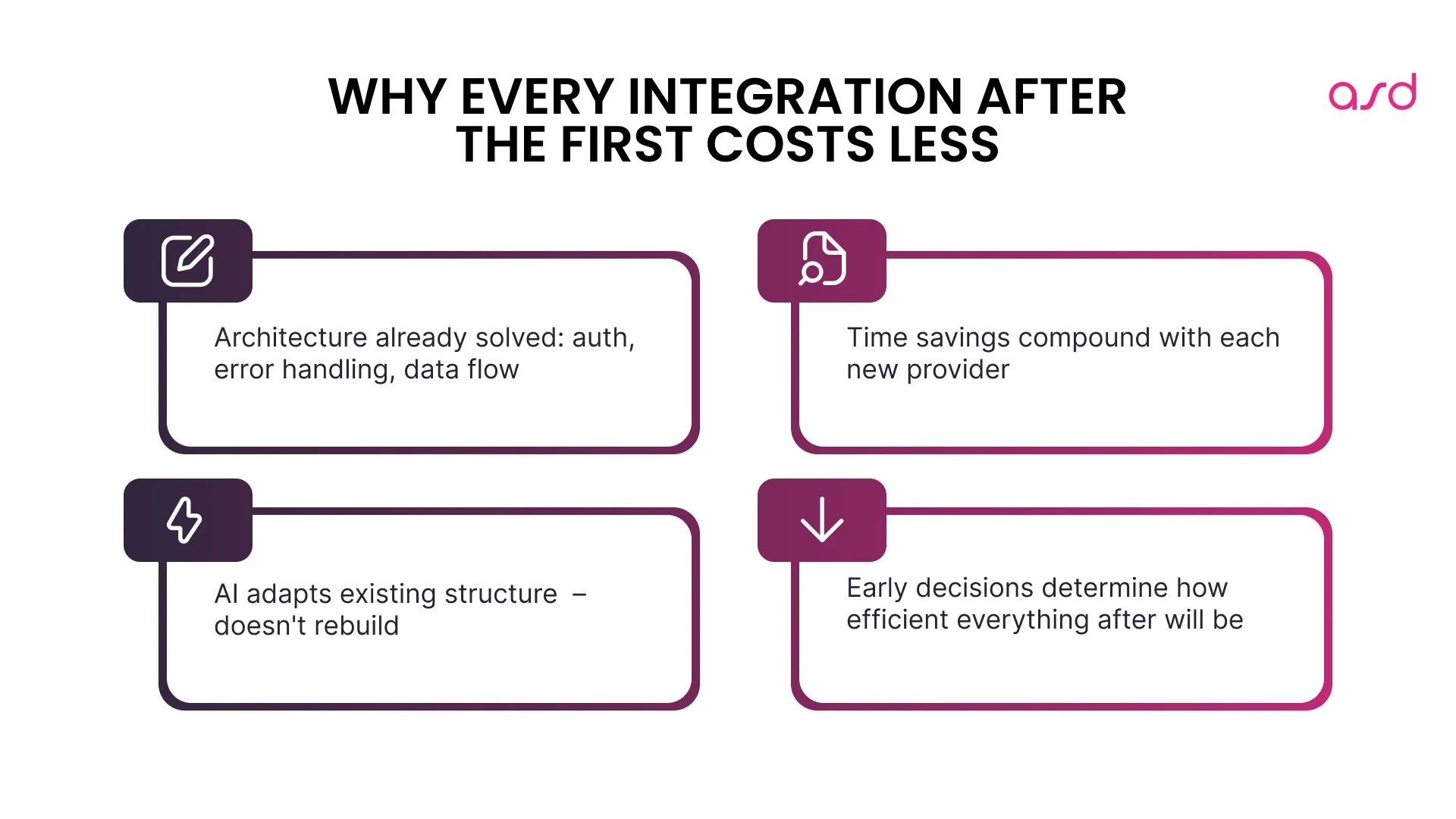
This approach compounds in value because the second integration in the same category is never a full rebuild.
If one travel API provider is already integrated, the architecture is partially solved – authentication patterns, error handling, data flow, UI states, and internal record structure are already there. AI is well suited to adapt that existing structure to a new provider. It can move code from “known provider” to “new provider” much faster than writing everything manually.
The time savings only appear when the team has already done the hard part: understanding the API, confirming its real behavior, and building a reliable foundation. Once that exists, every subsequent integration in the same category gets cheaper. This is the same compounding effect that applies to how to choose travel APIs – the decisions made early determine how painful or efficient everything that comes after will be.
Already have integrations, but something off? Reach out to ASD Team through this form and get a free API Integration audit.
We diagnose why your integration layer is fragile, what's creating business risk, and what to fix first. You get a clear map and roadmap – not a list of opinions.
Special Offer · Integration Stability Review
$2,500 → Free
Your integrations are live,
but you don't trust them
5–10 working days
Fixed scope
No commitment
Free integrations stability Audit
Tell us what's breaking.
We'll get back within 1 working day with next steps and a calendar slot.
Request received
Thanks — we've got it.
How ASD Team Uses AI to Speed Up API Integration
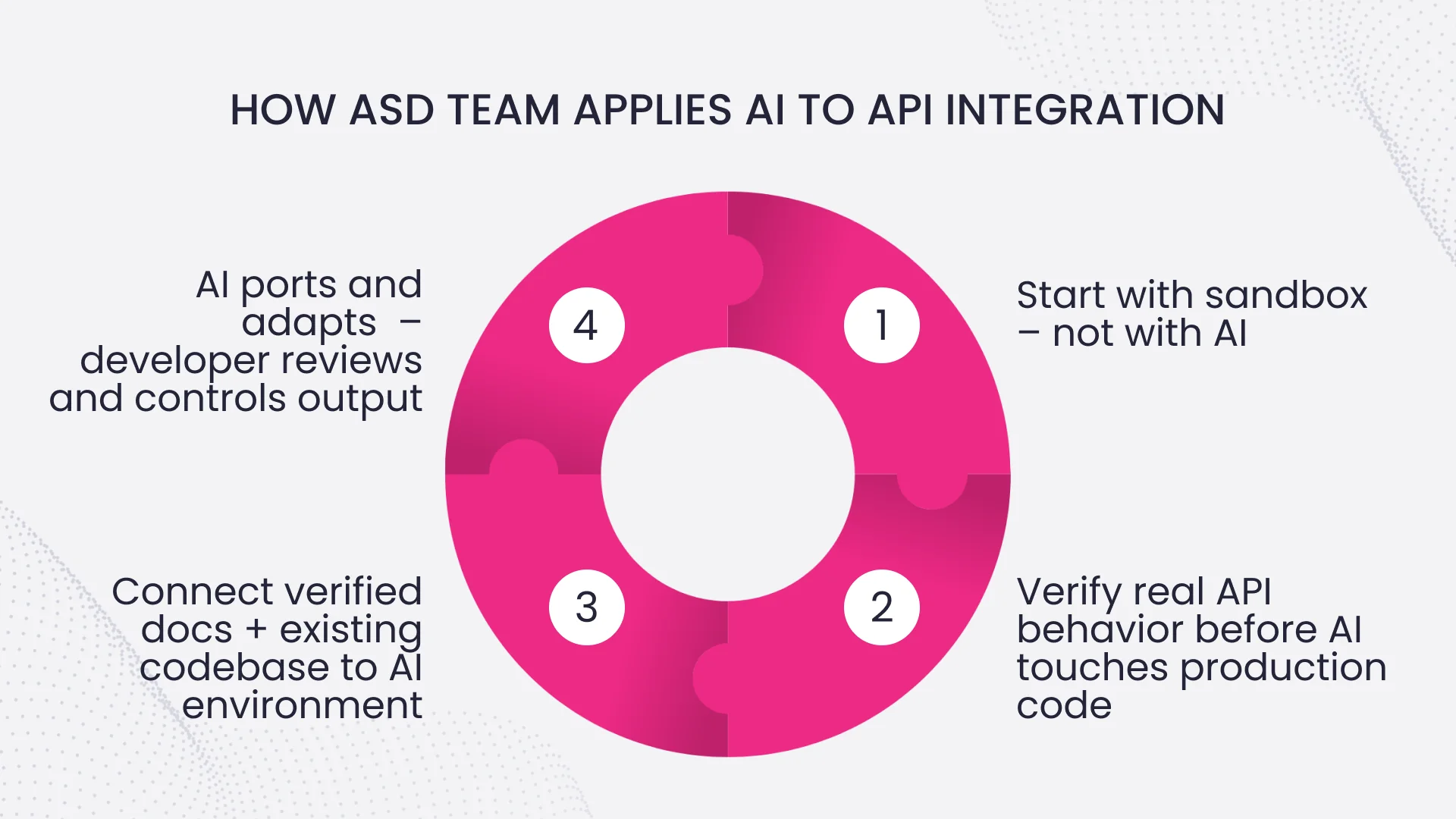
We don’t start with AI. We start with the API.
Before any AI tool touches production code, we build a minimal sandbox and confirm how the API actually behaves – not how the documentation says it should. Once real behavior is confirmed, we connect verified documentation and the existing codebase to the AI environment. From that point, AI handles the porting, adaptation, and boilerplate. The developer stays in the loop throughout – reviewing output, stepping in for undocumented gaps, and deciding what’s safe to ship.
The sequence matters because AI output quality is almost entirely determined by what you give it. The same model that invents endpoints when given no context produces accurate, working code when given a verified sandbox and real API schema. We didn’t change the AI. We changed what we gave it to work with.
This approach works especially well when a product already has one provider integrated. The architecture is solved – error handling, data flow, UI patterns, internal records. AI adapts that existing structure to the new provider instead of building from scratch. That’s where the time savings compound.
What This Means for Travel API Integration Specifically
Travel API integration is a strong fit for this approach because the stakes are high and the workflows are recognizable across providers. Booking flows, payment handling, availability sync, status updates, and cancellation logic all follow patterns – which is exactly where AI accelerates the work.
But travel is also where the cost of AI getting it wrong is highest. Availability showing incorrectly, bookings failing silently, statuses not propagating – these aren’t abstract failure modes. They are the recurring production failures in travel platforms that skipped the validation step and let AI work from assumptions.
That is why AI should be treated as a productivity layer, not a substitute for engineering discipline. In travel especially, the best results come from combining AI speed with developer judgment – in that order.
ASD Team is a travel API integration company that uses AI-assisted development to reduce integration timelines without reducing engineering rigor.
Can AI replace a developer for travel API integration?
No. AI can accelerate the pattern-based parts – porting logic, generating boilerplate, adapting existing code to a new provider. It cannot handle undocumented API behavior, architecture decisions, or production validation. In travel specifically, where booking and payment failures have immediate business consequences, developer judgment is non-negotiable.
What travel API tasks is AI actually good at?
Porting an existing integration to a new provider, generating first drafts of API calls from verified documentation, adapting data structures and UI flows that already exist in the codebase. AI performs best when the developer has already confirmed how the API actually behaves and given the model accurate, verified context to work from.
Why does AI struggle with niche travel APIs?
AI training data is unevenly distributed. Well-known APIs like Stripe have extensive coverage. Niche travel APIs – regional booking systems, specialist channel managers, less common GDS connections – have almost none. Without reliable training data, AI fills gaps with plausible-sounding inventions that fail when run against the real API. Get a free project estimation to know how much time it would take to integrate niche API to your product.
How much faster is AI-assisted travel API integration?
It depends on the conditions. When an existing integration in the same category already exists and the API has been validated in a sandbox first, the speed improvement is significant – one recent project moved from a three-month estimate to three weeks of active development. Without those conditions, AI can add time rather than save it.
What is the most important thing to do before using AI on a travel API integration?
Test the API in a sandbox and confirm how it actually behaves before AI touches any production code. Give AI verified documentation and real API behavior to work from, not its own assumptions. The sequence – validate first, AI second – is what makes the output reliable.
Show more


Related Articles:
API-First Approach: Why Your Integrations Keep Breaking (And How to Fix the Foundation)
11 mins
•
09 May 2026

AI Risks in Travel Tech: Hallucinations, Accuracy, Vendor Lock-in
10 mins
•
18 Feb 2026

AI Architecture Requirements for Travel Software
8 mins
•
18 Feb 2026

API Integration Best Practices: Processes and Approaches
19 mins
•
24 Apr 2025
We use cookies to personalize our services and improve your experience on this website. We may use certain personal data for analytics and marketing purposes.
Let’s Talk
Fill out the form to schedule a 30-minute call, where we’ll discuss your project requirements and explore the best solutions for your needs.
Free Consultation