
Table of Content
- What the Service Includes
- What Drives Cost and Timeline
- How the Process Works
- Agentic AI in Travel and API Products
- How to Choose a Partner
Automate your workflow with AI
Book a callAgentic AI development is not a single service – it’s a full engineering process: workflow scoping, orchestration layer design, tool integrations, reliability engineering, and human-in-the-loop design. This article covers what the service actually includes, what drives cost and timeline, and what to look for when choosing a development partner.
What Agentic AI Development Services Actually Include
Most companies searching for agentic AI development have a specific workflow in mind – something that currently requires a human to check, decide, and act repeatedly. The service covers everything required to turn that workflow into a system that runs reliably without constant human intervention.
A complete agentic AI development engagement typically includes:
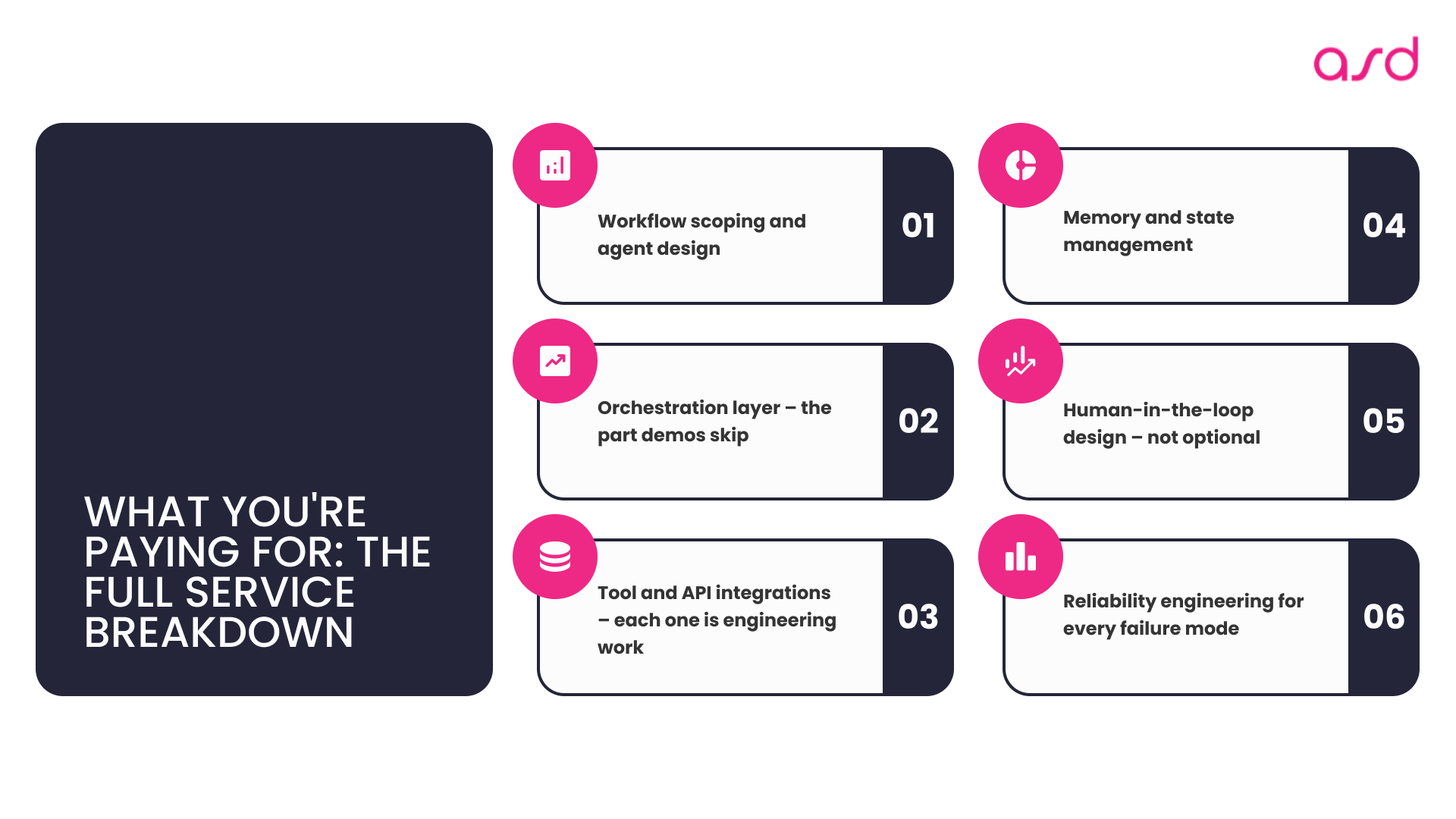
Workflow scoping and agent design
Defining exactly what the agent does, what tools it uses, where it escalates to a human, and what happens when it fails. This is the work that determines whether the system is safe to run in production – and it happens before any code is written.
Orchestration layer development
The code that coordinates agent behavior – which agent runs when, what it does with the output, how it handles unexpected responses, and how it passes context to the next step. This is the engineering layer most demos skip and most production systems require.
Tool and API integrations
Agents act through tools: APIs, databases, messaging systems, file systems, external services. Each integration is a separate engineering task with its own error handling, authentication, rate limits, and failure modes.
Memory and state management
For an agent to operate across multiple steps or sessions, it needs to store and retrieve context reliably. How this is structured directly affects whether the agent behaves consistently over time.
Human-in-the-loop design
Defining where human oversight is required, how the agent surfaces decisions for review, and what happens when the agent is uncertain. This is not optional – it is what makes agentic systems safe to operate.
Reliability and failure engineering
Agents fail. APIs go down. Responses arrive in unexpected formats. Tasks stall mid-sequence. A production agentic system needs defined behavior for every failure mode: retry logic, fallback paths, alerting, and recovery. This is the difference between a system that works in a demo and one that runs on a schedule.
End-to-end testing
Testing each component in isolation is not enough. The full agent sequence has to be tested end to end – the same way it will run in production – before it goes live.
AI workflow not scaling?
We design and build agentic AI systems that run reliably in production – with the right human oversight at the right points.
Let’s talk
What Drives Cost and Timeline
Agentic AI development costs vary significantly depending on four factors:
Workflow complexity
A single-agent workflow that monitors one data source and triggers one action is a different scope from a multi-agent system where several agents coordinate across different parts of a process. Each added agent, each additional decision point, and each coordination requirement adds engineering work.
Number of tool integrations
Every system the agent connects to is an integration. A workflow that reads from one database and sends one notification is straightforward. A workflow that pulls from three APIs, updates two internal systems, and routes results based on content requires proportionally more integration and testing work.
Production reliability requirements
A prototype that runs manually costs far less than a system that runs on a schedule, handles failures gracefully, and operates without monitoring. The gap between demo-quality and production-quality is where most of the engineering time goes.
State of existing infrastructure
If a product already has working API integrations, defined data models, and a clear architecture, the agentic layer builds on top of something solid. If the product needs significant stabilization before an agent can be added reliably, that work is part of the scope.
Typical ranges:
- Focused single-agent workflow, two to three tool integrations: 6–10 weeks
- Multi-agent system with coordination logic and multiple integrations: 3–6 months
- Rescue and stabilization of an existing agentic system that isn’t running reliably: depends on current state – starts with a scoped audit
Discover how long does an API integration take? The Complete Guide
How the Development Process Works
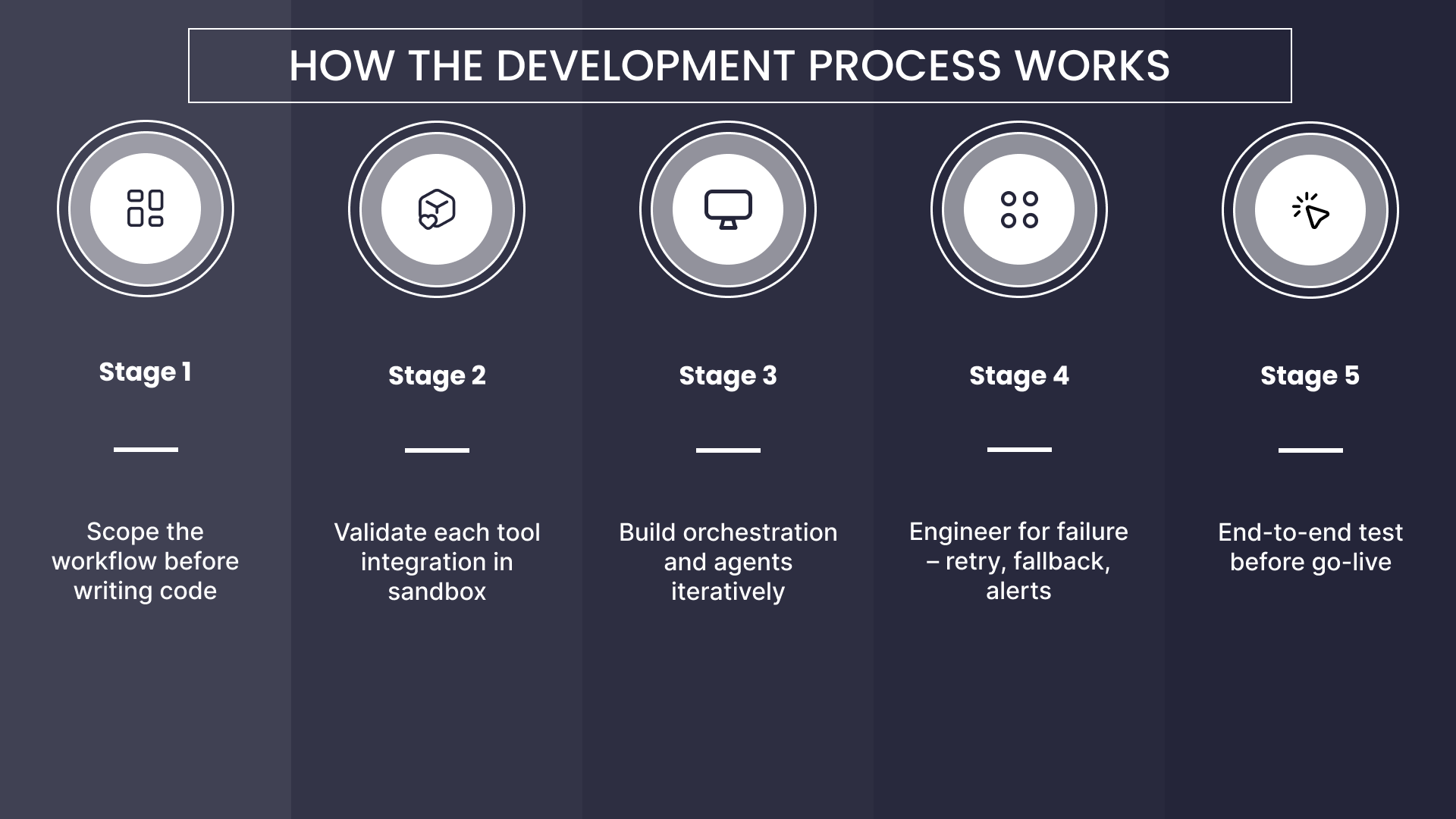
Stage 1: Scoping
The workflow is mapped in detail – what the agent does at each step, what tools it needs, where humans stay in the loop, and what the failure behavior looks like. This produces a scoped definition of the system before development starts.
Stage 2: Sandbox and integration validation
Before building the full agent, each tool integration is validated in isolation. This surfaces API behavior that differs from documentation, authentication complexity, rate limit constraints, and data format issues – before they become problems inside the running system.
Stage 3: Orchestration and agent development
The orchestration layer and individual agents are built iteratively, tested against the validated tool integrations, and refined until the full sequence runs correctly end to end.
Stage 4: Reliability engineering
Failure modes are defined and handled: what happens when a tool integration fails, when a response arrives in an unexpected format, when the agent stalls mid-sequence. Logging, alerting, and recovery logic are added.
Stage 5: End-to-end testing and handover
The full agent sequence is tested the way it will run in production – on a schedule, with real data, handling edge cases. Documentation and monitoring setup are part of handover.
Agentic AI in Travel Tech and API-Heavy Products
Travel platforms and products built on multiple API integrations are particularly well-suited to agentic AI – and particularly exposed to the cost of getting it wrong.
Agentic AI for Travel API Workflows
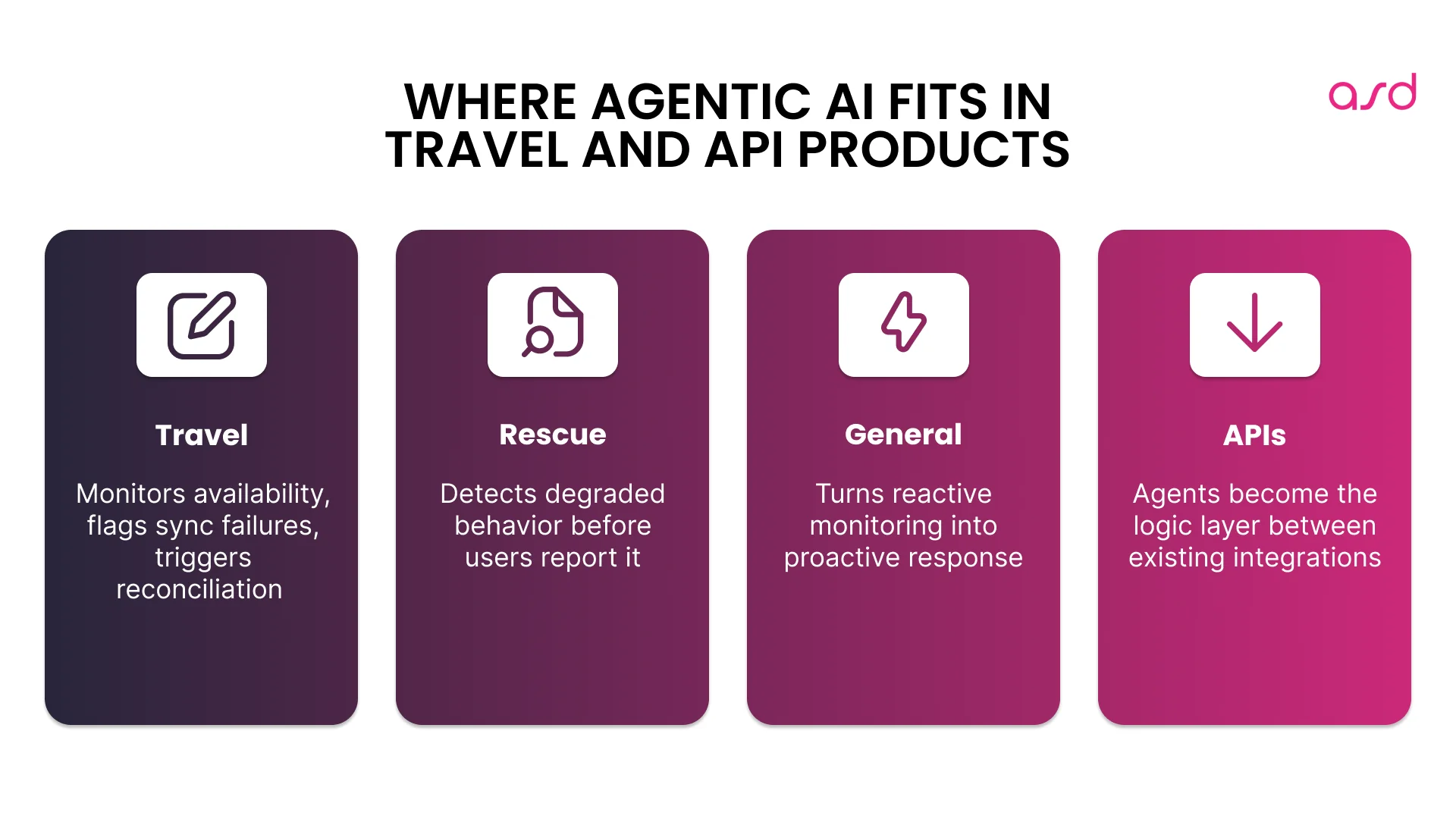
Travel products run workflows that are high-volume, time-sensitive, and follow recognizable patterns: availability changes across providers, booking statuses that need to propagate correctly, pricing updates arriving simultaneously from multiple sources, cancellation windows opening and closing on defined schedules.
These are exactly the conditions where agentic AI delivers value. An agent can monitor availability conflicts across providers, detect when a booking status hasn’t propagated correctly, flag pricing discrepancies before they reach a customer, or trigger reconciliation when a payment webhook doesn’t arrive on time. Travel API integration creates the data flows – agentic AI becomes the logic layer that watches how they behave and responds when they don’t, plus AI can speed up the process of tavel API integration.
Agentic AI in Software Project Rescue
For products already in production but unstable, agentic AI adds a layer that most existing systems lack: continuous observability with defined response behavior. An agent can monitor integration health across multiple API connections, detect when a provider is returning unexpected responses, log failure patterns before they become incidents, and trigger fallback behavior without waiting for someone to notice.
In a software project rescue context, this changes the problem from reactive – fixing failures after users report them – to proactive: catching degraded behavior before it becomes a full outage.
We diagnose why your integration layer is fragile, what's creating business risk, and what to fix first. You get a clear map and roadmap – not a list of opinions.
Special Offer · Integration Stability Review
$2,500 → Free
Your integrations are live,
but you don't trust them
5–10 working days
Fixed scope
No commitment
Free integrations stability Audit
Tell us what's breaking.
We'll get back within 1 working day with next steps and a calendar slot.
Request received
Thanks — we've got it.
How to Choose an Agentic AI Development Partner
The gap between a team that has integrated a language model and a team that has built a multi-agent system running reliably in production is significant. These questions separate the two:
Have they built agentic systems that run in production – not just demos?
A prototype that runs once on demand is a different engineering problem from a system that runs on a schedule, handles failures, and operates without constant monitoring. Ask for specifics: what runs, how long has it been running, what happens when it fails.
Can they scope what you actually need before development starts?
A development partner that can’t define clearly what the agent will do, what it won’t do, and what happens when it fails before writing code is one that will discover the answers during development – at your expense.
Do they understand human-in-the-loop design?
Where do humans need to stay in control? How does the agent surface decisions for review? What does it do when it’s uncertain? A team that treats full automation as the default goal will build systems that are either fragile or unsafe.
Do they have engineering depth alongside AI knowledge?
Agentic AI development requires backend engineering, API integration experience, reliability design, and AI knowledge together. Strong only on the AI side: works in demos, breaks in production. Strong only on engineering: robust but limited. Both are required.
Not sure if you need agentic AI? We scope the workflow, define the boundaries, and build what runs.
 Pavlo Boiko
CEO
Pavlo Boiko
CEO
Questions to ask before engaging:
- What agentic systems have you built that run continuously in production?
- How do you handle agent failures and unexpected API responses?
- Where do you recommend keeping humans in the loop – and why?
- What does your process look like from scoping to stable production?
- How do you test an agentic workflow end-to-end before it goes live?
ASD Team builds AI integration services including agentic AI systems – multi-agent orchestration, workflow automation, and AI-assisted development – for products where reliability matters as much as capability.
What do agentic AI development services include?
A complete engagement covers workflow scoping and agent design, orchestration layer development, tool and API integrations, memory and state management, human-in-the-loop design, reliability and failure engineering, and end-to-end testing. The scope depends on workflow complexity and the number of systems the agent needs to connect to.
How long does agentic AI development take?
A focused single-agent workflow with two to three tool integrations typically takes 6–10 weeks to reach a stable production version. Multi-agent systems with coordination logic and multiple integrations take 3–6 months. Timeline is directly affected by how well the workflow is defined before development starts and the state of existing infrastructure.
How much does agentic AI development cost?
Cost depends on workflow complexity, number of tool integrations, production reliability requirements, and the state of existing infrastructure. A scoped audit before full engagement defines exact effort and cost – and is the right starting point for any project where the scope isn’t fully clear. Get a free project estimation to know the cost for your product.
Can n8n be used to build agentic AI workflows?
Yes. n8n provides the orchestration backbone for many agentic use cases – connecting language models to external tools, defining multi-step sequences, and running agents on triggers or schedules. Building AI agents with n8n reduces infrastructure overhead for many workflow types. The AI reasoning layer and tool integrations still require engineering judgment to configure correctly.
What is the difference between agentic AI development and standard AI integration?
Standard AI integration connects a product to a single AI service – a language model, a classification API, a generation tool. Agentic AI development builds a system where multiple components – AI models, tools, APIs, memory – coordinate to complete multi-step workflows autonomously. The orchestration layer, reliability engineering, and human-in-the-loop design are what distinguish an agentic system from a single AI feature.
How do I know if my use case is ready for agentic AI development?
A use case is ready when the workflow is well-defined enough to describe in steps, the decision logic follows recognizable patterns, and the volume or frequency makes human handling the bottleneck. If the decisions require judgment that can’t be described in rules, a human-in-the-loop system that augments rather than replaces is the right starting point.
Show more


Related Articles:
How AI Can Speed Up the Process of Travel API Integration
7 mins
•
13 Aug 2026
API-First Approach: Why Your Integrations Keep Breaking (And How to Fix the Foundation)
11 mins
•
09 May 2026

Generative AI in Travel Tech: 5 Proven Use Cases We Delivered
11 mins
•
02 May 2025
How Long Does an API Integration Take? The Complete Guide
12 mins
•
13 Apr 2025
We use cookies to personalize our services and improve your experience on this website. We may use certain personal data for analytics and marketing purposes.
Let’s Talk
Fill out the form to schedule a 30-minute call, where we’ll discuss your project requirements and explore the best solutions for your needs.
Free Consultation