
Table of Content
- This Is Rarely a Random Bug
- Why the Data Is Wrong or Out of Date
- Why Updates Don’t Arrive or Don’t Match
- Why It Works in Testing but Not in Production
- Why Several Integrations Together Cause Trouble
- What Actually Fixes These Problems
- How ASD Team Approaches This
- Examples of How to Fix Broken API
What's showing incorrectly on your platform?
Book a callAn API is the way two programs talk to each other, for example your product and a payment provider. An integration that seemed fine at launch can start to misbehave once real customers, real data and real volume arrive. For a founder this shows up as wrong numbers, missing updates and problems nobody notices until a customer writes in. The causes are usually few and structural, not random. This article explains them in plain language, what they cost the business and what to ask your team or partner to do about them.
This Is Rarely a Random Bug
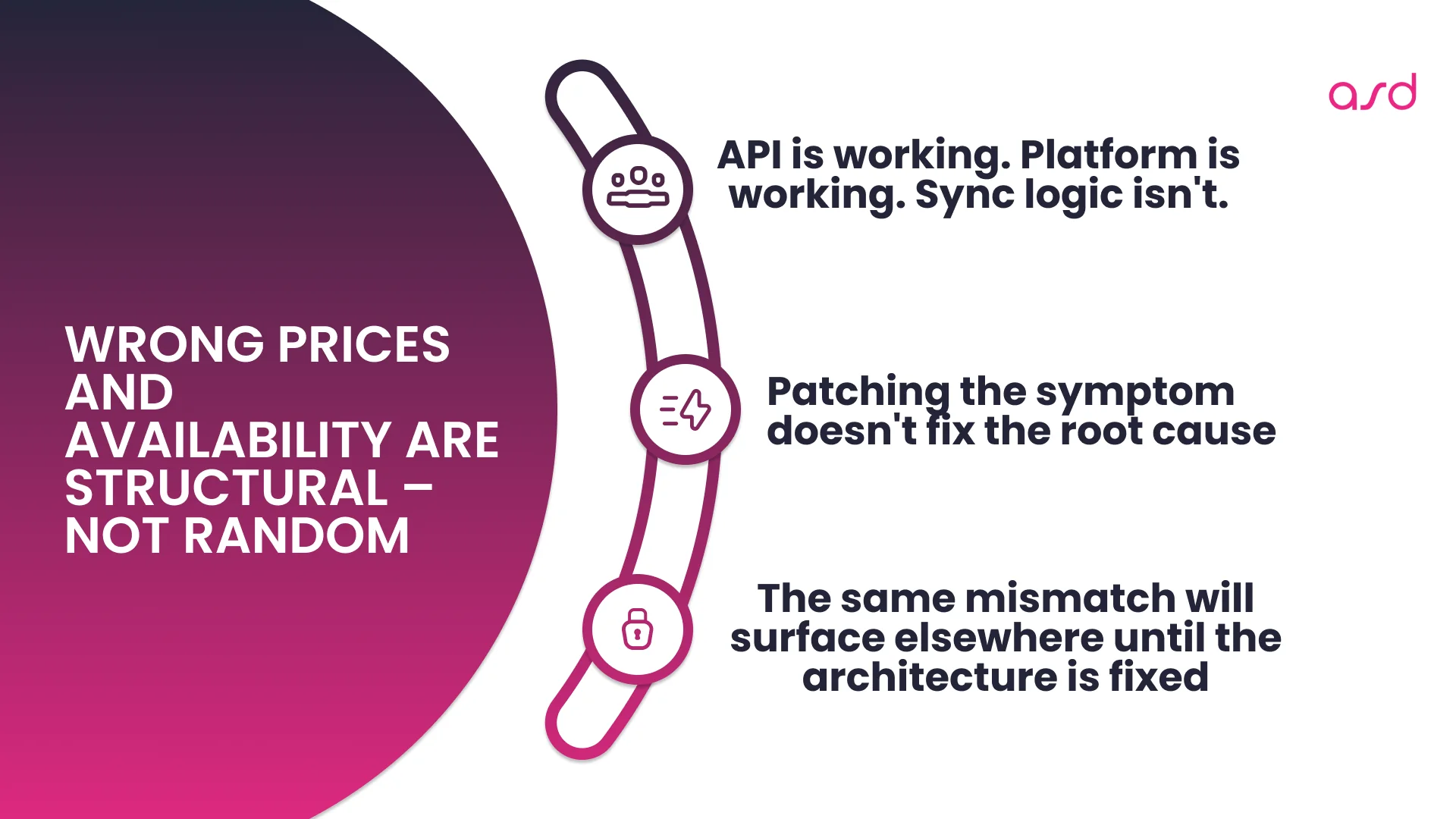
An order shows the wrong total. A customer is missing in your CRM. A payment is confirmed at the provider but still pending in your product. The natural reaction is to ask the team to find the bug, fix it and move on.
Most of the time, though, both sides work. The provider’s system is fine and so is your product. What’s missing is the agreement between them: when to ask for data, where to keep it, how to maintain API best practices, what to do when something goes wrong and how a change reaches every place that depends on it.
That matters because fixing one symptom doesn’t change how the systems exchange data. The same kind of mismatch shows up somewhere else, in another part of the product, under different conditions.
The usual signs:
- Numbers in your product differ from the provider’s
- Information is out of date, or arrives late
- Updates never arrive, or arrive twice
- Everything worked in testing and behaves differently with real customers
- Customers find the problems before your team does
The business cost is easy to recognize: hours spent correcting things by hand, refunds and support requests, and customers who lose some trust in the product.
This isn’t a sign of poor work by anyone. Most integrations are first built to prove that the main scenario works. Preparing for everything else is a separate step, and it often gets postponed while the product moves forward.
Why the Data Is Wrong or Out of Date
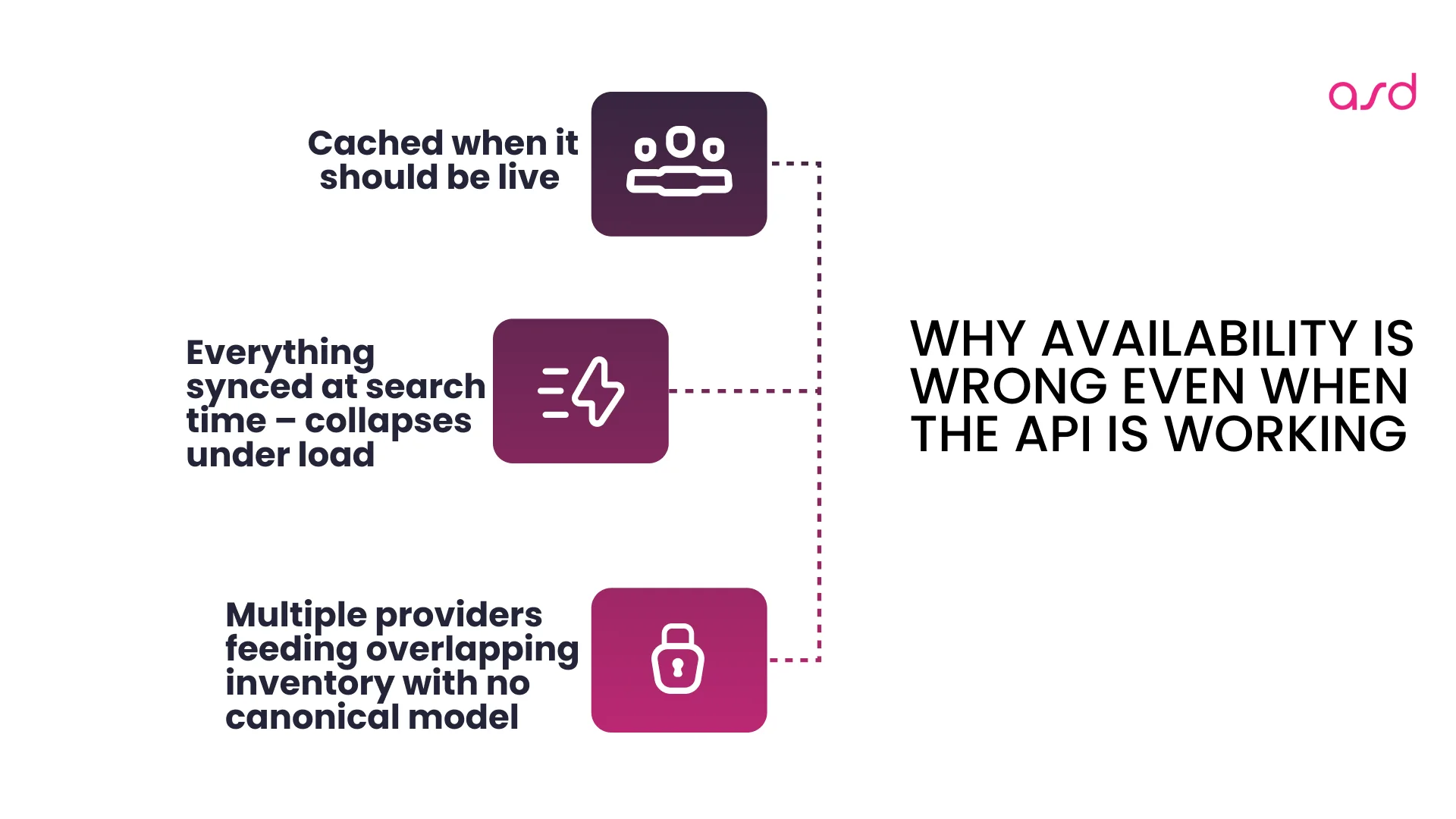
Your product is using an old copy. Think of a price list printed this morning: by 4 pm it may be wrong. Prices, stock levels, balances and statuses keep changing at the provider. If your product saves a copy and uses it later without checking again, it may act on something that is no longer true. A saved copy is fine for browsing a page. It is risky for charging a card, confirming an order or promising delivery.
What fixes it: decide which information must always be current and which can be refreshed on a schedule. Check again right before the actions that matter, such as charging, confirming or shipping.
The same rule is calculated in different places. Discounts, taxes, fees and rounding rules are often applied in more than one part of the product. If the cart and the invoice calculate differently, customers see two different totals, even though the provider sent the same number both times.
What fixes it: keep each rule in one place, so the whole product uses the same calculation.
The systems use different formats. Currencies, rounding, units, time zones and ID formats differ from system to system. An amount converted at one step and converted again at the next will drift. A time without a time zone will be wrong for someone.
What fixes it: agree on one format for each kind of data and convert it once, at the entry point.
The other system is itself slow to update. Some providers share data that is a few minutes or hours behind. Your product can only be as current as its source.
What fixes it: ask the provider how fresh their data is, and design the flow around that answer instead of assuming real time.
Why Updates Don’t Arrive or Don’t Match
Notifications are missed. Many systems tell yours about a change by sending an automatic message (developers call it a webhook). If your product was unavailable for a moment, or doesn’t know what to do with that type of message, the change never registers. The provider shows “confirmed”, your product shows “pending”, and often the first sign is a customer asking where their confirmation is. Messages can also arrive twice or in a different order than they were sent.
What fixes it: handle every type of message deliberately and ignore repeats. Add a regular check, for example overnight, that compares both systems and corrects the differences, do not skimp on middleware. It catches what never arrived.
Background tasks fail without anyone knowing. A lot of syncing happens quietly in the background. If a task fails and nothing retries it or tells a person, the data just stays out of date.
What fixes it: retry automatically, and alert a person when something keeps failing.
Statuses are misunderstood. Every system has its own life cycle for an order or a payment: pending, confirmed, on hold, cancelled, refunded. If your product doesn’t know every status the other system can send, it ignores or misreads some of them. A cancelled order stays pending, or a change is taken for a cancellation.
What fixes it: write down every status each provider can send, connect each one to a status in your product and decide which moves are allowed.
A repeated request creates a duplicate. If a request times out, it doesn’t mean it failed. If your product sends it again, the other system may create a second order, record or charge.
What fixes it: make sure the system can recognize “I’ve already done this” before creating anything (developers call this idempotency).
APIs do not match across systems?
We stabilize travel API integrations that are breaking in production.
Let’s talk
Why It Works in Testing but Not in Production
A test environment is a friendly place: quick responses, a small amount of data, no limits and no real customers. Real use adds things the test never did:
- Providers limit how many requests they accept per minute
- Providers are sometimes slow or unavailable for a short time
- Large results arrive in many parts
- Access keys expire, like a pass that stops working on a date nobody wrote down
- Providers update their systems and retire old versions
- Information arrives with gaps in it
A successful test of the main scenario doesn’t show that the integration is ready for any of this.
What fixes it: ask the team to test problems on purpose: a slow provider, a provider that is down, rejected requests, a repeated request and an expired key. After launch, watch response times, errors, tasks that keep failing, orders stuck in progress and differences between systems. Keep a calendar of every key and certificate that expires.
Why Several Integrations Together Cause Trouble
Systems connected directly to each other tangle. It’s like extension cords plugged into one another. A change in one system affects the others, and nobody sees the whole picture.
The same information lives in several systems, multiple APIs. A customer, product or order can exist in two or three places with different IDs and values. Neither copy is wrong on its own, but together they create duplicates and contradictions.
What fixes it: one agreed version of the truth inside your product. Every system translates to it, so conflicts are handled in one place.
One slow system slows everything. Products that grew quickly often ask every provider one after another each time a customer does something. With one provider that works. With several providers and real traffic, pages slow down, requests time out, and some answers are current while others are old copies, mixed on the same screen.
What fixes it: prepare ahead of time everything that can be prepared. Ask for live information from all providers at once, with time limits and a plan for when one doesn’t answer. Keep each connection separate, so a problem with one doesn’t spread.
What Actually Fixes These Problems
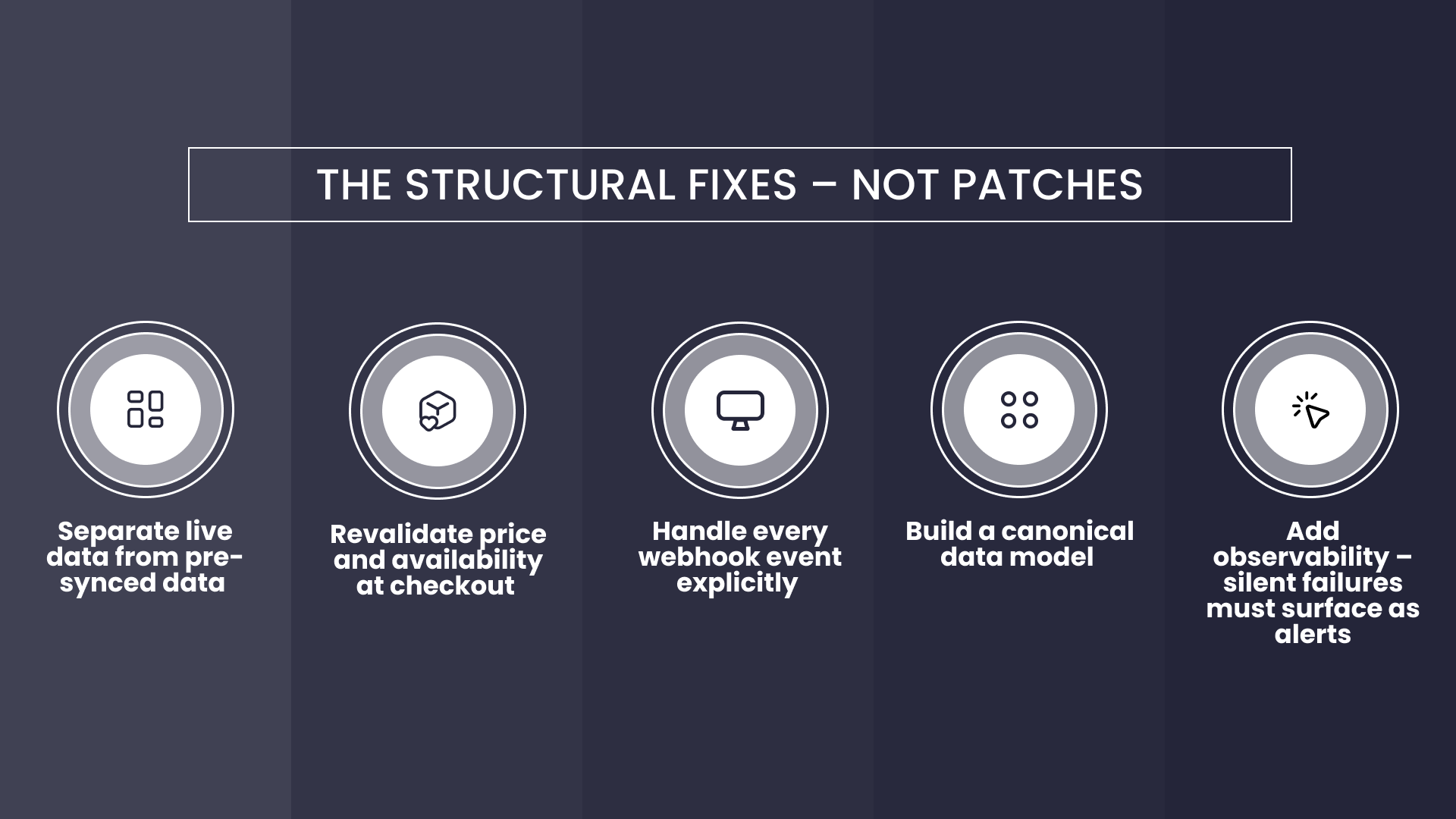
Each problem above has a specific fix. The cause underneath is almost always the same: the integration was built for the path where everything goes well, without planning for failures, timing and conflicting data. These are the structural fixes:
- Keep current data current. Information that changes quickly is requested when needed and checked again before important actions. Static content refreshes on a schedule.
- Check again before acting. A value that was right a minute ago may not be now. A quick check just before charging, confirming or shipping catches changes before customers do.
- Handle every update and status. Decide what the product does with each message and status it can receive, and add a regular check that compares both systems.
- Plan for repeats and retries. A repeated request must not create a duplicate, and a failed one should be tried again automatically.
- Agree one data format of your own. Amounts, statuses, dates and records follow your product’s format. Each provider is translated to it.
- Make problems visible. Every failed sync should send an alert to a person, not just leave a line in a log. Silent failures hurt customers most.
- Test the problems and watch after launch. Cover slow providers, limits, expired keys and repeated requests, then monitor the live system.
Questions to ask your team or partner
- Which of our data must always be current, and which can be refreshed on a schedule?
- What happens if a notification from a provider never arrives?
- What happens if the same request is sent twice?
- How would we find out that a sync failed, and how quickly?
- Which statuses does each provider send, and what does our product do with each?
- When did we last test a provider outage or an expired key?
- Is there one place where our business rules are calculated?
If some answers are “we’re not sure”, that’s a useful finding, and a good place to start.
Have integrations, but something is off? Tell us what you see and we’ll suggest the first step.
We diagnose why your integration layer is fragile, what's creating business risk, and what to fix first. You get a clear map and roadmap – not a list of opinions.
Special Offer · Integration Stability Review
$2,500 → Free
Your integrations are live,
but you don't trust them
5–10 working days
Fixed scope
No commitment
Free integrations stability Audit
Tell us what's breaking.
We'll get back within 1 working day with next steps and a calendar slot.
Request received
Thanks — we've got it.
How ASD Team Approaches This
You don’t need a technical team to work with us. We explain what we find and what it means for your business, and we agree on a plan before major work begins.
When we look at an integration that isn’t behaving, the review starts with the same questions. Is this information current or saved? Where does it change on the way? What happens when a sync fails? How do we find out? What happens when a request is repeated?
Then we:
- map how your systems exchange data and where information can be lost or duplicated
- complete the missing parts of the integration
- add error handling, retries and data checks
- set up monitoring and alerts, so you hear about issues from us first
We keep the parts that work. A rewrite is recommended only when the review shows why.
ASD Team provides API integration services for live products: payments, CRM, booking, supplier and AI services. We improve existing integrations and build missing ones.
Prices or Availability Wrong After Your API Integration? We find the sync architecture problem – not just the symptom.
 Pavlo Boiko
CEO
Examples of How we Fixed a Broken APIs
A second payment processor next to a live one
A second payment processor next to a live one A product needed another payment processor while the first stayed in use. We reused proven integration logic, ran both processors in parallel and used AI-assisted development grounded in real API behavior. The new integration was delivered in 3 weeks against an estimate of 3 months, and the existing Stripe integration stayed untouched.
AI services that needed to work as one product
AI services that needed to work as one product Several AI services (language model, speech and avatar) ran separately, data was lost between them and some providers were unstable. We built the missing orchestration layer instead of rewriting the product and replaced the unreliable providers. The result is one stable, scheduled pipeline.
Why does the information in my product differ from what the provider shows?
Usually for one of three reasons: your product used an old copy, the same rule is calculated differently in different places, or an amount or date is converted more than once. The fix is to check again before important actions, keep each rule in one place and use one format. Or get ASD Team’ free project estimation
Why do updates arrive late or not at all?
A notification was missed, wasn’t understood, or a background task failed without a retry or an alert. The fix is to handle every type of update deliberately and add a regular check that compares both systems.
Why does my integration work in testing but not with real customers?
Tests usually cover the main scenario in a friendly environment. Real use adds limits, slow or unavailable providers, expiring keys, provider changes and real data. The fix is to test those cases on purpose and watch the live system.
Why do I get duplicate orders, records or charges?
A request was repeated after a timeout, or the same update arrived twice, and nothing checked whether the action had already happened. The system needs to recognize repeats before creating anything.
Why does nobody notice problems until a customer reports them?
The problem is recorded somewhere, but nothing turns it into an alert for a person. Every failed sync or task should notify someone.
Is it a bug or a structural problem?
If the same kind of mismatch keeps appearing in different places after each fix, it’s structural. A single wrong value right after a change is more likely a bug.
How do I fix these problems for the long term?
Work on how data moves between your systems, not on individual mismatches: keep current data current, check before important actions, handle every update and status, plan for repeats and retries, agree one data format and make problems visible.
Show more


Related Articles:

How to Add Multiple APIs Without Breaking Your Product
9 mins
•
29 May 2026


AI Risks in Travel Tech: Hallucinations, Accuracy, Vendor Lock-in
10 mins
•
18 Feb 2026
How Long Does an API Integration Take? The Complete Guide
12 mins
•
13 Apr 2025
We use cookies to personalize our services and improve your experience on this website. We may use certain personal data for analytics and marketing purposes.
Let’s Talk
Fill out the form to schedule a 30-minute call, where we’ll discuss your project requirements and explore the best solutions for your needs.
Free Consultation