
Table of Content
- AI Tools vs. AI Product
- Why Combined Integrations Break
- What the Connection Layer Does
- How We Approached the Rescue
- Why Provider Replacement Is Hard
- What Stability Requires
- What This Means for You
Is your AI pipeline working end to end?
Book a callConnecting several AI tools to a product does not automatically create a working AI system. Each integration can pass its own test and still fail the moment its output has to become another service’s input. The missing piece isn’t a better model – it’s the engineering layer between them.
Connected AI Tools Are Not the Same as a Working AI Product
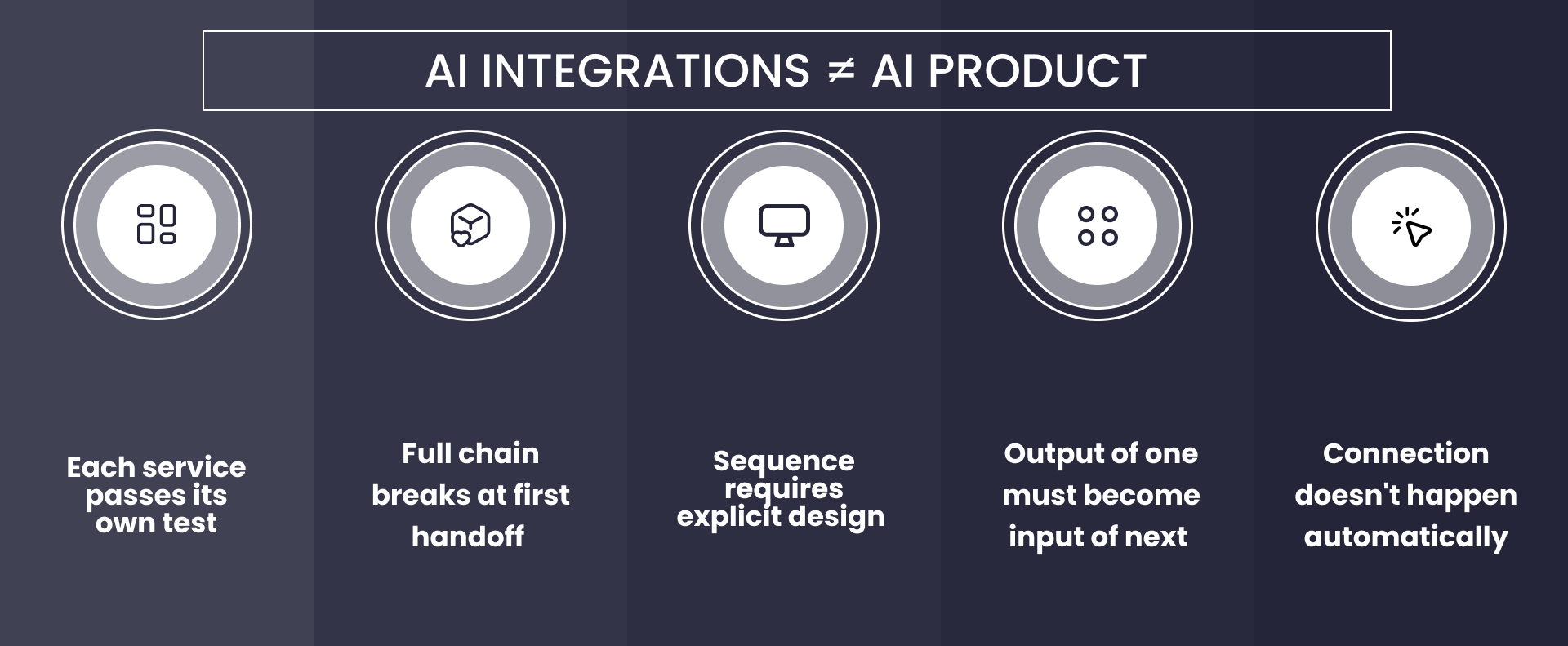
Multiple AI integrations working in isolation is not the same thing as a multi-AI product.
A successful API call confirms one thing: a single service can receive an input and return a response. It says nothing about whether that response is usable by the next stage. Whether the format is right. Whether required fields are present. Whether the next service will accept it at all.
A working AI product is a sequence – the output of one service becomes the input of the next, and the full chain runs reliably, on schedule, without someone manually checking each handoff. That sequence doesn’t happen automatically. It has to be designed and built.
This is the distinction that causes most multi-AI product failures – and it’s almost never the one teams are looking for when something breaks. And this is the exact reason why you may need AI integration services.
Why AI Integrations Break When Combined
Every AI service has its own input requirements, response format, processing rules, and practical limits. They don’t communicate with each other automatically. Passing the full output of one service directly to the next creates predictable problems:
- The data arrives in the wrong format
- The next service receives information it doesn’t need and can’t process
- Required fields are missing from the response
- The input exceeds token limits, slowing the process and increasing cost
- The next service misinterprets what it receives
On a recent platform rescue, three AI services had already been integrated – a large language model, a text-to-speech provider, and an AI avatar tool. Each worked correctly when tested on its own. Together, they couldn’t complete one stable end-to-end sequence.
The integrations weren’t broken. They were disconnected. And the difference between those two things is the entire problem.
Pipeline breaking mid-sequence? We review your multi-AI setup, identify where handoffs fail, and build the orchestration layer that makes the full sequence run.
 Pavlo Boiko
CEO
Pavlo Boiko
CEO
What the Connection Layer Actually Does
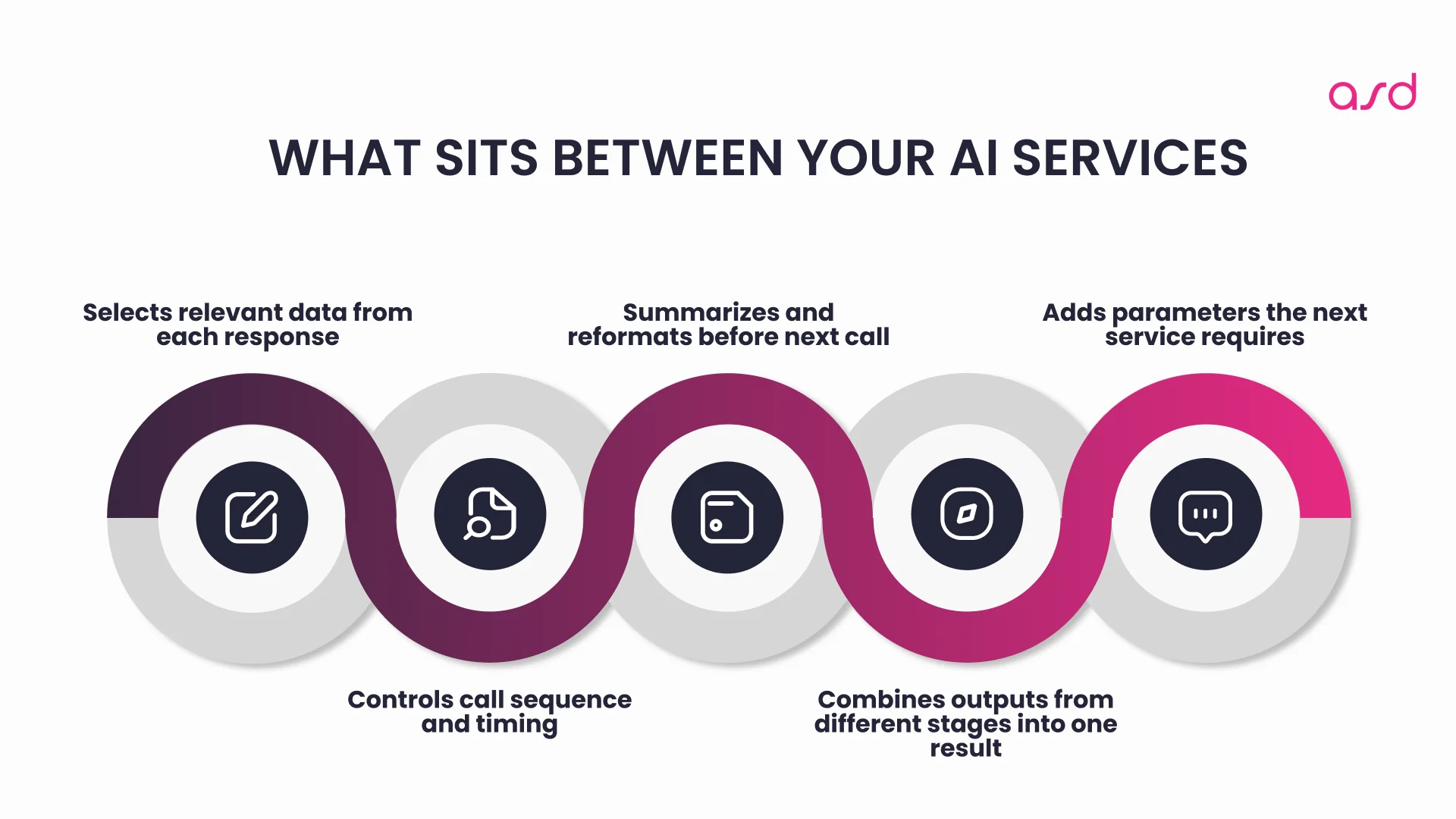
Making multiple AI tools work together requires a custom layer between the services – code that receives the output of one tool, processes it, and prepares it for the next API call.
Depending on the stage, this layer needs to:
- Select only the relevant information from a response
- Summarize or shorten content before it reaches the next service
- Transform the response into the format the next service requires
- Add parameters the next service needs but the previous one didn’t provide
- Separate different types of output – text, audio, visual – and route them correctly
- Control the order in which services are called
- Combine outputs generated at different stages into a final result
None of the AI providers handle this coordination themselves. It has to be designed and built inside the product.
In the platform we rescued, the full sequence looked like this once connected:
- Source content enters the system
- The LLM processes it and extracts key information
- The connection layer summarizes and formats the output into a delivery-ready script
- The system detects the mood of the content – positive, neutral, serious – so narration matches meaning
- Script and mood pass to the text-to-speech service together
- The connection layer receives the audio track and packages it
- The audio is passed to the AI avatar service alongside the script
- Audio and avatar output are assembled into the final video
The user can review and override both the script and the detected mood before the final generation runs. AI prepares the starting point and reduces manual work – it doesn’t remove the user from the process entirely.
Without the connection layer, step 3 didn’t exist. The LLM’s raw output – large, unstructured, full of analysis – went directly to the text-to-speech service, which needed a short, clean script and a delivery tone. Nothing translated between them. The sequence failed every time.
Not sure where to start? Get a free project estimation from us!
How We Approached the Rescue
The existing platform had accumulated unnecessary complexity around the multiple integrations – earlier workarounds built to compensate for the missing connection logic. The instinct on a project like this is to rewrite everything. That’s almost always the wrong call.
Step 1: Map before touching anything
We reviewed each integration individually – what it received, what it returned, and where its output was supposed to go next. This made the actual failure points visible: not the AI calls themselves, but the handoffs between them. Mapping existing flows before integration is the same discipline that applies to any multiple API product – AI makes it more complex, not different in kind.
Step 2: Build the missing connection layer
We designed and implemented the orchestration logic the platform never had. Concretely: summarizing source content before it reached the LLM to control cost and keep the response focused; extracting a script and mood from the LLM’s output; passing both to the text-to-speech stage in the format it needed. Each handoff explicitly defined.
Step 3: Simplify instead of rebuild
The parts that worked stayed untouched. The parts that existed only because the missing connection layer forced earlier workarounds were removed component by component. The goal was a clear, traceable sequence – not a cleaner version of the same complexity.
Step 4: Replace providers that couldn’t hold up in the full sequence
Testing each service in isolation had not caught how they behaved as part of the complete process. Once the pipeline was connected end to end, some of the original text-to-speech and avatar providers proved unstable – failing to return audio, stalling mid-process, or producing outputs that couldn’t be reliably combined. We tested alternatives against the same full sequence and replaced what couldn’t complete its part consistently.
“Testing each AI tool by itself tells you almost nothing. The whole thing only matters once you connect it end to end and run it the way it’ll actually run in production.” – Lead Developer, ASD Team
AI integrations connected but not working?
We find what's missing between the services and build it.
Let’s talk
Why Provider Replacement Is Harder Than It Looks
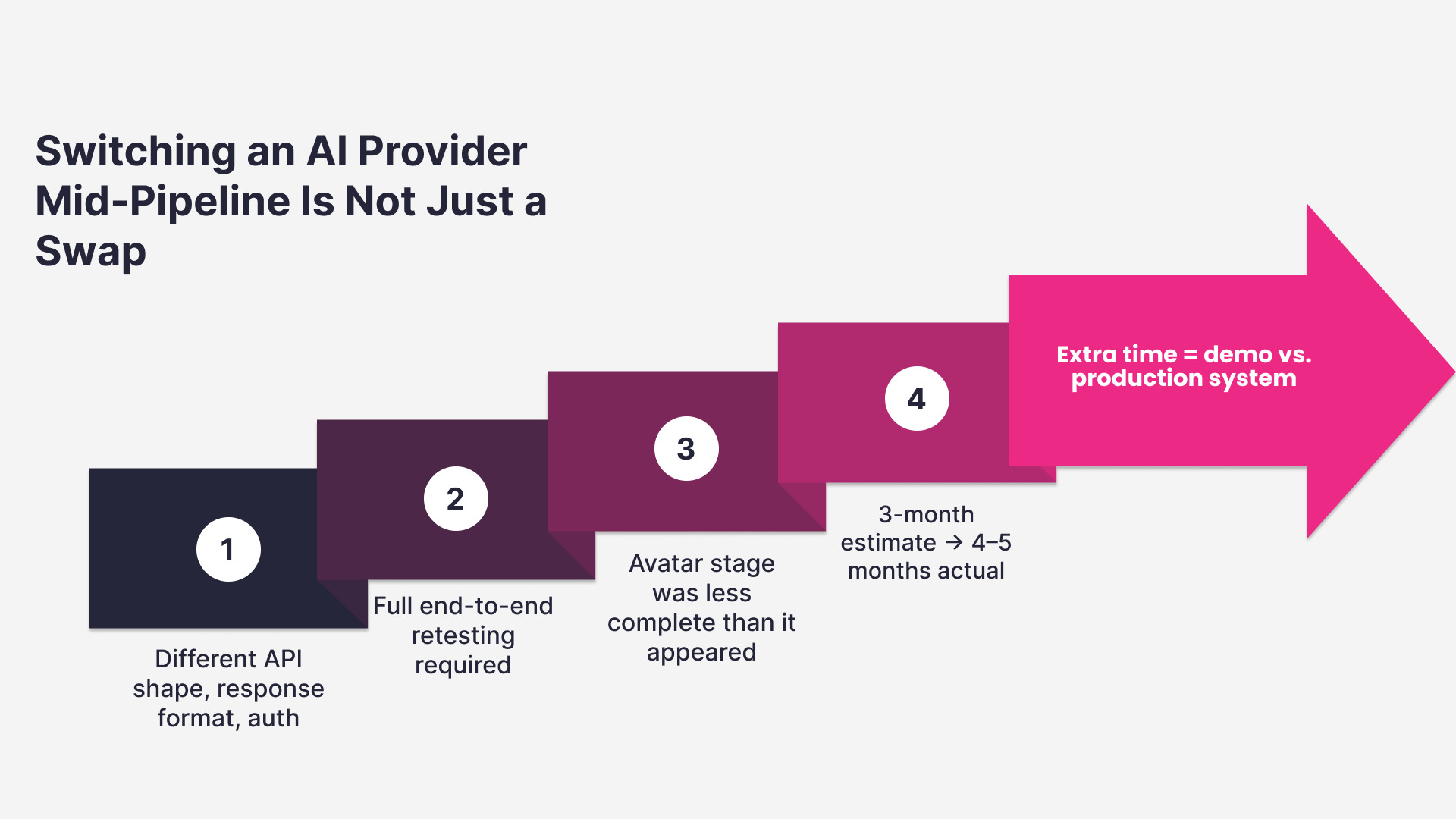
Switching an AI provider mid-pipeline isn’t a like-for-like swap. A different text-to-speech or avatar service means a different API shape, a different response format, different authentication, and different behavior under load – all of which has to be integrated and tested against the full sequence, not just in isolation.
On this project, replacing one provider meant rebuilding the connection layer around that stage, re-testing every handoff downstream of it, and validating the final assembly with the new output format. The initial estimate for stabilization was around three months. It took four to five.
Two things drove the difference: the avatar-generation stage was less complete than it appeared from the outside and had to be built out further before it could connect to anything. And each provider replacement required full end-to-end testing of the sequence, not just unit-level validation of the new integration.
The extra time went into the work that separates a demo from a production system: a pipeline that runs on schedule, recovers predictably, and doesn’t require someone to check each stage manually.
Get a Free Multi-AI Pipeline Review
We map your AI service sequence and identify where the connection layer is missing or broken.
We diagnose why your integration layer is fragile, what's creating business risk, and what to fix first. You get a clear map and roadmap – not a list of opinions.
Special Offer · Integration Stability Review
$2,500 → Free
Your integrations are live,
but you don't trust them
5–10 working days
Fixed scope
No commitment
Free integrations stability Audit
Tell us what's breaking.
We'll get back within 1 working day with next steps and a calendar slot.
Request received
Thanks — we've got it.
What Stability Actually Requires in a Multi-AI System
Many AI tools perform well during manual, one-off tests. The bar changes completely when the tool becomes part of a process that runs on a defined schedule without intervention.
Every service in the pipeline had to answer the same question – not “does this produce a good result once,” but “does this consistently accept the input the previous stage prepared, return what the next stage needs, and complete without getting stuck – every time, on schedule.”
That question determined which providers stayed and which were replaced. And it’s the question that any multi-AI product eventually has to ask, whether it discovers the answer during development or in production.
A practical architecture for a working multi-AI system needs to define, for every stage:
- What information enters this stage
- What the AI service is expected to return
- Which parts of the response are needed downstream
- How the response must be transformed before passing forward
- How outputs from different stages are combined
The connection layer is the central piece of this. It doesn’t generate content – it makes sure the separate tools function as one process.
What This Means If You’re Building on Multiple AI Services
If your product uses more than one AI service and they need to work together, the integration work is only part of what you’re building. The other part – the part most teams underestimate – is the orchestration layer between them.
Signs the orchestration layer is missing or incomplete:
- Individual services pass tests but the full workflow fails
- Outputs from one service are passed directly to the next without transformation
- The pipeline only completes reliably in some runs, not all
- Provider failures at one stage take down the whole process
- Token costs are higher than expected because inputs aren’t being trimmed
Adding multiple API providers to a product creates the same architectural challenge as connecting multiple AI services – each one needs a defined interface, and the space between them needs explicit engineering. The AI version is more complex because the outputs are less predictable, but the principle is the same.
ASD Team is a software development company specializing in AI integration services and software project rescue – including multi-AI orchestration for products where the individual pieces exist but the system doesn’t work.
What is the difference between AI integrations and a working AI product?
An AI integration confirms that one service can receive an input and return a response. A working AI product is a sequence – the output of one service becomes the input of the next, and the full chain runs reliably. The connection layer between services is what turns integrations into a product. Without it, you have a collection of tools, not a system.
Why do AI integrations that work individually fail when combined?
Each AI service has its own input requirements, response format, and practical limits. They don’t communicate automatically. When one service’s raw output goes directly to the next without transformation, the format is usually wrong, required fields are missing, or the input exceeds limits. The connection layer handles this translation – without it, the handoffs fail.
What does an AI orchestration layer actually do?
It receives the output of one AI service, transforms it, and prepares it for the next. Concretely: selecting only relevant information, summarizing or reformatting content, adding parameters the next service requires, controlling the call sequence, and combining outputs from different stages. It doesn’t generate content – it makes the sequence run.
How long does it take to stabilize a multi-AI pipeline?
It depends on how complete the existing integrations are, how many providers need to be tested or replaced, and how complex the connection logic is. A project that looked like three months of stabilization work took four to five months when provider replacements required full end-to-end retesting of the sequence. Build in buffer for provider evaluation – isolated tests don’t reveal how a service behaves inside the full pipeline.
When should I replace an AI provider in a pipeline?
When it fails to consistently accept the input the previous stage prepared, return what the next stage needs, or complete processing without stalling – across repeated runs, not just in isolated tests. A provider that performs well in a demo but stalls mid-pipeline under scheduled conditions needs to be replaced before production.
How is this different from a standard API integration?
Standard API integration connects your product to a single external service. Multi-AI orchestration connects multiple AI services to each other, with each handoff requiring explicit data transformation. The connection layer between AI services is what makes the difference – and it has to be designed specifically for the sequence your product runs, not borrowed from a generic integration pattern.
Show more


Related Articles:
How to Choose the Right APIs for Your Travel Product
8 mins
•
03 Jul 2026
API-First Approach: Why Your Integrations Keep Breaking (And How to Fix the Foundation)
11 mins
•
09 May 2026
How to Build an AI Trip Planner App: The Smart, Modern Approach
10 mins
•
08 Jul 2025
Generative AI in Travel Tech: 5 Proven Use Cases We Delivered
11 mins
•
02 May 2025
We use cookies to personalize our services and improve your experience on this website. We may use certain personal data for analytics and marketing purposes.
Let’s Talk
Fill out the form to schedule a 30-minute call, where we’ll discuss your project requirements and explore the best solutions for your needs.
Free Consultation