
Table of Content
- What API-First Means
- Why Integrations Break Without an API-First
- API-First vs. Code-First
- API-First in Practice
- When Switch to an API-First Strategy?
- How API-First Architecture Affects Product and Integration Stability
- PMS Integration That Kept Breaking Until the Contract Changed
- Common API-First Mistakes
Want your integrations to last?
Book a callMost integration problems aren’t caused by bad code. They’re caused by building the integration before designing the contract.
An API-first approach means defining how systems will communicate – before writing a single line of implementation. The teams that skip this step don’t discover the cost immediately.
They discover it six months later, when data mismatches appear in production, a PMS partnership stalls, or a new integration takes three times longer than expected.
So basically, API-first should be your go-to if your product is used by more than 10 clients, and you want at least 3 partnerships. Not to mention scaling. This is why this article is for teams that already have integrations but can’t fully rely on them.
What Is an API-First Approach – and What Does It Actually Mean?
API-first design means the API contract comes before the implementation. Before any service is built, the team defines: what endpoints exist, what they accept, what they return, and what errors they produce. That contract becomes the source of truth – for the team building the service, for the team consuming it, and for any external partner connecting to the product.
This is different from simply “having an API.” Most products have APIs. The question is whether the API was designed intentionally – as a contract between systems – or whether it emerged as a side effect of building features and connecting them afterward.
In practice, API-first architecture means:
- Contracts are defined in a spec (OpenAPI, AsyncAPI, GraphQL schema) before implementation begins
- Frontend, backend, and integration teams can work in parallel against a shared contract
- Partners and external systems have a stable, versioned interface to build against
- Breaking changes are managed explicitly – not discovered in production
The simplest way to think about it: in an API-first development workflow, the API is the product. Everything else – the implementation, the database, the business logic – is built to fulfill the contract, not the other way around.
Why Do Integrations Break Without an API-First Strategy?
The short answer: because the contract was never defined, so there’s nothing to protect.
When integrations are built code-first – connecting systems as features are shipped – a few predictable things happen. The API shape reflects the internal data model at the time it was built, not the stable interface the integration actually needs. And, it prevents complications while [integrating multiple APIs]. Fields get renamed when the database schema changes. Response formats shift when a developer refactors a service. A partner’s system breaks on a Friday afternoon because an endpoint quietly changed its behavior in a Tuesday deploy.
None of these is an intentional failure. They’re the natural consequence of treating the API as an internal implementation detail rather than a public contract.
By the time a team has five or more integrations built this way, the maintenance surface becomes significant. A change in one service can break multiple downstream consumers. Adding a new integration requires reverse-engineering what the current API actually does – because the spec was never written. PMS partnerships become difficult to establish because the API isn’t stable enough to hand to an external team with confidence.
The data mismatches teams experience – where a booking shows different availability in the channel manager versus the booking engine – are usually symptoms of this: no shared contract, no versioning, no single source of truth for what the data should look like.
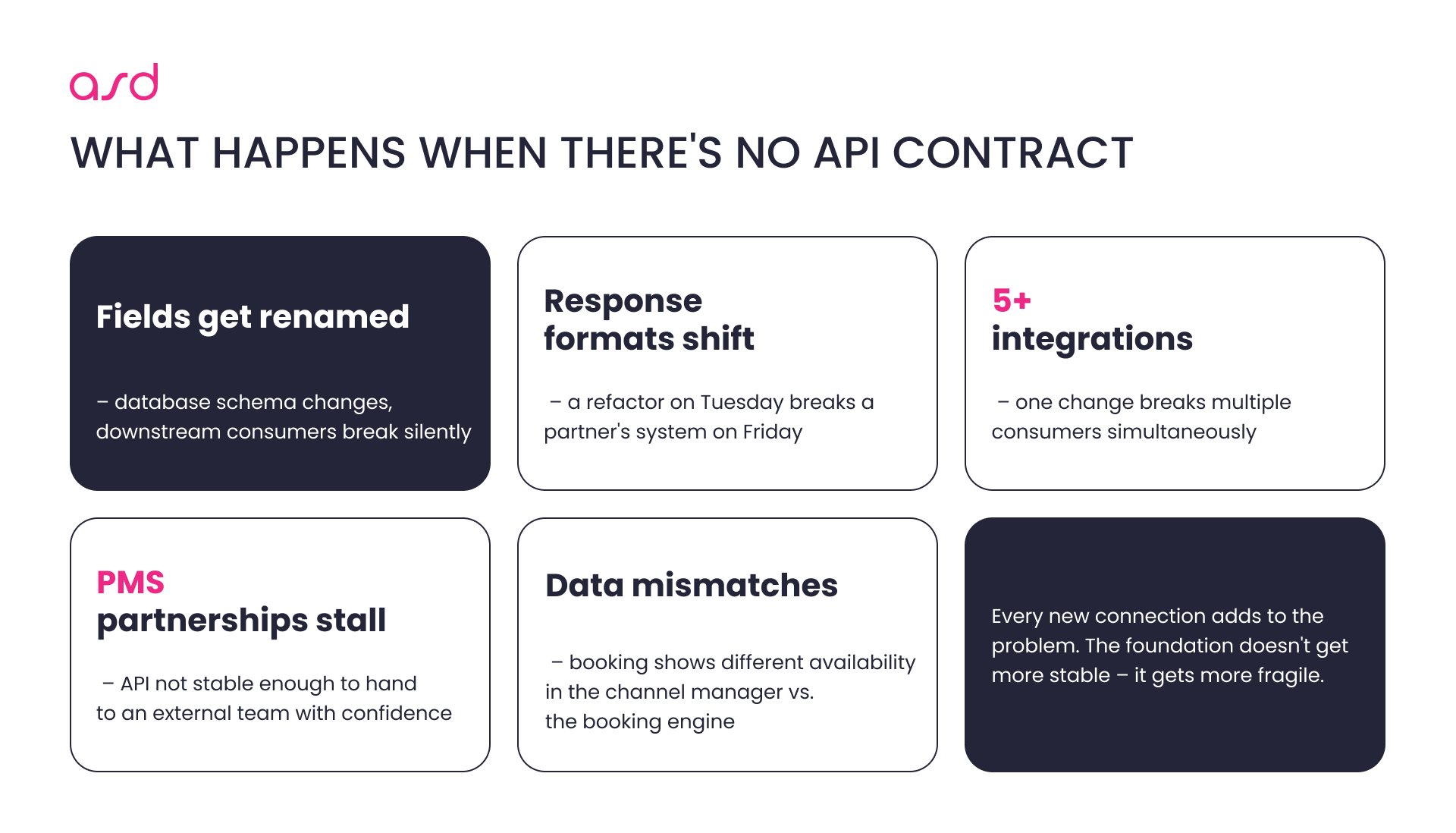
Without an API-first integration strategy, every new connection adds to the problem. The integrations accumulate, but the foundation doesn’t get more stable – it gets more fragile.
API-First vs. Code-First: What’s the Real Difference?
This is the comparison that clarifies most of the confusion around the API-first approach vs. the code-first approach.
| Dimension | Code-First | API-First |
| Where it starts | Implementation – build the feature, expose an endpoint | Contract – define the interface, then build to fulfill it |
| API spec | Generated after the fact (or not at all) | Written first, becomes the source of truth |
| Parallel development | Frontend waits for backend; integration waits for both | All teams build against the spec simultaneously |
| Breaking changes | Discovered in production or by a downstream team | Managed explicitly through versioning and deprecation |
| Partner integrations | Difficult: API shape is tied to internal implementation | Straightforward: stable contract, versioned, documented |
| Onboarding a new integration | Requires reading the code to understand the API | Read the spec – the contract is the documentation |
| Refactoring cost | High: internal changes break external consumers | Low: internal changes stay behind the contract |
| Time to integrate
(new partner) |
Weeks to months, depending on API stability | Days to weeks – spec is available before implementation |
The key distinction in API design-first vs. code-first isn’t about which produces better code – it’s about when the contract is established and who controls it. Code-first means the contract is an accident of implementation. API-first means the contract is a deliberate decision.
For teams building API-first SaaS products or platforms with multiple external partners, the difference compounds with every new integration. Code-first works at two or three connections. It breaks down at eight.
Is your API ready for partners? If a PMS provider asked for your API spec today, would you have one to share? Let's find out.
 Pavlo Boiko
CEO
Pavlo Boiko
CEO
What Does API-First Development Look Like in Practice?
A team adopting API-first development doesn’t necessarily change its tech stack or slow down its shipping cadence. The shift is mostly structural – a change in the order of decisions and the artifacts that get produced.
In a typical API-first architecture workflow, the process looks like this:
A new integration or feature is planned. Before any implementation begins, the team writes the API contract – usually an OpenAPI spec that defines the [API endpoints design], request/response shapes, authentication method, and error codes. This takes a day or two for a standard integration surface.
That spec gets reviewed by the teams that will consume it – the frontend team, the integration team, and the external partner if one is involved. Disagreements about the contract surface at this stage, not after six weeks of parallel development.
Once the contract is agreed upon, all teams build simultaneously. The backend implements to fulfill the spec. The frontend builds against a mock server generated from the spec. The integration team maps its data model to the contract. Nobody waits for anyone else.
When the implementation is ready, it’s validated against the spec. If the implementation deviates from the contract, that’s a build failure – not a production incident.
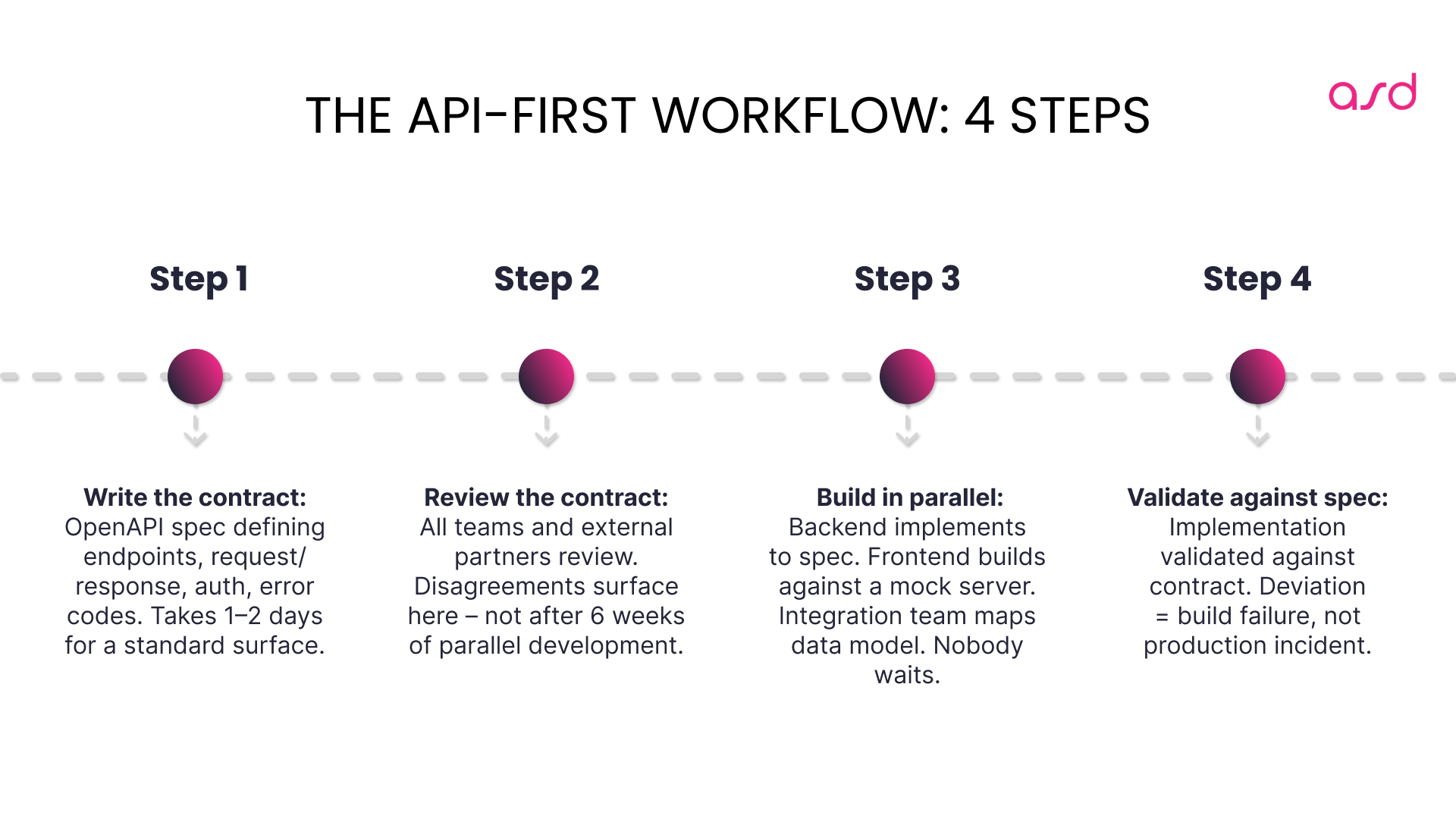
This is what API Integration Best Practices look like when applied consistently: the API is the first artifact, not the last.
When Should a Team Switch to an API-First Strategy?
Earlier than most teams do, and later than the people selling API design tools suggest.
When API-First Adds Overhead Instead of Value
For a product at the MVP stage with one or two internal integrations, a full API-first strategy adds overhead before the product’s shape is clear. The spec you write today may describe endpoints that don’t survive contact with users. Building a rigorous contract for an interface that will change in three weeks isn’t always a good use of time.
The inflection point arrives when the integrations start having external consumers – partners, clients, third-party platforms – or when the number of internal integrations makes uncoordinated changes painful. Practically, this tends to happen around the third or fourth integration, which is also when middleware integration patterns start making sense.
What Are the Signals That API-First Is Already Overdue?
- A PMS or channel manager partner asks for API documentation, and the team doesn’t have a spec to share
- Data mismatches appear between systems, and tracing them requires reading implementation code, not a contract
- A backend refactor breaks an integration that the team didn’t know was consuming that endpoint
- New integrations consistently take longer than estimated because the existing API surface needs to be reverse-engineered first
- Two teams are blocked on each other because one is waiting for the other’s implementation before they can begin
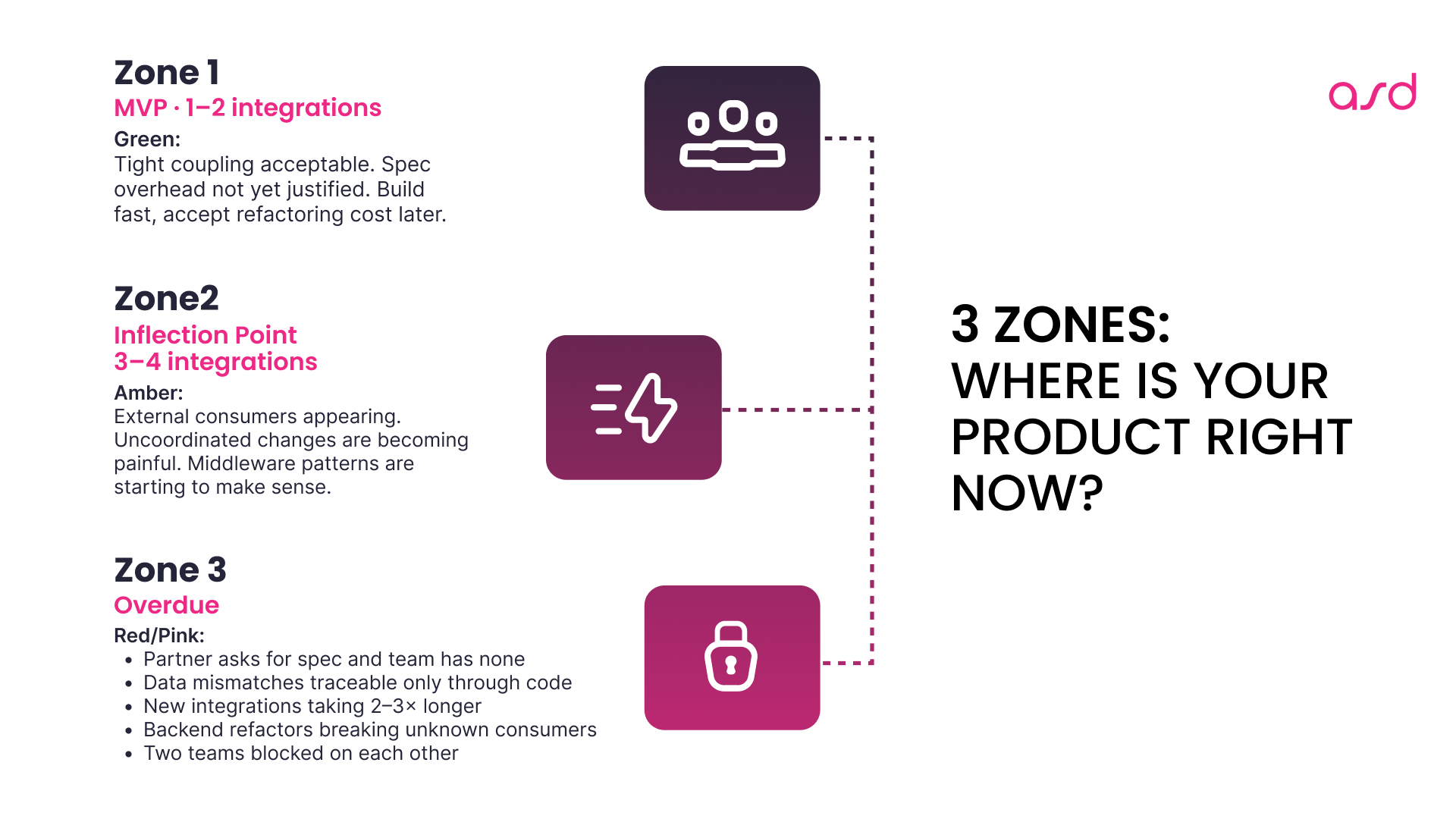
When three or more of these are present, the question isn’t whether to adopt an API-first design approach – it’s how to do it without stopping existing development. The answer is usually incremental: new integrations are built API-first, existing ones are progressively documented and stabilized.
Your integrations work, but can you rely on them?
Talk to our team and find out where your API contracts need work.
Let’s talk
How Does API-First Architecture Affect Product and Integration Stability?
The stability benefits of API-first development are most visible in two places: partner integrations and internal team velocity.
On the partner side, a stable API contract changes the nature of PMS and channel manager relationships. A partner can build against a versioned spec with confidence that the interface won’t change under them. Breaking changes, when necessary, are versioned and communicated in advance. The integration doesn’t break on a Tuesday because someone renamed a field. This matters significantly for API-first booking solutions and API-first booking systems in hospitality and travel, where the number of external integrations is high, and API instability has direct revenue consequences.
On the internal team side, parallel development becomes practical. Frontend and backend teams no longer need to serialize their work – they build against the same contract simultaneously. A new engineer joining the team has a spec to read rather than implementation code to trace. The how long api integration take question has a more predictable answer when the contract is defined upfront rather than negotiated through trial and error.
The quantifiable effects teams typically see after adopting API-first best practices:
- New integration time drops by 30–50% because the contract is clear before development starts
- Partner onboarding time decreases significantly – a partner with a spec can begin building in days, not weeks
- Production incidents caused by unannounced API changes drop to near zero with proper versioning
- Backend refactors no longer require coordinating with every downstream consumer
These aren’t theoretical benefits. They’re the practical outcome of treating the API as the product’s public interface – designed deliberately, versioned explicitly, and protected from internal implementation changes.
Why Did a Hospitality SaaS Lose Three PMS Partnerships – and How Did API-First Fix It?
A mid-size hospitality SaaS had built connections to three PMS providers over two years. Each integration had been built code-first – connecting to the provider’s API as features were shipped, mapping their data model directly into the platform’s core logic.
The integrations worked in the sense that data flowed. But they were difficult to maintain and nearly impossible to hand to an external team. When a fourth PMS provider came to the table for a partnership discussion, the platform’s team couldn’t provide API documentation. The spec didn’t exist – the API had emerged from the implementation. The PMS provider’s technical team needed three weeks to reverse-engineer what the platform’s API actually did before they could assess the integration effort.
The partnership stalled. Not because the platform’s API was bad – but because it wasn’t legible to an outside team.
After redesigning the integration layer with an API-first architecture – writing OpenAPI specs for each integration surface, versioning the endpoints, and separating the internal data model from the external contract – the same team onboarded a fifth PMS provider in under two weeks. The spec was the documentation. The partner’s team could read it, ask questions about the contract rather than the implementation, and begin building against a mock server before the platform’s backend was ready.
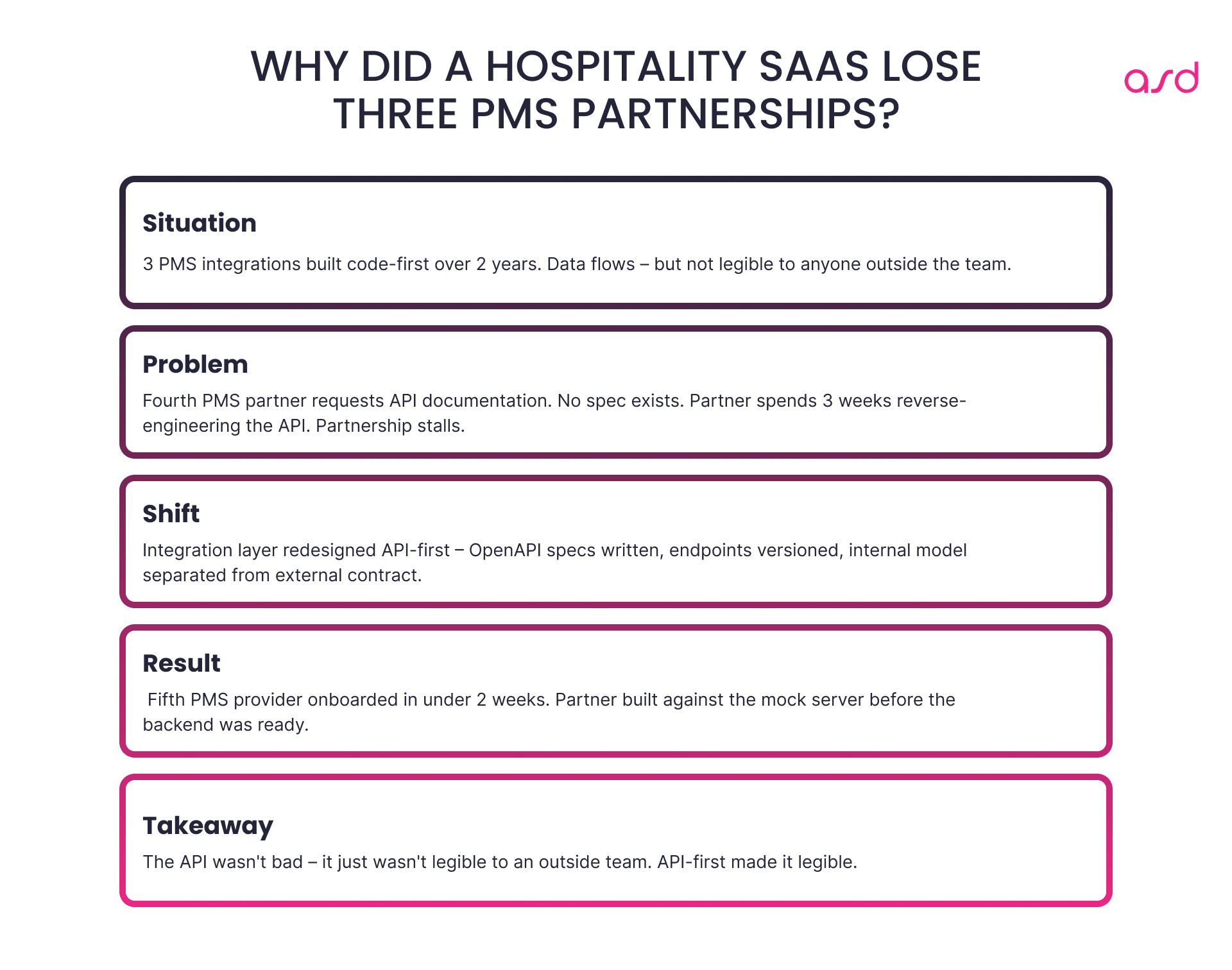
This is what implementing an API-first strategy produces in practice: integrations that external teams can actually build against.
Discover about travel APIs types and integration specifics
Does API-First Mean Slower Development? ASD Team’s Take on Common Misconceptions
API-first development has a reputation for adding overhead – writing specs, maintaining documentation, and going through a design review before implementation begins. For teams used to moving fast, this feels like friction.
In practice, the overhead is front-loaded and the savings are continuous. Writing a spec for a new integration surface takes one to two days. Not having a spec means every downstream consumer spends time reverse-engineering the API – repeatedly, every time they need to integrate or debug. The spec pays for itself the first time a new team member needs to understand the integration surface, or the first time a partner asks for documentation.
The more common mistake isn’t writing specs that are too detailed – it’s writing specs that are disconnected from the implementation. A spec that describes an API that doesn’t match the actual service creates more confusion than no spec at all. The discipline that makes API-first best practices work is keeping the spec as the source of truth: validating the implementation against it, treating deviations as build failures, and versioning the contract when the interface needs to change.
ASD Team works with SaaS and B2B products across hospitality, travel, and marketplace sectors where integration stability is a product requirement, not a nice-to-have. The pattern we see most often: teams that have grown past five integrations without an API-first foundation, where each new integration is slower and more fragile than the last. The fix isn’t always a full redesign – it’s usually a combination of decoupled architecture at the structural level and API-first contracts at the integration surface. The two solve different problems and work together.
If you’re not sure where your integration layer stands, a free project estimation is a practical starting point – mapping the current integration surface before deciding what to stabilize first.
What is an API-first approach in simple terms?
Design the contract before writing the code. Define what the API accepts, returns, and does – in a spec – before anyone builds anything. Everything else is built to fulfill that contract, not the other way around.
What’s the difference between API-first and code-first?
In code-first development, the API is a side effect of implementation – it reflects whatever the code does at the time it was built. In API-first development, the API is designed as a deliberate contract before implementation begins. The practical difference: code-first APIs break partner integrations when the implementation changes; API-first contracts protect external consumers from internal changes.
When does it make sense to switch to an API-first approach?
When you have external consumers – partners, clients, third-party platforms – building against your API. Or when internal integration changes are regularly breaking downstream systems. Or when a partner asks for API documentation and you don’t have a spec to share. These are the signals that the contract needs to be made explicit. If you’re unsure whether your current setup warrants the switch, our custom API integration services can help assess the integration surface.
Does API-first mean writing documentation before building?
Not documentation in the traditional sense – a spec. An OpenAPI file or equivalent that defines the contract formally enough that a mock server can be generated from it, and the implementation can be validated against it. It’s a working artifact, not a document that lives in a wiki and goes out of date.
Can I adopt API-first incrementally without stopping current development?
Yes, and this is usually the right approach. New integrations are built API-first from the start. Existing integrations are progressively documented: write the spec that describes what the API currently does, then use that as the baseline for future changes. Over time, the integration surface becomes legible and stable without requiring a full rewrite.
Show more


Related Articles:
Middleware vs In-Core Integrations: How to Build APIs That Actually Scale
9 mins
•
13 Apr 2026

API Integration Best Practices: Processes and Approaches
19 mins
•
24 Apr 2025
How Long Does an API Integration Take? The Complete Guide
12 mins
•
13 Apr 2025
We use cookies to personalize our services and improve your experience on this website. We may use certain personal data for analytics and marketing purposes.
Let’s Talk
Fill out the form to schedule a 30-minute call, where we’ll discuss your project requirements and explore the best solutions for your needs.
Free Consultation