
Not every travel API your product could integrate is one it should integrate first. Knowing how to choose API integration starts with mapping what your product actually needs, then evaluating each candidate against specific criteria before any code is written.
What Makes a Travel API Different From a Regular API?
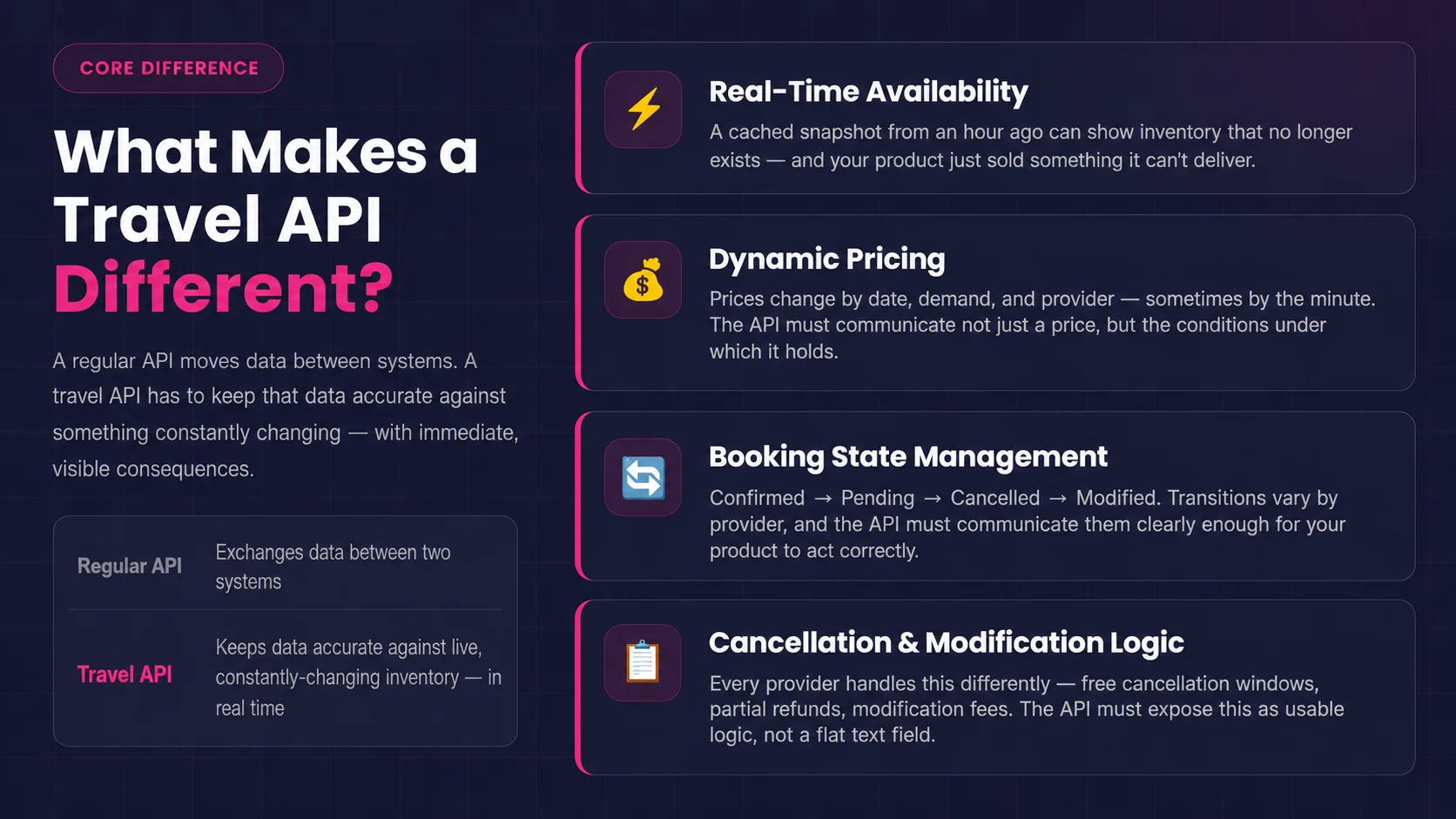
A regular API moves data between two systems. A travel API has to keep that data accurate against something that’s constantly changing – and the consequences of getting it wrong are immediate and visible to a paying customer.
Travel APIs carry domain-specific requirements that generic APIs simply don’t have to handle: real-time availability, dynamic pricing, booking state transitions, and cancellation rules that vary by provider.
Real-Time Availability
A room, seat, or rental car either exists right now or it doesn’t. A travel API that returns a cached snapshot from an hour ago can show availability that no longer exists – and your product just sold something it can’t deliver.
Dynamic Pricing
Prices in travel change by date, demand, and provider – sometimes by the minute. A travel API needs to communicate not just a price, but the conditions under which that price holds.
Booking State Management
Confirmed, pending, cancelled, modified – these states have specific transitions that vary by provider, and a travel API has to communicate them clearly enough that your product can act on them correctly.
Cancellation and Modification Logic
Every provider handles this differently – free cancellation windows, partial refunds, modification fees. A travel API has to expose this logic in a way your product can actually use, not just store as a flat text field.
A generic e-commerce or CRM API doesn’t have any of this complexity built in. This is exactly why evaluating a travel API requires different criteria than evaluating most other API categories.
Discover what the API-first approach is and how it can help you
How Do I Choose the Right API for My Project?
Before evaluating any specific API, define the core flows your product depends on. Not what’s available. Not what looks impressive in a demo. What your product actually requires to function.
This usually comes down to a short list:
- How will users search and book?
- How will payment be processed?
- How will availability and pricing stay accurate?
- How will property, room, or activity data populate your platform?
- How will users be notified about confirmations, changes, or cancellations?
Each of these maps to a category of API. Skipping this step – and integrating based on what APIs are popular or easy to find – is one of the most common reasons travel products end up with integrations that don’t actually solve the problem they were meant to solve.
Not sure where to start? Book a free call, and we will help you sort Travel APIs out and choose the right one!
 Pavlo Boiko
CEO
Pavlo Boiko
CEO
The Core Types of APIs Travel Products Typically Need
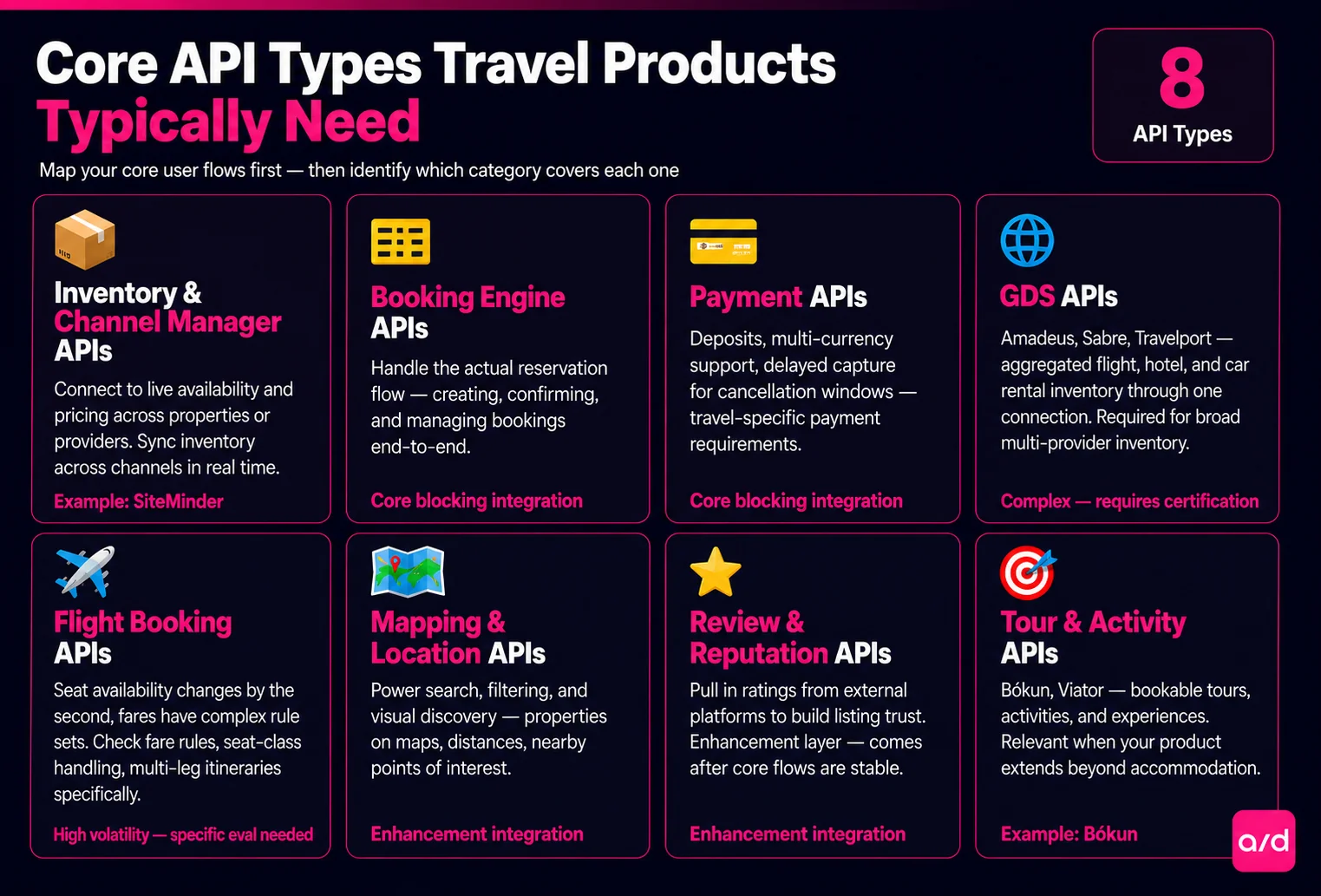
Inventory and Channel Manager APIs
Connect your product to live availability and pricing across multiple properties or providers. SiteMinder is a common example of a hospitality products that need to sync inventory across channels in real time.
Booking Engine APIs
Handle the actual reservation flow – creating, confirming, and managing bookings end-to-end.
How to Choose a Flight Booking API
If your product includes flights, this is its own specific evaluation. Flight inventory carries volatility and fare-rule complexity that hotel or activity APIs don’t – seat availability changes by the second, fares have complex rule sets, and a flight booking API needs to expose all of that reliably. Check specifically how the API handles fare rules, seat-class availability, and multi-leg itineraries before committing.
Payment APIs
Payment APIs process transactions securely, often with travel-specific requirements like deposits, multi-currency support, and delayed capture for cancellation windows.
How to Choose an API for Prepaid Card Systems
For products handling prepaid balances, loyalty points, or gift-card-style transactions, this follows a related but distinct set of criteria – focused on balance accuracy, fraud handling, and settlement timing rather than booking logic.
GDS APIs
Global Distribution Systems – Amadeus, Sabre, Travelport – give access to aggregated flight, hotel, and car rental inventory through a single connection. Necessary if your product needs flight or broad multi-provider inventory.
Mapping and Location APIs
Power search, filtering, and visual discovery – showing properties or activities on a map, calculating distances, displaying nearby points of interest.
Review and Reputation APIs
Pull in ratings and reviews from external platforms to build trust on listings.
Tour and Activity APIs
Platforms like Bókun or Viator give access to bookable tours, activities, and experiences – relevant if your product extends beyond accommodation into broader trip planning.
Most travel products don’t need all of these. They need the specific subset that supports their core user flows – which is exactly why the previous step matters before this one.
Travel and Booking APIs: Сonnectivity Landscape

How to Choose API Integration Service Providers
Once you know which category of API you need, evaluate specific candidates against the same criteria every time.
Documentation Quality
Is it complete, current, and does it reflect how the API actually behaves? Poor documentation is one of the strongest predictors of integration delays.
Rate Limits at Your Scale
A limit that’s fine during testing can become a production bottleneck once real traffic hits. Check limits against your expected volume, not your current volume.
Real-Time vs. Batch Sync
Some APIs push updates instantly. Others require polling on an interval. For availability and pricing, real-time matters significantly more than it does for, say, review data.
Sandbox Availability
Can you test the full integration – including edge cases and failure scenarios – before touching production? An API without a usable sandbox is a much riskier integration.
Authentication Complexity
OAuth, API keys, certificate-based auth – some methods require significantly more setup and maintenance than others.
Pricing Model at Scale
Per-call pricing that looks reasonable in a demo can become expensive once your product has real usage volume. Model the cost against projected scale before committing.
Reliability Track Record
Does the provider have a public status page or known uptime history? An unreliable API becomes your product’s reliability problem the moment it’s integrated.
Fit With Your Data Model
Does the API’s data structure map cleanly to what your product needs, or will significant translation work be required? This affects both initial development time and long-term maintenance.
How to Choose a B2B Travel API
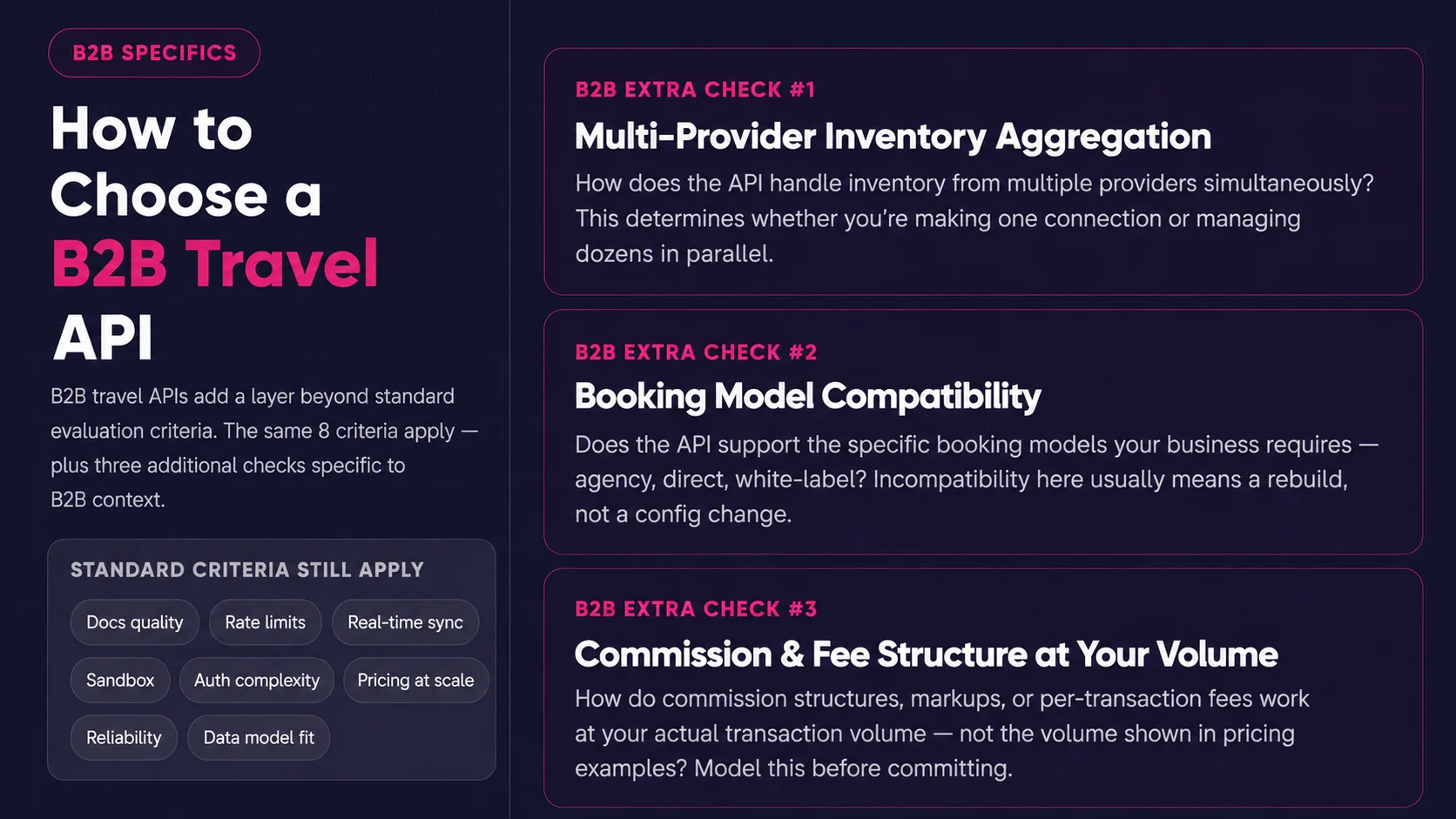
B2B travel APIs add a layer beyond the standard evaluation criteria above. Beyond documentation and rate limits, check how the API handles multi-provider inventory aggregation, whether it supports the specific booking models your business requires – agency, direct, white-label – and how its commission or fee structure works at your actual transaction volume, not the volume shown in pricing examples.
Already have integrations, but something off? Reach out to ASD Team through this form and get a free API Integration audit.
We diagnose why your integration layer is fragile, what's creating business risk, and what to fix first. You get a clear map and roadmap – not a list of opinions.
Special Offer · Integration Stability Review
$2,500 → Free
Your integrations are live,
but you don't trust them
5–10 working days
Fixed scope
No commitment
Free integrations stability Audit
Tell us what's breaking.
We'll get back within 1 working day with next steps and a calendar slot.
Request received
Thanks — we've got it.
How to Choose Middleware for API Orchestration
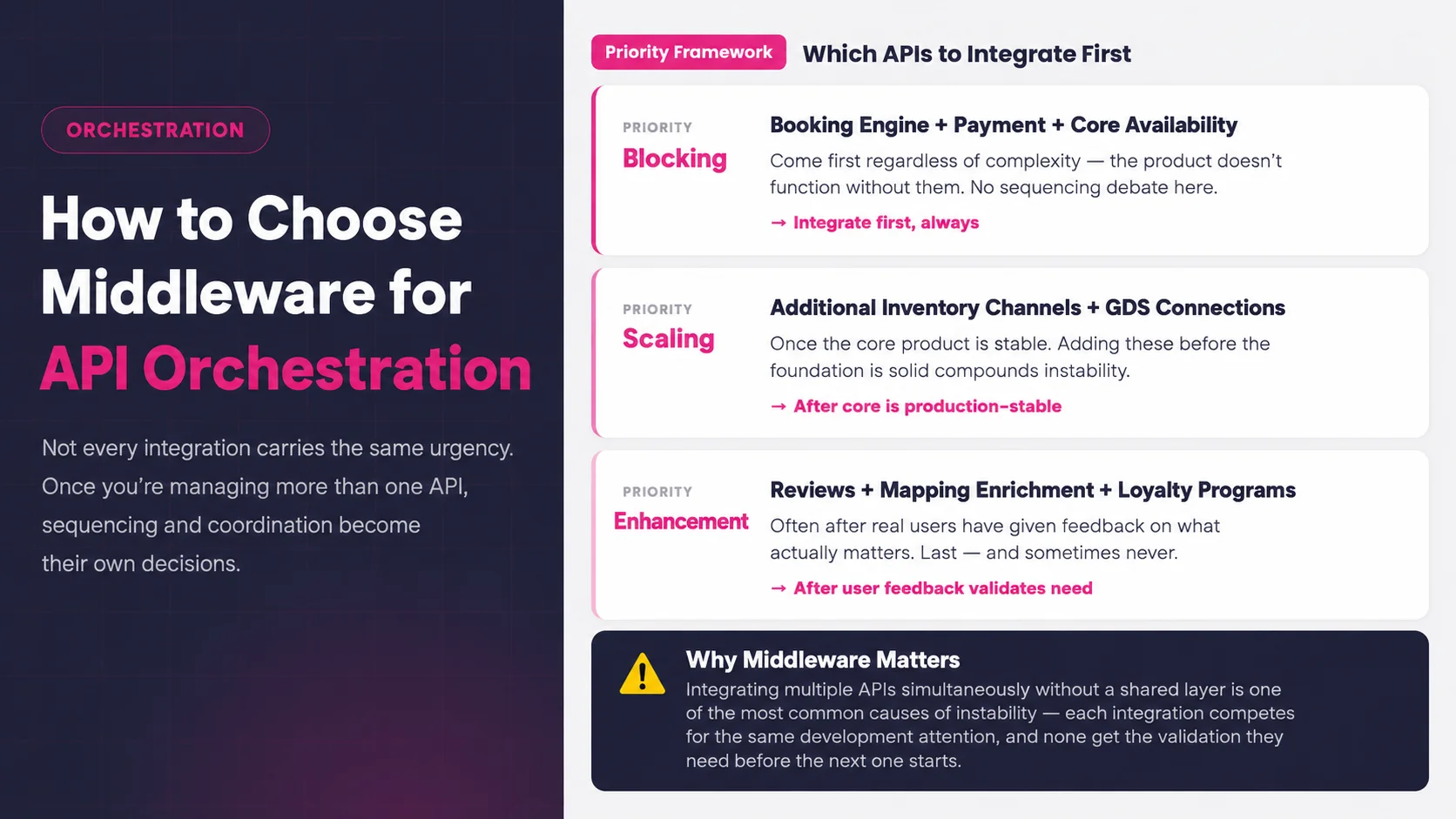
Not every API integration carries the same urgency, and once you’re managing more than one, sequencing and coordination become their own decisions.
Prioritizing Which APIs to Integrate First
A simple framework: blocking integrations – booking engine, payment processing, core availability – come first regardless of complexity, because the product doesn’t function without them. If you’re planning your implementation roadmap, understanding how long API integration takes can help you set realistic timelines before development begins. Scaling integrations – additional inventory channels, GDS connections – comes once the core product is stable. Enhancement integrations – reviews, mapping enrichment, loyalty programs – come last, often after real users have generated feedback on what actually matters.
Which API Gateway Should I Choose?
As the number of integrations grows, the question shifts from “which API” to “how do these APIs work together without breaking my product?” Middleware – a shared integration layer – coordinates multiple APIs so they don’t each become an individual point of failure. For most travel products, a single well-structured integration layer is the right starting point; a more complex API gateway setup with domain-specific routing only becomes necessary at significant scale, when different flows genuinely need to be isolated from each other.
Integrating multiple APIs simultaneously, without this kind of sequencing and a shared layer underneath them, is one of the most common causes of instability in travel platforms – each integration competes for the same development attention, and none of them get the validation they need before the next one starts.
Which Travel API Is Right for Your Product?
If you're comparing travel APIs and want a clearer path forward, we can help you evaluate the best fit for your product.
Let’s talk
When to Get Outside Help Evaluating Travel APIs
If you’re not sure which APIs your product actually needs, or you’ve already integrated one and it’s not delivering what you expected, an outside evaluation is often faster than continuing to guess.
Signs it’s worth getting expert input before committing further:
- You’re choosing between multiple similar APIs and can’t tell which fits your product
- An API you’ve already integrated isn’t syncing reliably or matches poorly with your data model
- You’re planning to add several integrations and aren’t sure what order makes sense
- Your team has limited travel-domain experience and is evaluating travel-specific APIs for the first time
ASD Team is a travel API integration company that helps product owners evaluate, select, and integrate the right APIs for their specific product – from initial evaluation through stable, production-ready implementation.
How long does it take to integrate a travel API?
Typically 2–6 weeks per API depending on complexity, documentation quality, and whether real-time sync is required. Niche or poorly documented APIs take longer due to additional testing needed.
Should I integrate multiple travel APIs at once or one at a time?
One at a time, prioritized by what blocks core functionality. Integrating multiple APIs simultaneously without a shared structure is one of the most common causes of instability in travel platforms later.
How do I choose a B2B travel API specifically?
Beyond the standard evaluation criteria, check how the API handles multi-provider inventory, whether it supports the specific booking flows your business model requires, and how its commission or fee structure works at your transaction volume.
How do I choose API integration service providers?
Evaluate documentation quality, rate limits at your expected scale, real-time vs. batch sync behavior, sandbox availability, authentication complexity, pricing at scale, reliability track record, and how well the API’s data model fits your product. Apply the same criteria consistently across every candidate.
How do I know which travel APIs my product actually needs?
Start with your core user flows – booking, payment, availability display – not with a list of available APIs. Map what your product must do first, then find the APIs that support those specific flows.
What’s the difference between a travel API and a regular API?
A travel API handles domain-specific logic that generic APIs don’t – real-time availability, dynamic pricing, booking state transitions, and cancellation rules that vary by provider. A regular API just exchanges data; a travel API has to keep that data accurate against constantly changing inventory.
Show more


Related Articles:

Best Travel API Integration Companies: How to Choose the Right One
8 mins
•
02 Jun 2026

API-First Approach: Why Your Integrations Keep Breaking (And How to Fix the Foundation)
11 mins
•
09 May 2026

API Integration Best Practices: Processes and Approaches
19 mins
•
24 Apr 2025

How Long Does an API Integration Take? The Complete Guide
12 mins
•
13 Apr 2025
We use cookies to personalize our services and improve your experience on this website. We may use certain personal data for analytics and marketing purposes.
Let’s Talk
Fill out the form to schedule a 30-minute call, where we’ll discuss your project requirements and explore the best solutions for your needs.
Free Consultation