
Table of Content
- In-Core Integrations: How They Work and Why They Break
- Integration Middleware: What It Is and How It Works
- Types of Integrations
- Middleware vs In-Core: Comparison Table
- When to Use Each Approach
- Real-World Examples: Middleware in Action
- Scale Smarter with Middleware
- Common Mistakes to Avoid
- Where Do You Go From Here?
Untangle your integration architecture?
Book a callIn-core integration gets you moving fast, and middleware keeps you moving fast as you scale. If you’re managing 3+ integrations and already feeling the maintenance drag, middleware is the answer.
Your first integration usually takes a weekend. The tenth one costs you a senior engineer for a month. By the twentieth, your codebase starts looking like a bowl of spaghetti nobody dares touch.
This isn’t bad luck. It’s a structural problem – one that most teams don’t see coming until it’s already slowing them down.
The root cause is almost always the same: integrations were built in-core, one by one, with no unified strategy. Each new API becomes another hard-coded dependency. Each provider change becomes an incident. And the more integrations you add, the more fragile the whole system gets.
There’s a better path – and it starts with understanding the difference between in-core integrations and middleware-based integrations.
What Are In-Core Integrations (And Why They Break)?
In-core integrations live directly inside your application codebase. When your app needs to talk to Stripe, Salesforce, or a shipping provider, you write that logic into your service layer, your controllers, or wherever it fits at the time.
It works fine at first. There’s no overhead, no extra infrastructure, and your team ships fast. For an MVP or a product with one or two integrations, it’s often the right call.
The problems show up at scale:
- Every integration is tightly coupled to your core logic. Change one thing, and something else breaks.
- Error handling is scattered across different parts of the codebase, built each time differently.
- When a provider goes down or changes their API, your team scrambles to track down and patch every affected touchpoint.
- Onboarding new developers becomes harder – there’s no consistent pattern for how integrations work.
- Testing is painful. You’re either hitting live APIs or maintaining a growing collection of mocks.
None of these problems are fatal early on. But as your product grows – more features, more providers, more customers – the maintenance cost compounds. What started as a fast shortcut becomes the slowest part of your engineering process.
What Is Integration Middleware (And How Does It Actually Work)?
Middleware integration introduces a dedicated layer that sits between your application and the external services it communicates with. Instead of each part of your codebase talking directly to third-party APIs, all that traffic is routed through a central integration layer.
Think of it as an orchestration hub. Your app sends a request to the middleware. The middleware handles authentication, request formatting, retry logic, error handling, and response transformation – then delivers the result back to your app in a consistent format.
In practice, middleware integration can take several forms:
- An API gateway that handles authentication, rate limiting, and routing
- An orchestration layer that coordinates multi-step workflows across multiple providers
- An event-driven integration bus that decouples services and handles asynchronous data flows (particularly is closely tied to decoupled architecture)
- A unified data model layer that normalizes responses from different APIs into a consistent schema
The key difference from in-core integrations isn’t just architecture – it’s ownership. In a middleware setup, the integration layer is responsible for reliability. Your application logic stays clean and doesn’t need to know the details of how any individual provider works.
Types of Integrations: Light, Full, and Middleware-Based
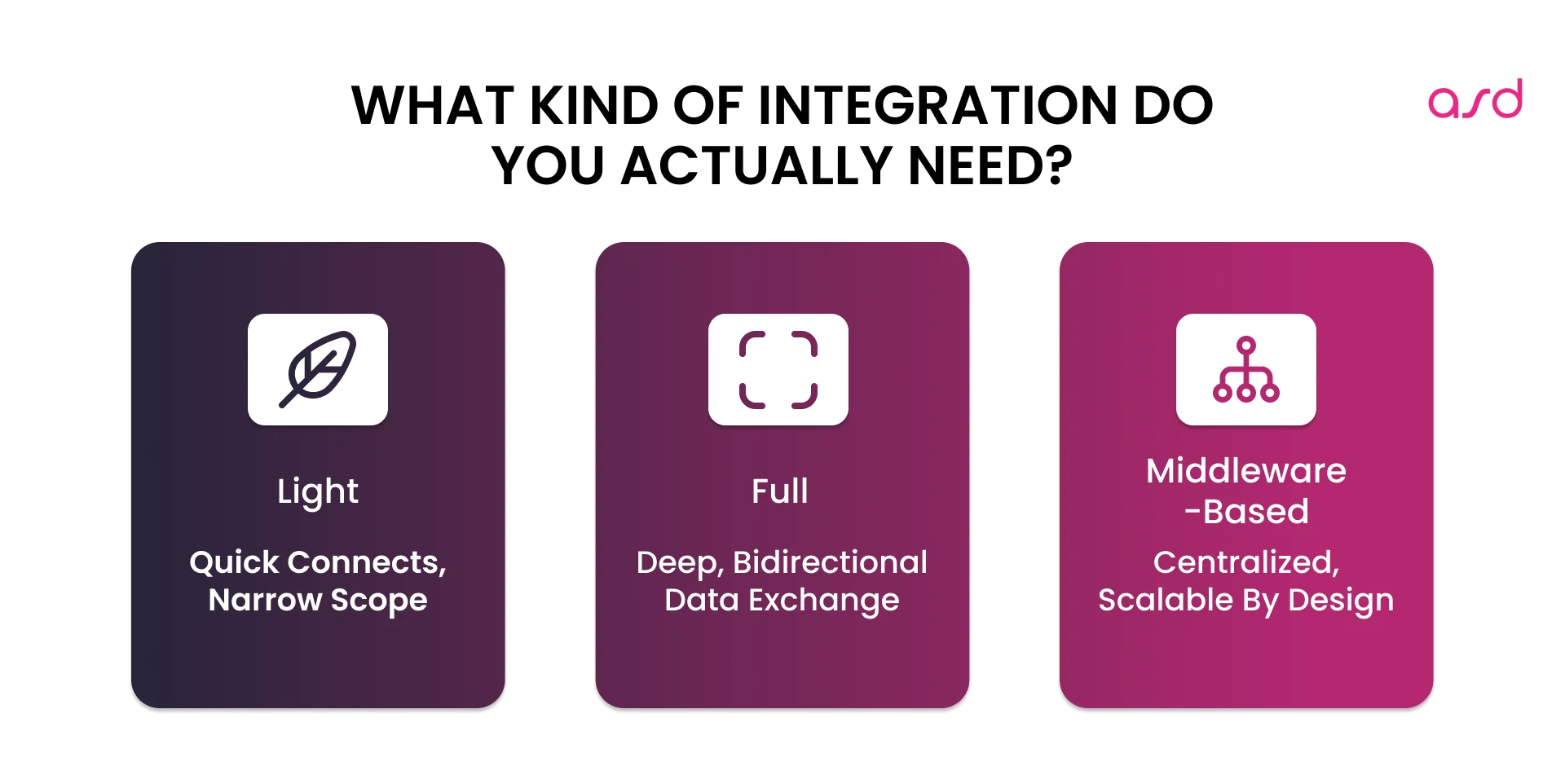 Before comparing approaches, it’s worth clarifying what ‘integration’ actually means in practice, because not all integrations are created equal.
Light Integrations
Light integrations connect two systems for a narrow, specific purpose: syncing a field, triggering a webhook, pushing a notification. They’re fast to build and don’t require much logic.
Examples: sending a Slack notification when a payment succeeds, adding a row to a Google Sheet on form submission, triggering an email via a transactional provider.
Light integrations are fine when the scope stays narrow. When that scope expands – more triggers, more conditions, more data transformations – they tend to grow into something unmanageable.
Full Integrations
Full integrations involve deep, bidirectional data exchange between systems. They include complex business logic: mapping data models, handling edge cases, managing sync conflicts, and supporting ongoing workflows.
Examples: a CRM integration that syncs deals, contacts, and activities across platforms; an ERP integration that connects inventory, orders, and finance data.
Full integrations take longer to build and require ongoing maintenance. When built in-core, they’re the ones most likely to become technical debt.
Middleware-Based Integrations
Middleware-based integrations aren’t a different category of use case – they’re an architectural approach that can support both light and full integrations. The difference is that the integration logic lives in a centralized, reusable layer rather than being spread across the application.
This makes them particularly powerful for products that need to support many integrations, serve different customer configurations, an API-first approach design, or evolve quickly without constantly reworking existing connections.
Middleware vs In-Core: Side-by-Side Comparison
Here’s how the two approaches compare across the dimensions that matter most for growing products:
| Criteria | In-core | Middleware |
| Scalability | Low | High |
| Maintenance | Complex | Centralized |
| Dev Speed | Fast (short-term) | Moderate |
| Flexibility | Low | High |
| Cost (long-term) | High | Optimized |
The takeaway: in-core integrations win on initial speed. Middleware wins on everything that happens after.
When to Use In-Core vs. Middleware Approaches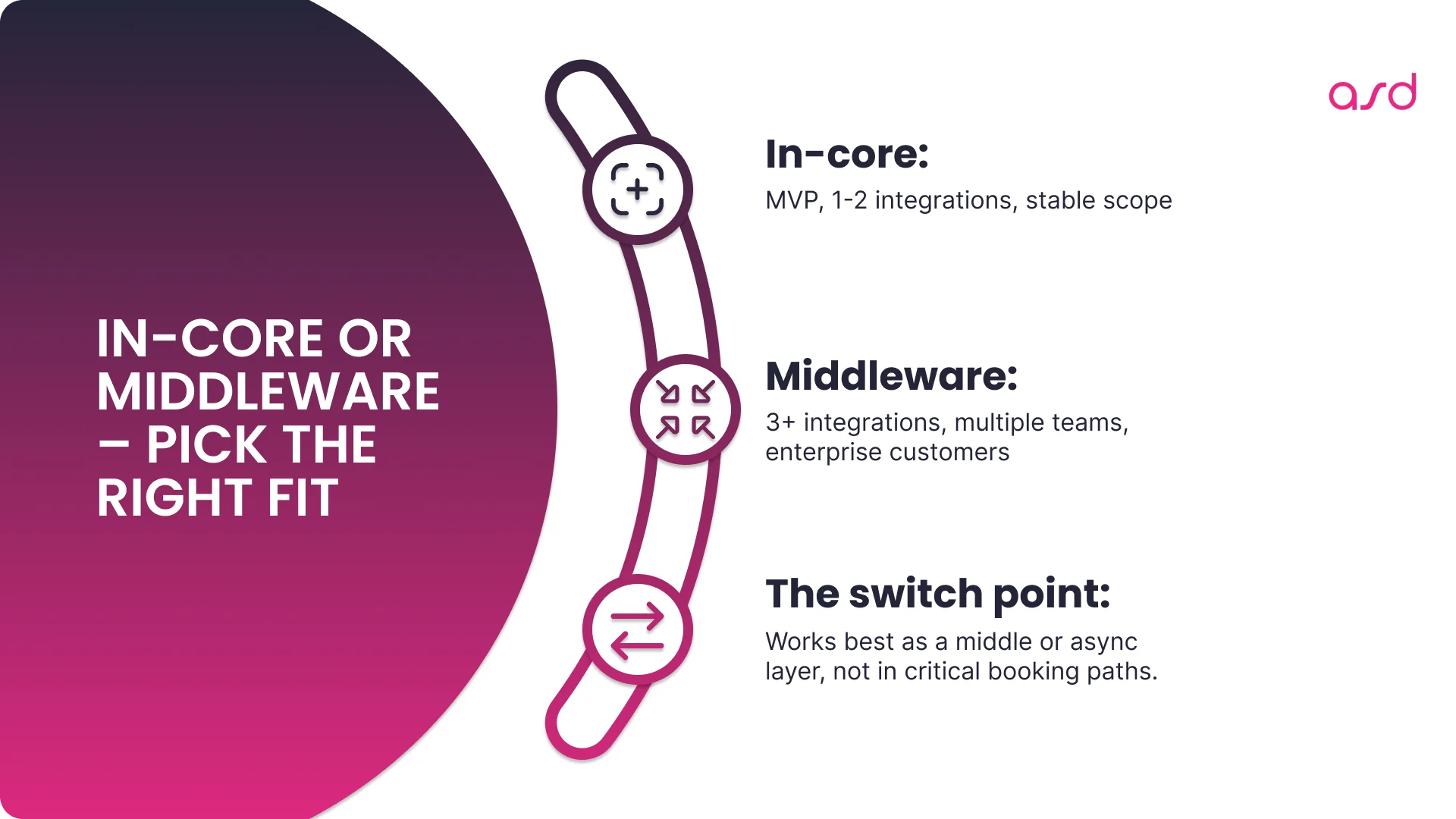
Start In-Core When…
- You’re building an MVP and need to validate the product before optimizing the architecture
- You have one or two integrations and no near-term plans to add more
- Your team is small and adding infrastructure overhead would slow you down
- The integration is simple, stable, and unlikely to change
There’s no shame in starting in-core. The mistake isn’t the initial decision – it’s not recognizing when the approach has outlived its usefulness.
If you’re at this stage and want to make sure your current integrations are at least following solid fundamentals before you scale, our API integration best practices guide covers the patterns worth applying even in a lean, in-core setup.
Move to Middleware When…
- You’re adding your fourth or fifth integration and already feeling the maintenance burden
- Multiple teams are touching integration code, creating conflicts and inconsistencies
- You’re onboarding enterprise customers who need custom API configurations
- Provider instability (API changes, outages, deprecations) is regularly causing incidents
- Your product roadmap includes significantly more integrations in the next 12 months
A good rule of thumb: if your integration logic has its own bugs, its own incident history, and its own backlog of improvements – it deserves its own layer.
Let's Optimize Your Integrations Too many in-core APIs or scaling issues? Tell us where you are, and we'll take it from there.
 Pavlo Boiko
CEO
Pavlo Boiko
CEO
Real-World Examples: Where Middleware Makes the Difference
- Use Case 1: SaaS Platform Supporting 20+ CRM Integrations
A B2B SaaS company built its first few CRM integrations directly in its core application. Each one followed a slightly different pattern, handled errors differently, and was maintained by whichever engineer happened to build it.
By the time they needed to support enterprise customers with custom CRM requirements, the in-core approach had become a liability. Adding a new CRM took weeks; fixing a bug in one integration risked breaking another.
After introducing a middleware integration layer, the team was able to define a unified connector interface. New CRM integrations could be added without touching core application code. Error handling, retry logic, and logging were standardized across all connectors. The time to add a new integration dropped from weeks to days.
- Use Case 2: Marketplace with Unstable Third-Party Payment Providers
A marketplace product relied on several regional payment providers, each with different APIs, reliability profiles, and rate limits. Payment failures were causing lost orders and support tickets.
The engineering team built a middleware orchestration layer that abstracted the provider-specific logic. The application sent payment requests to the middleware; the middleware handled provider selection, retries, fallback routing, and response normalization.
When one provider changed their API, only the middleware connector needed updating – not the core payment flow. When a provider went down, the middleware automatically routed to a backup. Customer-facing errors dropped significantly.
How Middleware Helps You Scale Without Rebuilding Everything
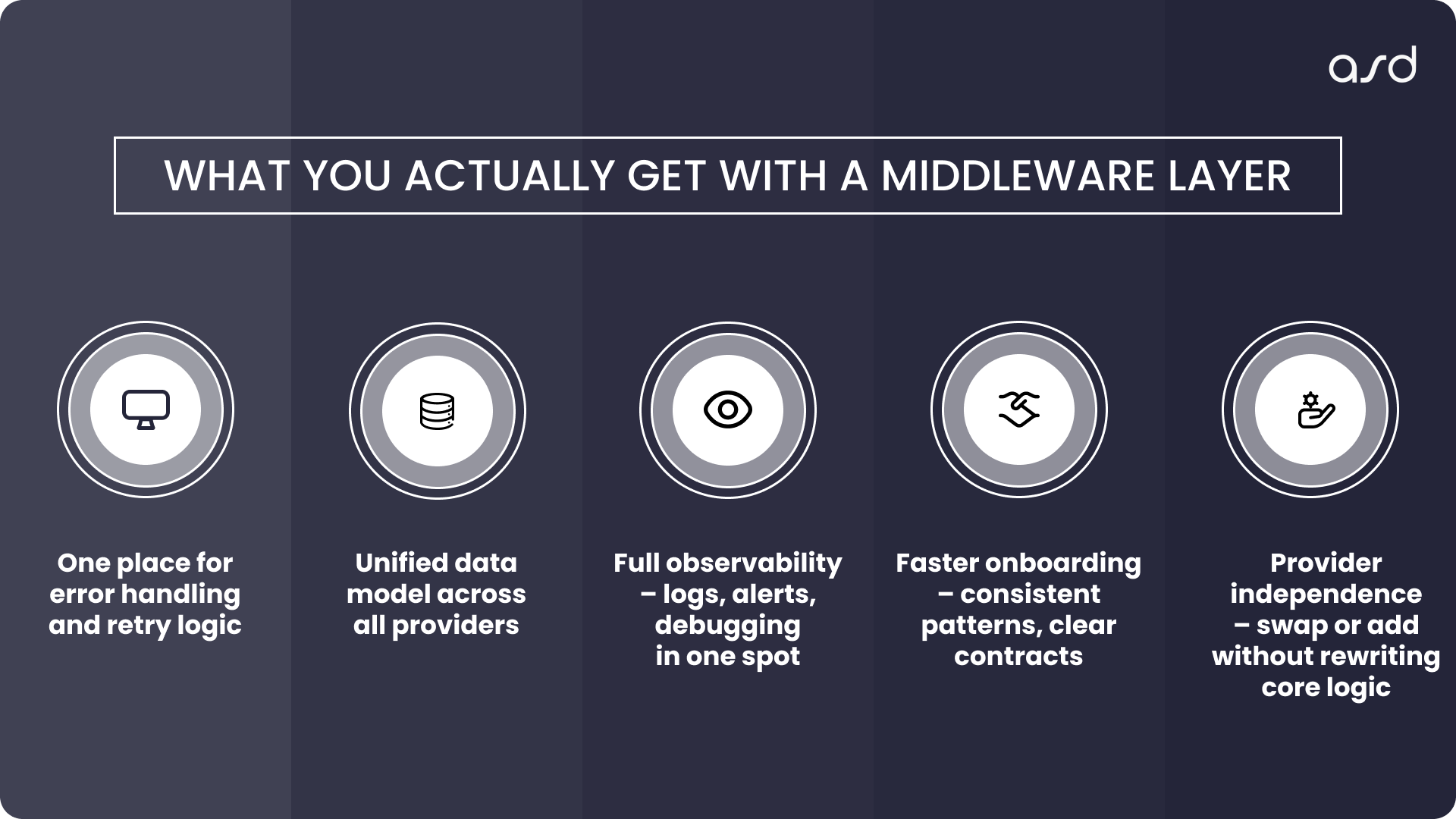
The architectural benefits of middleware integration compound over time. Here’s what you actually gain:
- Centralized Error Handling and Retry Logic
Instead of every integration implementing its own approach to failed requests, the middleware handles retries, backoff strategies, and circuit breakers in one place. When something breaks, you fix it once.
- Unified Data Models
Different APIs return data in different formats. Middleware normalizes these into a consistent internal schema, so your application logic doesn’t need to know whether a “customer” is coming from Salesforce, HubSpot, or a custom CRM. Middleware knows how to integrate multiple APIs without those moving parts turning into a maintenance burden.
- Observability and Debugging
With all integration traffic flowing through a central layer, you get a single place to add logging, monitoring, and alerting. Debugging an integration issue stops being a codebase-wide investigation.
- Easier Onboarding and Team Scaling
When integrations follow a consistent pattern, new engineers can understand and contribute to them faster. There’s a clear contract between the application and the integration layer.
- Provider Independence
Switching from one provider to another – or supporting multiple providers simultaneously – becomes a configuration change rather than a code rewrite.
This provider independence is especially relevant in microservices architectures and microservices middleware, where individual services need to communicate across boundaries without creating tight dependencies.
Stop Patching. Start Scaling
See how middleware integration fits your current architecture.
Let’s talk
Common Middleware Mistakes That Slow Down Your Integration Strategy
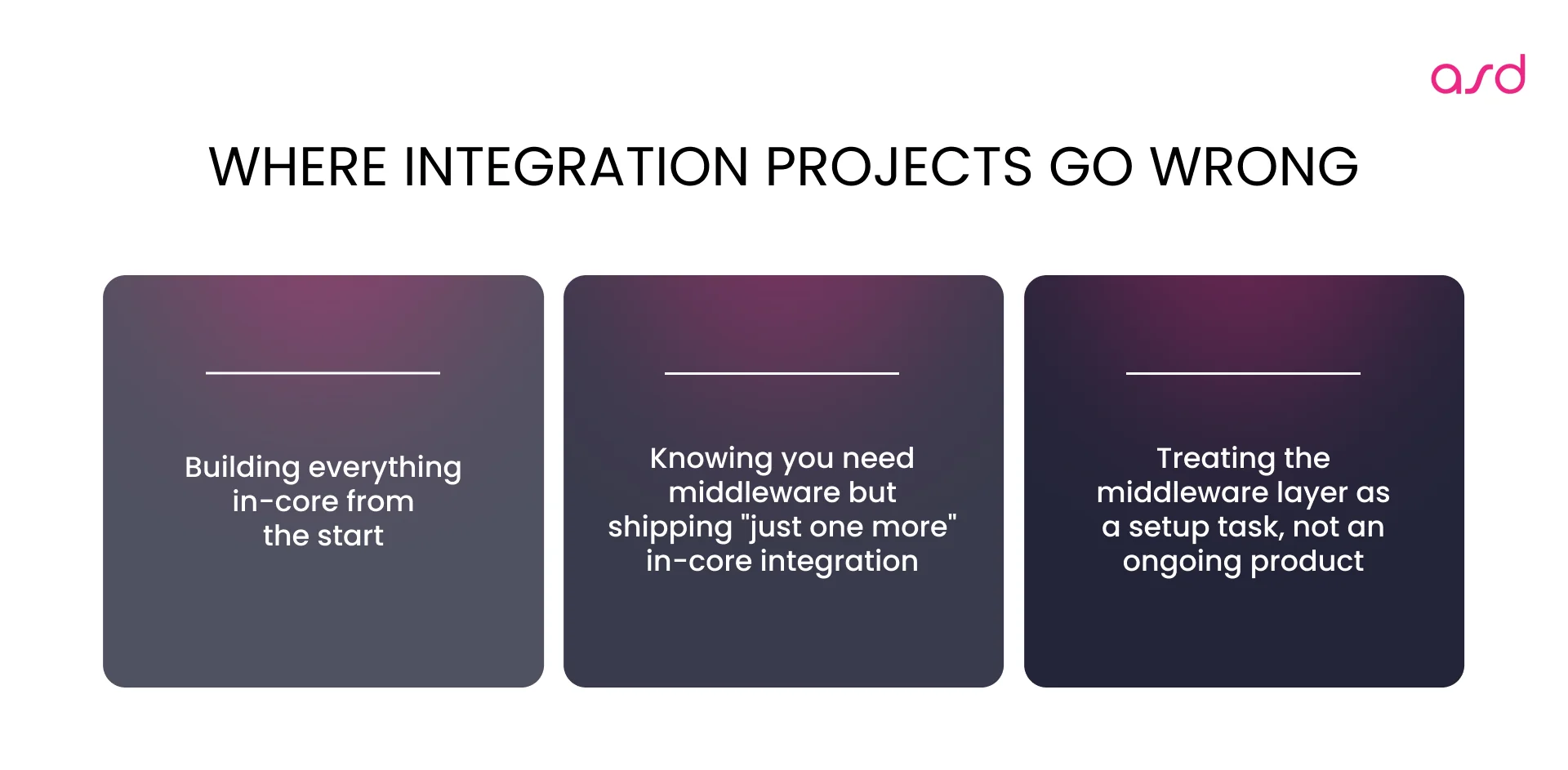
- Building Everything In-Core From the Start
This works until it doesn’t. The problem is that by the time you realize you need a different approach, you’ve accumulated enough in-core integration debt that migrating is a major project. If your roadmap already includes more than a handful of integrations, design for middleware from the beginning.
- Waiting Too Long to Introduce Middleware
The flip side: teams often know they need a middleware layer but delay the decision because it feels like a distraction from shipping features. The longer you wait, the more integrations you’ll need to migrate, and the harder the transition becomes.
A practical approach: introduce the middleware layer when you’re building your third or fourth integration, before the pattern is fully entrenched. The migration cost is much lower, and you’ll immediately start benefiting from the new architecture.
- Treating Middleware as a One-Time Setup
Middleware integration isn’t infrastructure you build once and forget. It needs to evolve as your product grows: new providers, new data models, new reliability requirements. Plan for ongoing ownership, not just initial implementation.
Travel and Booking APIs: Сonnectivity Landscape

Most integration problems aren’t really integration problems – they’re architecture problems that show up as integration symptoms. Slow deployments, recurring incidents, fragile codebase, stalled roadmaps.
The choice between in-core and middleware integration is ultimately a choice about where you want to invest your engineering capacity. In-core gets you moving fast; middleware keeps you moving fast as you scale.
The right time to make that shift is earlier than most teams think.
ASD Team helps SaaS and B2B products design and implement middleware integration strategies that scale – without rebuilding everything from scratch. Whether you’re planning your next integration or dealing with the fallout from a dozen in-core ones, explore our API integration services or reach out directly to discuss your situation. Explore our API integration services or reach out directly to discuss your integration challenges.
What is middleware integration, and how is it different from a regular API integration?
A regular API integration connects your application directly to a third-party service – the logic lives inside your codebase and your app talks to the external API directly. Middleware integration introduces a separate layer between your application and external services. That layer handles the communication: authentication, data transformation, error handling, retries, and routing. Your application only talks to the middleware; the middleware handles everything else. The result is that your core product stays clean and decoupled from the specifics of any individual provider.
When should I switch to middleware?
There’s no single rule, but a practical signal is when you’re building your third or fourth integration and already feeling friction – recurring maintenance issues, inconsistent error handling, or engineers reluctant to touch integration code. At that point, the cost of introducing a middleware layer is still manageable, and the benefit compounds immediately. Waiting until you have ten or fifteen in-core integrations makes the migration significantly harder and more disruptive.
What are the main types of middleware used for application integration?
The most common types include API gateways (which handle routing, authentication, and rate limiting), message brokers and event buses (which manage asynchronous data flows between services), integration platforms or orchestration layers (which coordinate multi-step workflows across multiple providers), and unified API layers (which normalize data from different sources into a consistent internal schema). The right choice depends on your architecture – many products use a combination of these as they scale.
Does middleware integration slow down development in the short term?
It can add some upfront overhead – you’re designing an abstraction layer rather than just wiring up a single API directly. But this is largely a one-time cost. Once the middleware layer is in place, each subsequent integration is faster to add, easier to test, and cheaper to maintain. Teams that invest early in middleware infrastructure consistently report that the per-integration cost drops significantly over time, while in-core approaches tend to get slower and more expensive with each addition.
Can middleware integration help with enterprise API compliance and security requirements?
Yes – this is one of its most practical advantages for B2B and enterprise products. Because all external API traffic passes through a centralized layer, it’s far easier to enforce consistent security policies: authentication standards, data masking, audit logging, and access controls. Compliance requirements (such as GDPR data handling or SOC 2 audit trails) can be addressed in one place rather than scattered across every individual integration. For products serving enterprise customers with strict security requirements, the middleware layer often becomes an essential part of the compliance story.
Will moving to middleware actually reduce bugs and incidents?
In most cases, yes – and meaningfully so. The majority of integration-related incidents come from the same root causes: inconsistent error handling, no retry logic, and zero visibility into what failed and why. When those concerns are scattered across in-core integrations, every fix is a one-off. Middleware centralises all of it, so a single improvement – better retry strategy, smarter circuit breakers, unified logging – applies across every integration at once. Teams that make the switch typically see fewer on-call escalations, faster root cause analysis, and a significant drop in the kind of silent failures that only surface when a customer complains. If you want to understand the scope of work before committing, a free estimation can give you a realistic picture of what the transition involves for your specific setup.
How long does it realistically take to move to a middleware-based approach?
Typically, it takes 3–9 months, but it depends on how many in-core integrations you’re migrating, how deeply they’re embedded in your codebase, and what your target architecture looks like. A product with three to five integrations and reasonably clean code can typically complete the transition in four to eight weeks. A larger system with ten or more tightly coupled integrations, legacy dependencies, or custom data models will take longer – often three to nine months for a full migration done without disrupting production. The good news is you don’t have to do it all at once. Most teams introduce the middleware layer incrementally, migrating one integration at a time while new ones are built the right way from the start. For a breakdown of timelines by project type, see our article on how long API integration takes.
We’re building a new product, should we start with an API-first approach from day one?
If you know integrations will be a core part of your product, and for most SaaS and B2B products, they will be, then yes, designing API-first from the start saves significant rework later. An API-first approach means treating your integration layer as a product decision, not a technical detail to figure out later. You define the contracts, the data models, and the boundaries upfront, which makes it much easier to add middleware infrastructure as you scale. Starting in-core isn’t wrong, but starting without any architecture in mind is. Our API integration services team can help you design the right foundation before you write the first line of integration code.
Show more


Related Articles:

API Integration Best Practices: Processes and Approaches
19 mins
•
24 Apr 2025

How Long Does an API Integration Take? The Complete Guide
12 mins
•
13 Apr 2025

How to Build a Software Product from Scratch?
17 mins
•
17 Mar 2025
We use cookies to personalize our services and improve your experience on this website. We may use certain personal data for analytics and marketing purposes.
Let’s Talk
Fill out the form to schedule a 30-minute call, where we’ll discuss your project requirements and explore the best solutions for your needs.
Free Consultation