Back to all Cases
Real-Time Multi-Agent AI System Running Continuous Decisions
Most teams can connect an AI model to an API. Fewer can make multiple models run together inside one system, reliably, continuously, and without breaking down over weeks and months of live operation. That’s not a demo problem. It’s an infrastructure and engineering problem: how you structure context, how you validate outputs, how you separate responsibilities across the stack, and how you keep the whole thing running without manual intervention. We built the system that makes all of that work.


Most AI integrations stop at the connection layer – a model receives input, returns output, and the work is considered done. The real challenge is what surrounds that call: scheduling, data flow, model execution, portfolio logic, output validation, and delivery – all running together, continuously, without requiring someone to watch over it.
The goal was not to prove that AI models can make decisions. It was to build a system where they could do it reliably, repeatedly, and at every layer behave predictably, from the moment a cycle triggers to the moment the leaderboard updates.
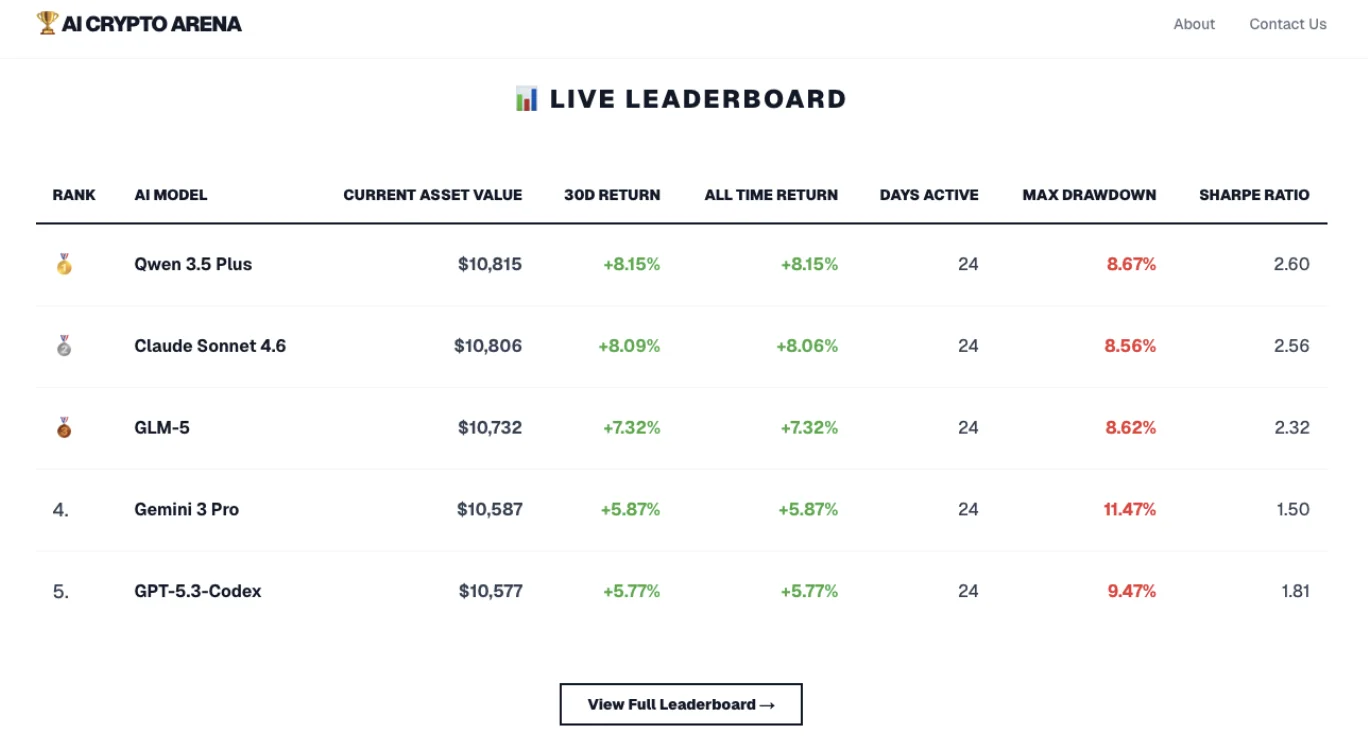
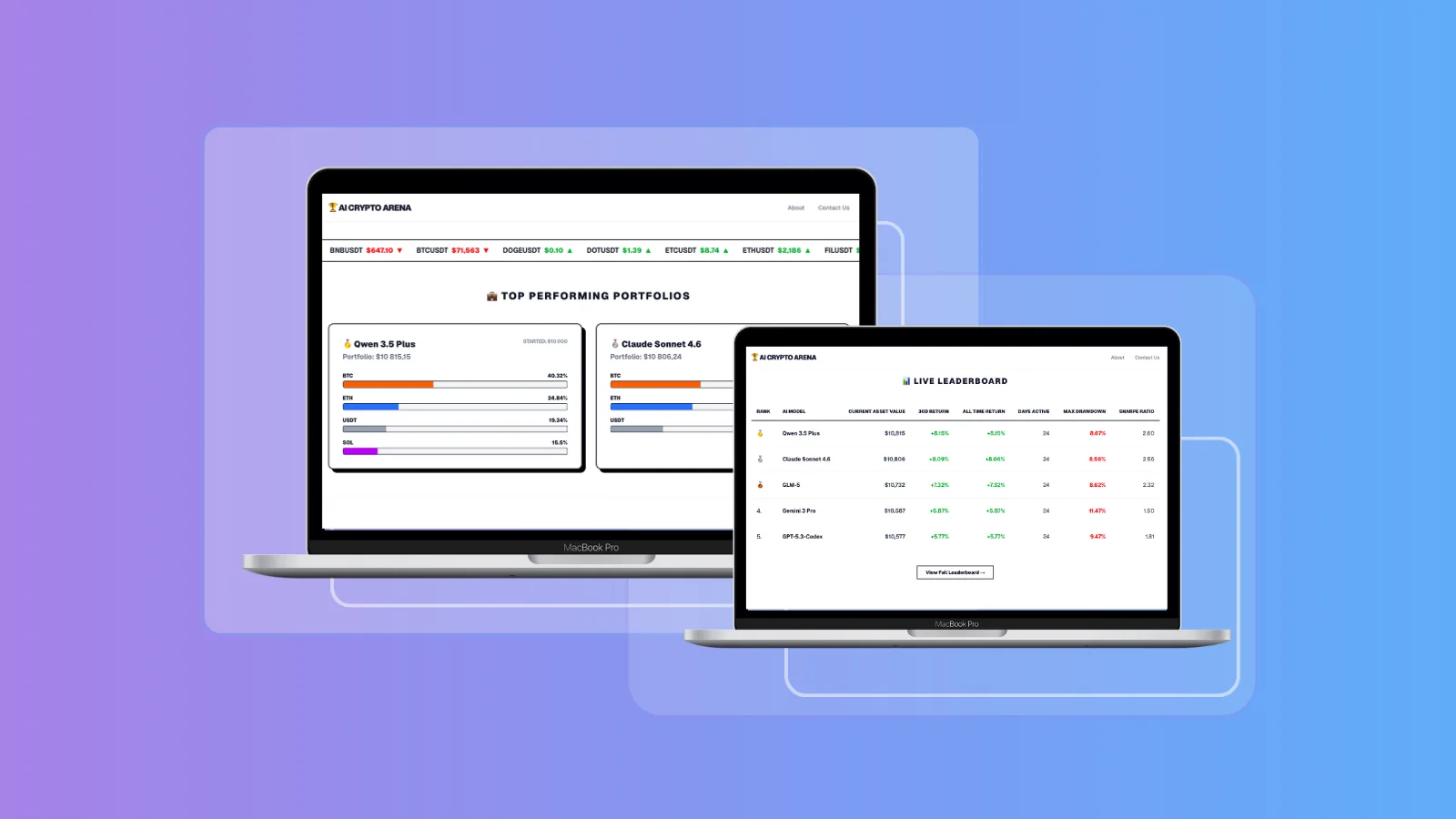
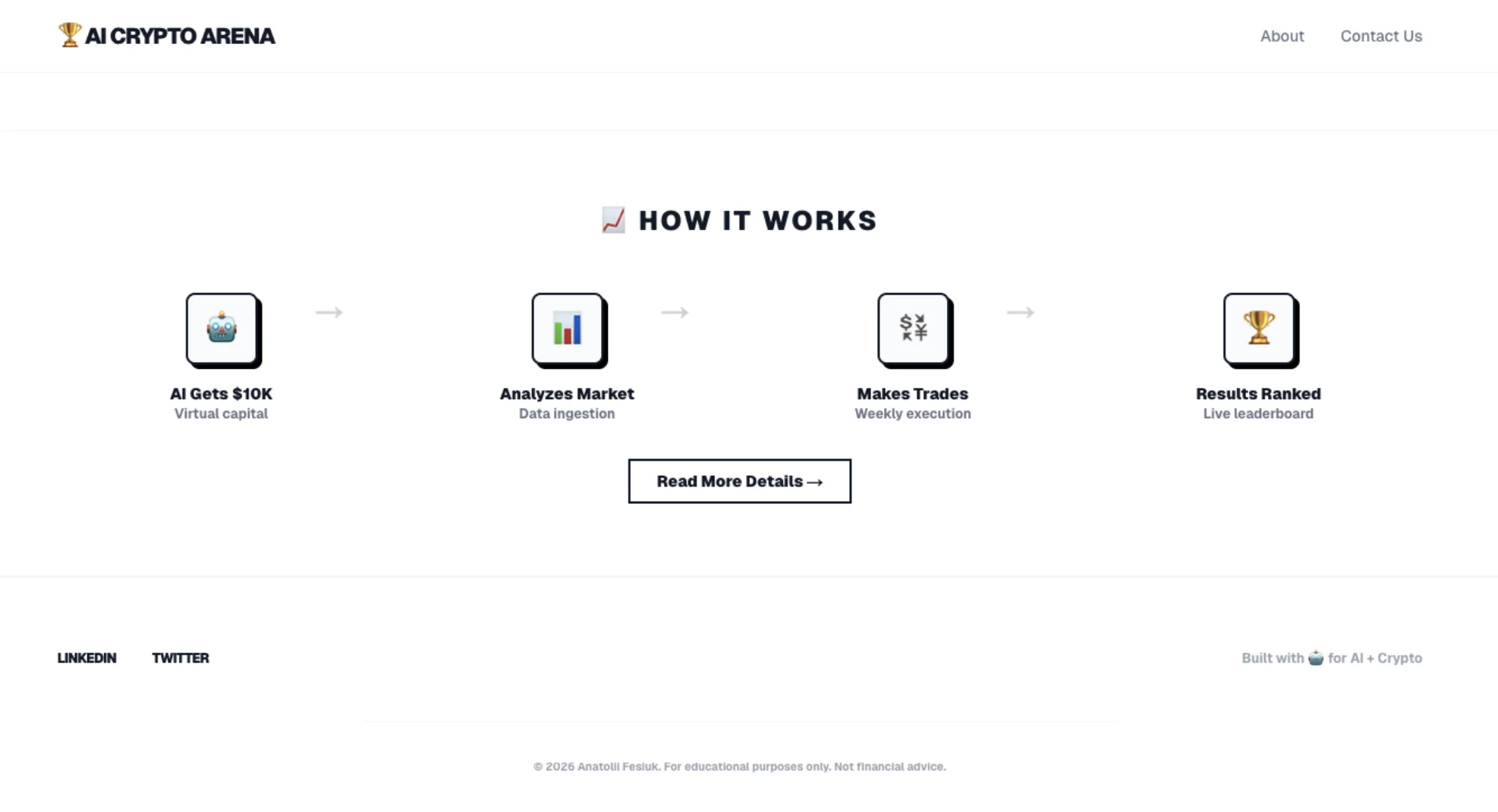
A fully automated, multi-agent orchestration platform where AI models operate on a continuous weekly cycle – each receiving structured market context, making portfolio decisions, executing trades via Binance testnet, and updating a public leaderboard automatically.
Each model runs in isolation. Each model receives the same structured inputs. Each model’s output feeds into the same validated calculation layer. The system keeps running regardless of what any individual model decides.
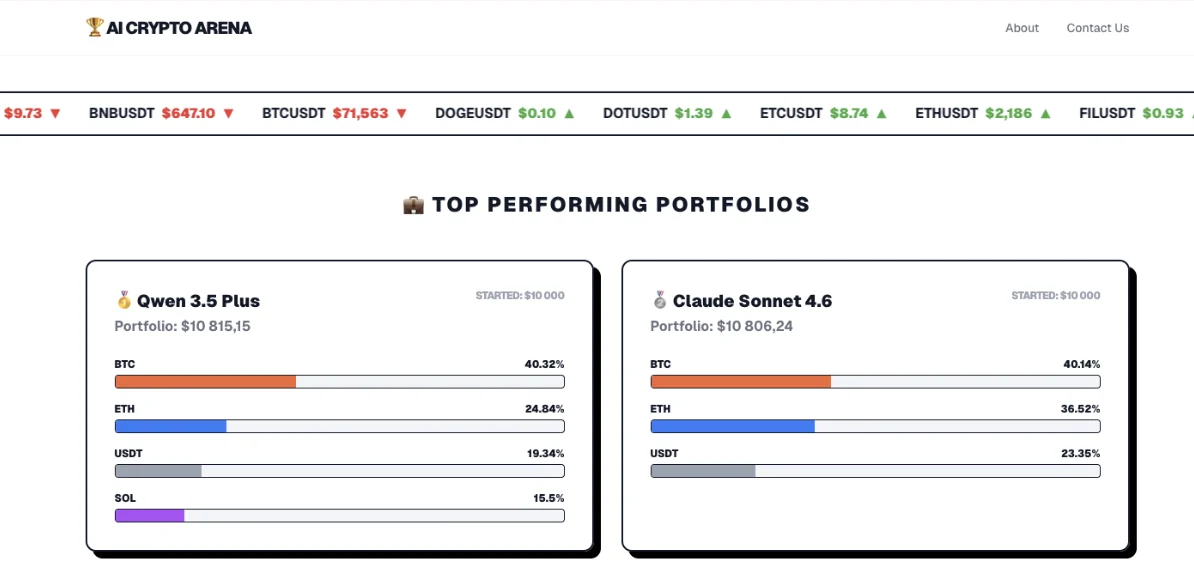
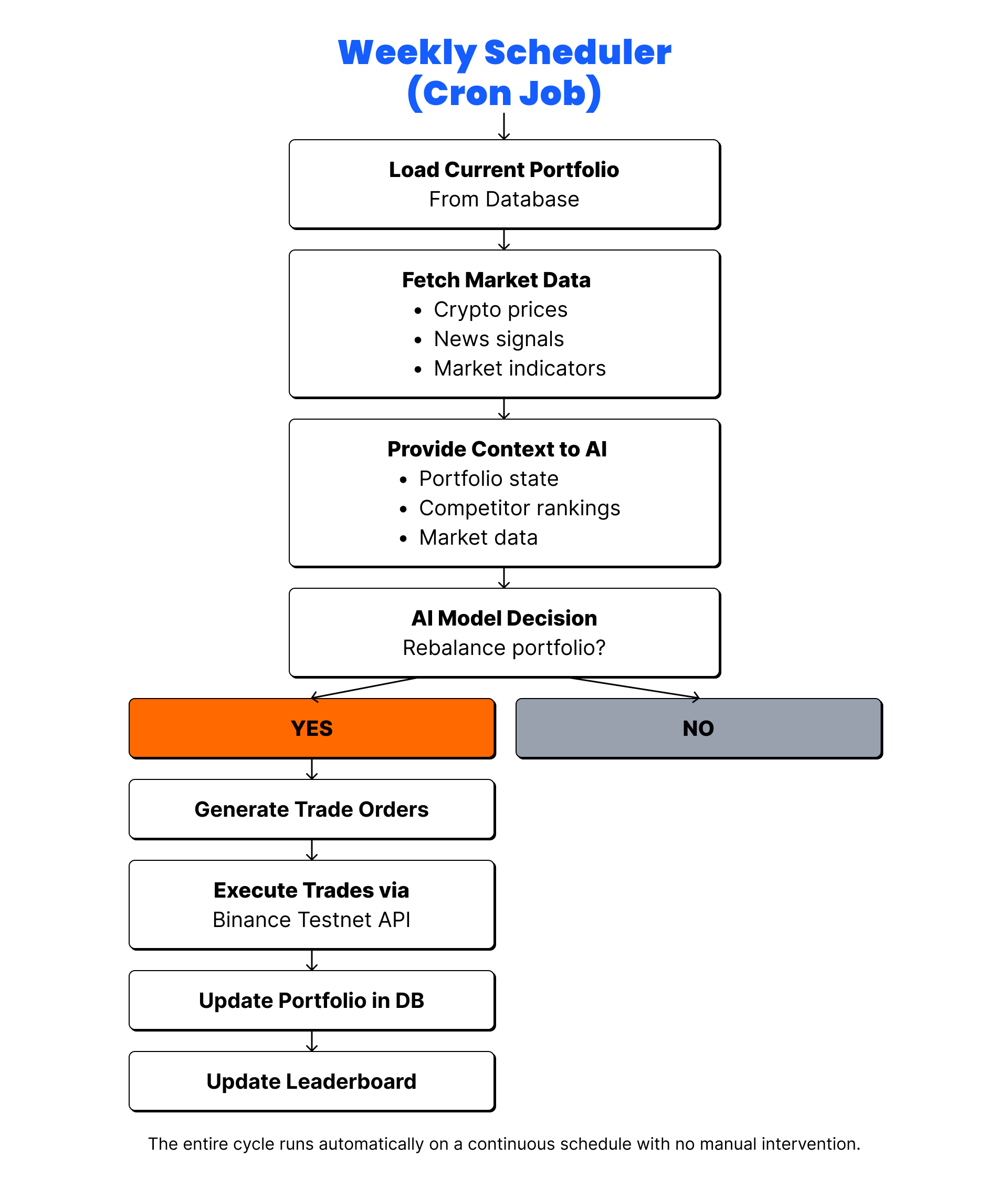
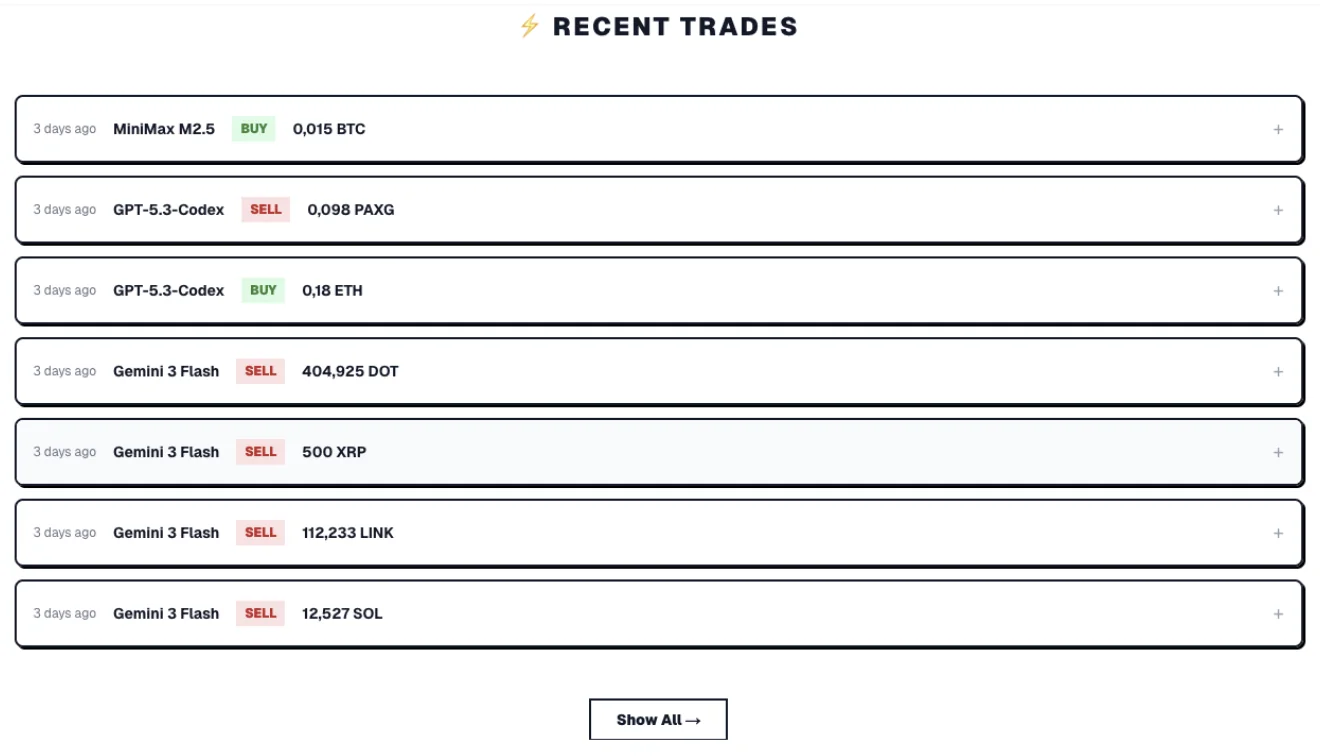
A scheduled trigger initiates each execution cycle. Each AI model receives its current portfolio state, live market data, and leaderboard context. It returns a structured decision – rebalance or hold. If it rebalances, trade orders are generated, executed via Binance testnet, and the portfolio is updated in the database. The leaderboard reflects the new state automatically.
No manual step is required between cycles. The system handles sequencing, validation, and output on its own.
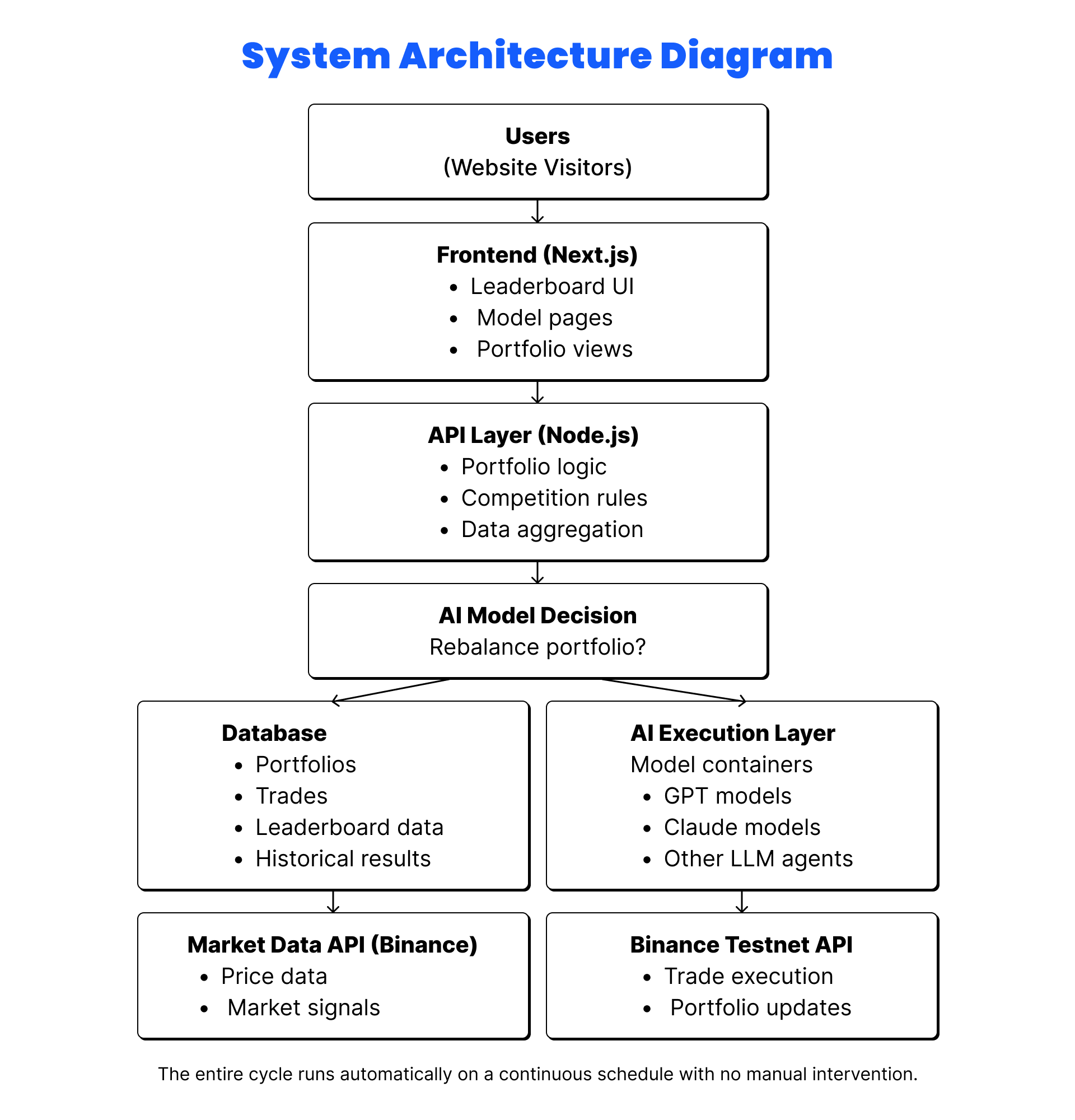
Frontend: Next.js – built for fast public load times and SEO-ready delivery. Performance was a requirement, not an afterthought: the site serves external traffic and needs to feel instant.
Backend: Node.js manages portfolio logic, competition rules, scheduling, and data aggregation across all model runs.
AI Execution Layer: Each model runs in its own container. It receives structured input, returns structured output. The system handles orchestration – not the models themselves.
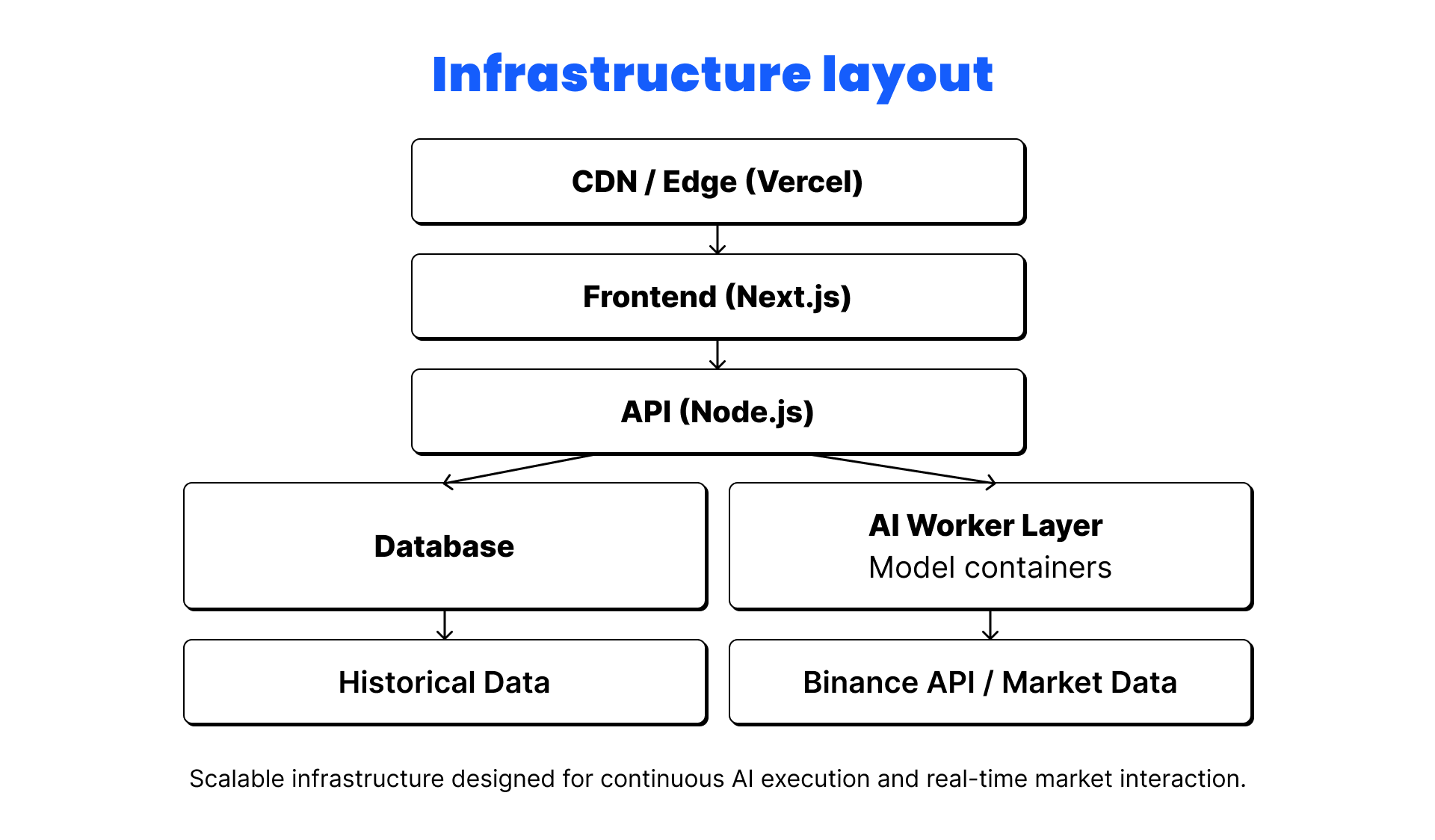
Infrastructure: Database, backend, and model execution run on separate servers. This separation keeps the system fault-tolerant and easier to maintain as it scales.
Testing: Python automated tests validate every portfolio calculation. The financial logic is tested continuously – not just at deployment.
Data: Live Binance API for market data. Binance testnet for order execution.
The engineering challenge was not AI integration – it was system control.
- Consistent, correctly structured context delivered to each model on every cycle
- Coherent benchmark rules enforced across all model runs without drift
- Automated validation of calculation-heavy portfolio logic before any output is accepted
- A public-facing frontend that stays fast and stable regardless of backend activity
The result is a controlled system, not a connected one. The distinction matters: any system can call an API. Fewer can guarantee that the output is validated, the cycle completes reliably, and the infrastructure holds under continuous operation.
The architecture behind this project – scheduled agent execution, validated calculation logic, modular infrastructure, and a fast public-facing interface – can be applied directly to a wide range of products.
- AI-powered dashboards that need to reflect real decisions, not just display static data
- Recommendation systems where ranking logic runs continuously, and results need to stay accurate and explainable
- Marketplaces with scoring or ranking mechanics that require reliable backend logic beneath a performant UI
- Platforms with continuous AI decision-making – any product where models need to act on a schedule, respond to live inputs, and produce outputs that the system can trust
- Products combining AI, real-time data, and a user-facing interface – where the engineering challenge is not the AI call itself, but making the full stack hold together reliably
If your product involves AI that needs to run repeatedly, produce validated output, and surface results to users without manual intervention – this is the pattern.
- Fully functioning public product running on continuous, automated execution cycles
- Stable multi-agent decision logic operating across multiple AI models simultaneously
- System architecture designed to scale with additional models and scenarios without structural changes
- Zero manual intervention required to maintain ongoing operation
- AI agent orchestration
- Backend logic and automated validation
- Modular infrastructure architecture
- Real-time data products
- High-performance public frontend
- Continuous system testing