
Table of Content
- Why the Right Partner Is Hard to Find
- Travel API Specialist vs. General Dev Shop
- 5 Criteria for Choosing a Vendor
- 8 Companies Worth Evaluating
- How to Make the Final Decision
Let's integrate Travel APIs?
Book a callYou need to choose a company with experience in travel tech. Not every dev shop understands travel API logic. The right travel API integration company knows how OTA availability works, how booking flows break, and how to stabilize what you have – not just add more connections. This guide covers what to look for and who is worth evaluating.
But first, here is the short but insightful comparison table:
| Company | Specialty | Best for |
| ASD Team | Travel API integration, multi-API stabilization, project rescue | Hospitality and travel founders with broken or scaling integrations |
| GP Solutions | GDS integrations, tour operator systems, 25+ years in travel | Travel agencies and OTAs need GDS connectivity |
| Onix Systems | Hospitality and transportation API integrations, full-cycle dev | Mid-size travel products needing an end-to-end partner |
| DataArt | Enterprise travel systems, large-scale API architecture | Enterprise OTAs and airlines at a significant scale |
| Intellectsoft | Booking systems, mobile + backend integration | Products needing mobile and backend under one team |
| Railsware | Product design + integration architecture combined | Early-stage travel products building from scratch |
| Relevant Software | Hospitality and booking platform development | Startups needing a dedicated team with travel exposure |
| Mobilunity | Staff augmentation, dedicated travel-experienced developers | Teams that need integration capacity, not a full agency |
Why Finding the Right Travel API Integration Partner Is Harder Than It Looks
You have a live travel platform. Bookings are coming in – or they were, until something broke. Availability is showing incorrectly. A recent release caused pricing to stop syncing. Or you need to connect three more OTAs, and the last integration took six weeks and still isn’t stable.
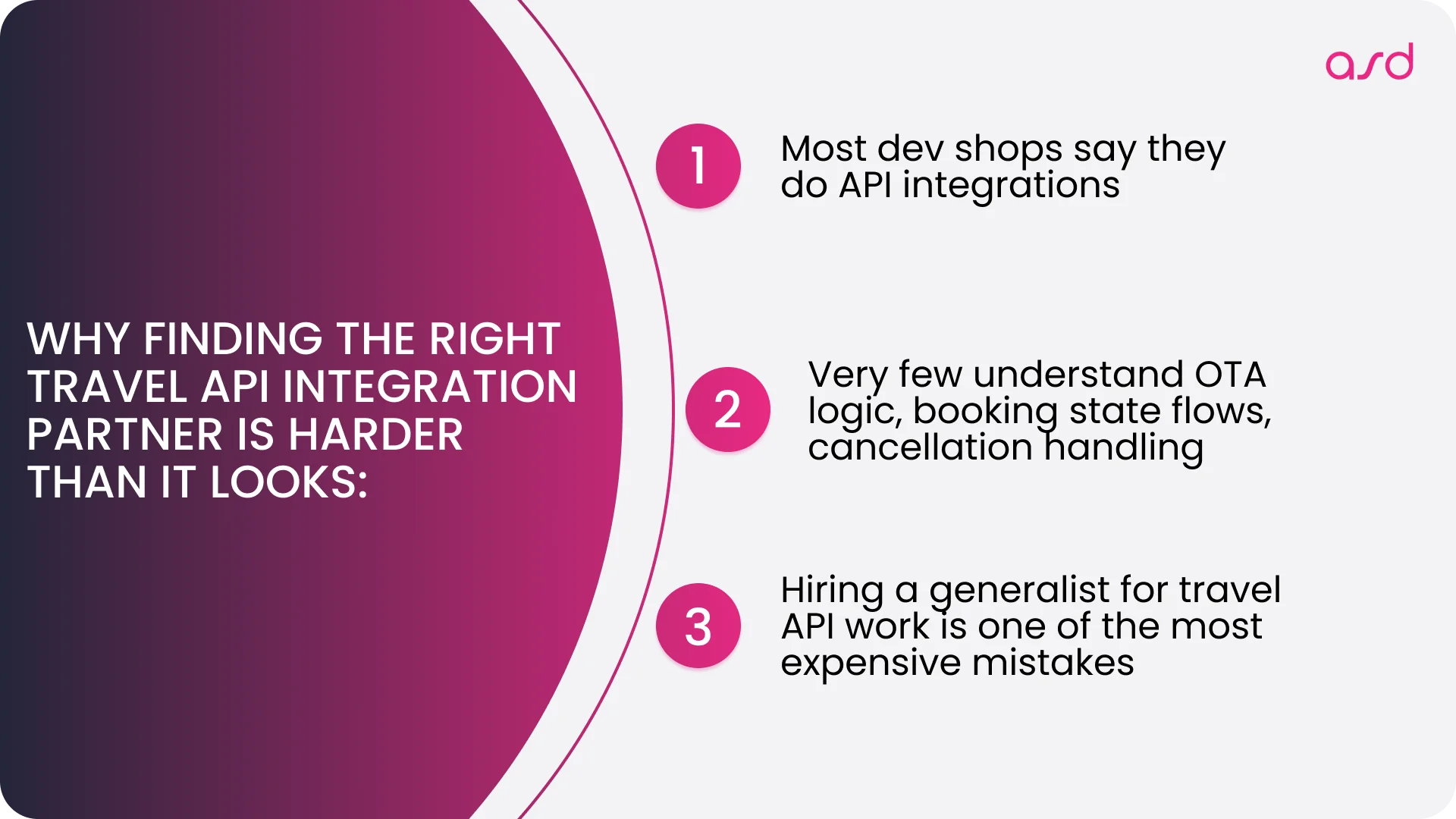
You search for a development company. Most of them say they do API integrations. Very few of them understand what it actually means to integrate with Booking.com, SiteMinder, or Amadeus – the specific failure modes, the rate limit behavior, the booking state logic, the cancellation flows that vary by provider.
Hiring a generalist team for travel API work is one of the most common and expensive mistakes product owners make. They underestimate the complexity, build something that works in demo, and hand it over – leaving you to debug it in production.
This guide covers what separates a real travel API integration company from a generic dev shop, five criteria for evaluating vendors, and a shortlist of companies worth considering.
What Makes a Travel API Integration Company Different From a General Dev Shop?
Travel APIs are not generic REST connections. They carry domain-specific logic that a team without travel experience will consistently underestimate, and they demand API-first approach:
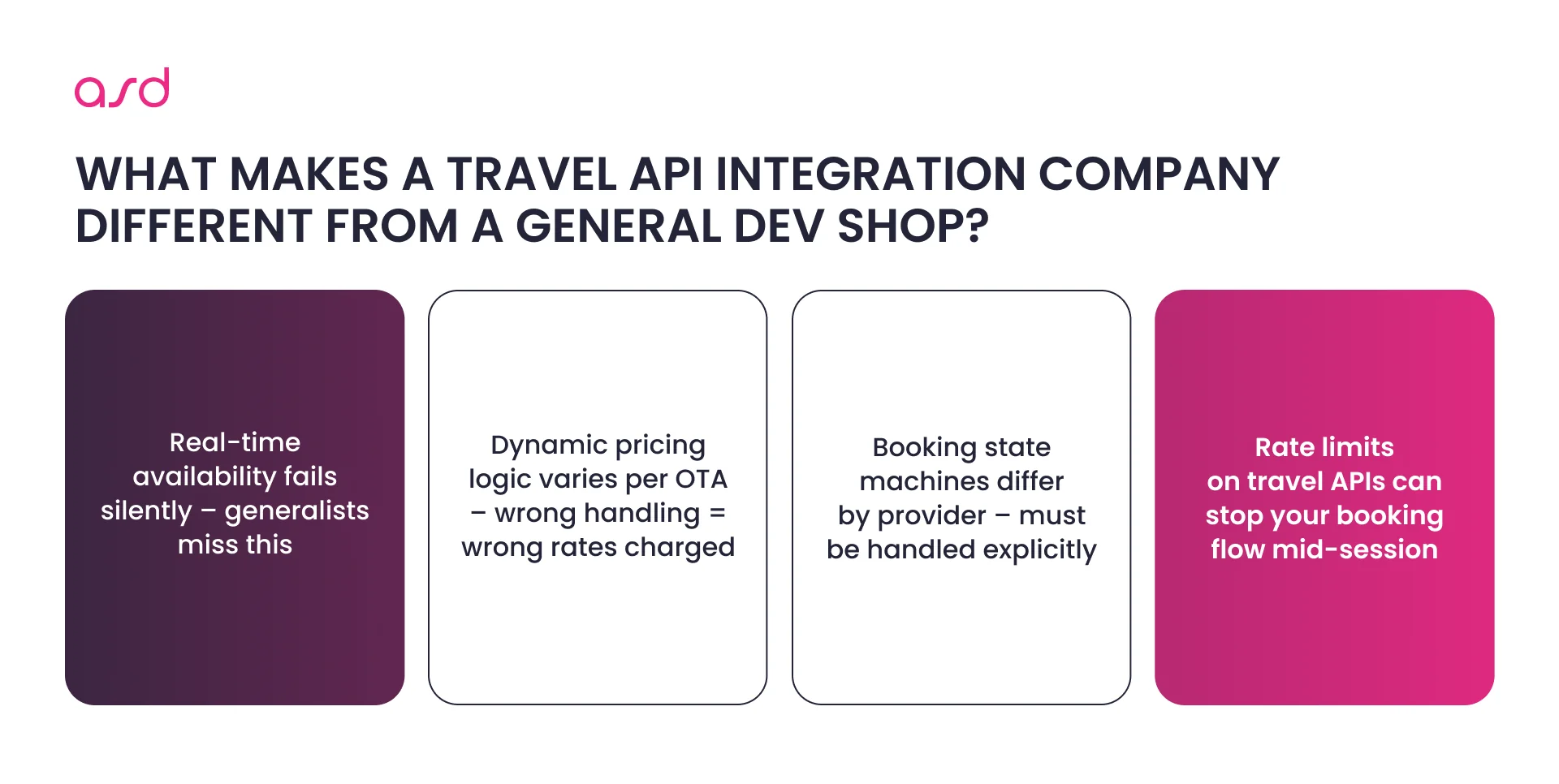
- Real-time availability means a booking can be made and confirmed in seconds – or fail silently if the sync isn’t handled correctly
- Dynamic pricing from OTAs changes based on demand, dates, and availability – a product that caches prices incorrectly will show rates that don’t match what users get charged
- Booking state machines have specific transitions – confirmed, pending, cancelled, modified – that vary by provider and must be handled explicitly
- Cancellation and modification flows differ across GDS, OTA, and PMS connections and are a common source of data conflicts
- Rate limits and quota behavior on travel APIs are strict – exceeding them can stop your booking flow mid-session
A team that has integrated SiteMinder, Amadeus, or Expedia before knows where these systems break. A team that hasn’t will spend weeks discovering problems you could have avoided.
5 Criteria for Choosing a Travel API Integration Company
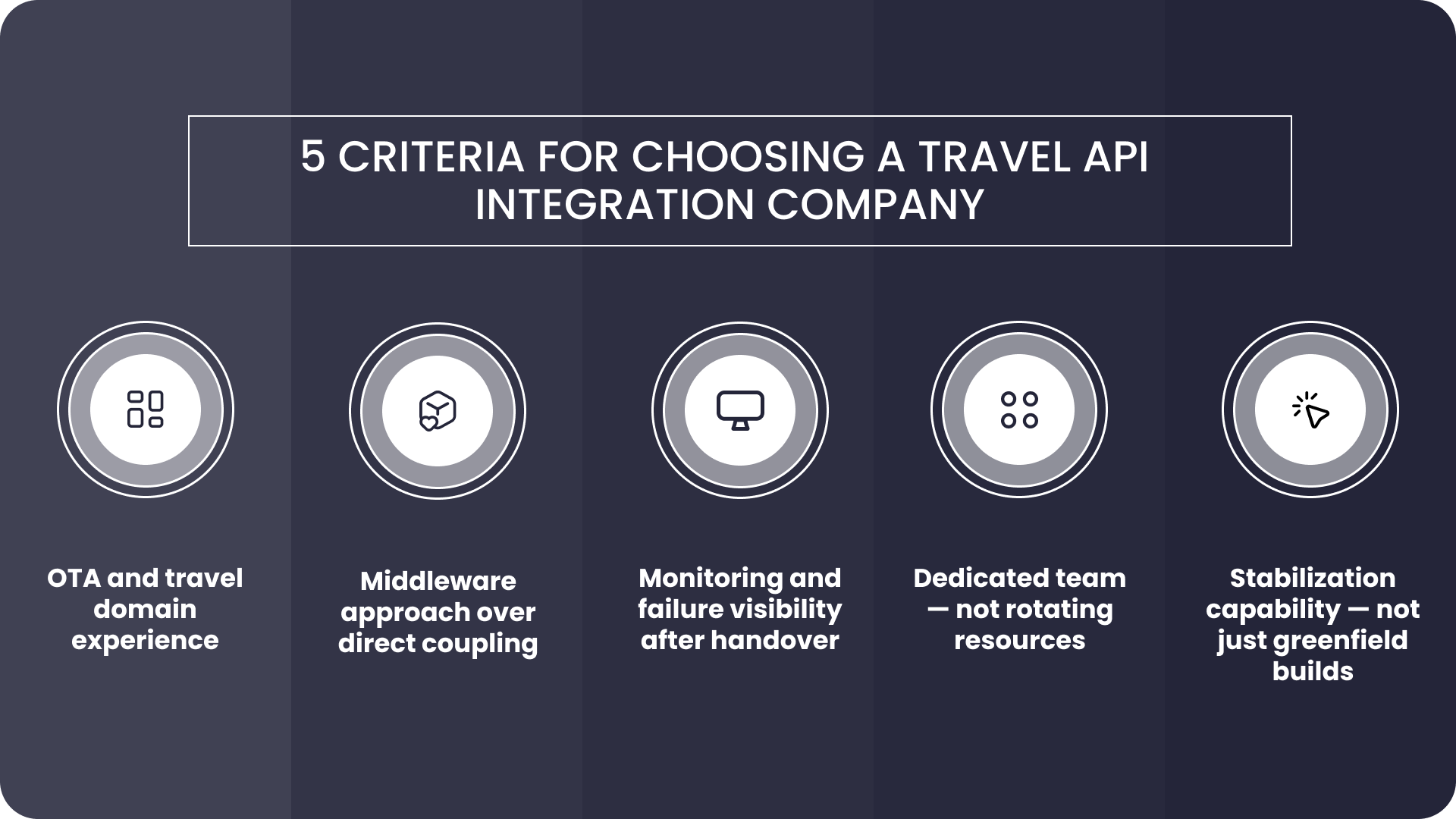
1. Proven OTA and travel domain experience
Ask specifically: which travel APIs have they integrated? Booking.com, Expedia, SiteMinder, Amadeus, Sabre, Airbnb, RateGain? Can they describe the failure modes they’ve encountered? Domain experience is not a bonus – it is the baseline for travel integration work.
2. Middleware approach over direct coupling
Does the company build a shared integration layer – one place where all external APIs connect to your product – or do they bolt each API directly onto your codebase? Direct coupling is faster to start and consistently harder to maintain. Every new OTA you add compounds the instability. A middleware-first approach protects your core product from external API changes.
3. Monitoring and failure visibility
What happens when an integration silently fails after handover? Do they set up monitoring per integration – alerts on availability sync failures, booking confirmation errors, pricing mismatches? Or do they hand over working code with no visibility into what breaks in production?
4. Dedicated team model
Travel integrations require context. A team that rotates resources between projects loses that context – and you spend time re-explaining your booking logic every few weeks. Look for companies that assign a dedicated team to your project for the duration.
5. Stabilization capability
Can they take over a broken integration from a previous team and fix it without a full rebuild? This is a specific skill – reading unfamiliar codebases, mapping existing integration logic, identifying what is salvageable. Not every company does this well, and many prefer greenfield work.
Not Sure Which Integration Approach Is Right for Your Product?
Tell us what you're building, we'll map the risks and suggest the right setup.
Get a consultation
8 Travel API Integration Companies Worth Evaluating
ASD Team
A dedicated software development company, with 18+ years of experience, specializing in API integration architecture for travel and hospitality products, with hands-on experience in OTA connections, channel manager integrations, and multi-API stabilization.
- Deep travel domain experience across booking platforms, PMS systems, and OTA connections, including SiteMinder
- Builds shared integration layers rather than direct API coupling – protects product stability as integrations grow
- Takes on project rescues and stabilization work, not just greenfield builds
Best for: Travel and hospitality founders who need a stable multi-API architecture, are dealing with broken integrations from a previous team, or are building a direct booking product on top of multiple providers.
Not sure where your integrations are breaking? We review your current setup, map the risks, and define the fastest path to stability.
Special Offer · Integration Stability Review
$2,500 → Free
Your integrations are live,
but you don't trust them
We diagnose why your integration layer is fragile, what's creating business risk, and what to fix first. You get a clear map and roadmap – not a list of opinions.
5–10 working days
Fixed scope
No commitment
Free integrations stability Audit
Tell us what's breaking.
We'll get back within 1 working day with next steps and a calendar slot.
Request received
Thanks — we've got it.
GP Solutions
A travel technology company with over 25 years of experience focused exclusively on the travel industry, covering GDS, OTA, and tour operator systems.
- Long track record with GDS integrations – Amadeus, Sabre, Travelport – and travel-specific middleware
- Strong domain knowledge in tour operator and travel agency platform development
- Wide range of travel verticals: flights, hotels, transfers, packages
Best for: Travel agencies, tour operators, and OTA platforms that need GDS connectivity and complex travel inventory management.
Onix Systems
A software development company with a travel and hospitality practice covering API integrations, booking platform development, and mobile applications.
- Experience with travel API integrations across hospitality and transportation verticals
- Full-cycle development from discovery to post-launch support
- Flexible engagement models for different project sizes
Best for: Mid-size travel and hospitality products looking for a full-cycle development partner with travel domain exposure.
Travel and Booking APIs: Сonnectivity Landscape

DataArt
A global technology consultancy with a dedicated travel practice, working with major players across airlines, hospitality, OTAs, and travel tech.
- Enterprise-level experience with complex travel systems and large-scale API integrations
- Strong consulting and architecture capabilities for products at significant scale
- Works with globally recognized travel brands
Best for: Enterprise travel companies and large OTAs that need a consultancy-level partner for complex, high-volume integration architecture.
Intellectsoft
A software development company with travel and hospitality as a named vertical, covering booking systems, API integrations, and mobile platforms.
- Travel and hospitality project experience across booking, property management, and loyalty systems
- Strong mobile development capability alongside backend integration work
- Works across startup and enterprise project sizes
Best for: Travel products that need both mobile and backend integration work under one team.
Railsware
A product development company with experience building travel tech products and integrations, known for a strong product thinking approach alongside technical delivery.
- Product-first approach – combines UX and architecture thinking with integration work
- Experience with travel booking flows and third-party API connections
- Smaller, selective team model with high involvement per project
Best for: Early-stage travel products where product design and integration architecture need to be developed together.
Relevant Software
A Ukrainian software development company with a travel and hospitality vertical covering API integrations, booking platforms, and custom travel product development.
- Travel domain experience across hospitality, transportation, and booking platforms
- Full-cycle development with a dedicated team model
- Strong React and Node.js stack commonly used in travel tech
Best for: Startups and growing travel products looking for a dedicated development team with travel domain exposure.
Mobilunity
A dedicated development team provider with travel and hospitality among its verticals, offering staff augmentation and dedicated team models.
- Flexible staffing model – augment your existing team with travel-experienced developers
- Cost-effective option for teams that need integration capacity without a full agency engagement
- Travel and hospitality client experience across booking and property systems
Best for: Product teams that already have technical leadership in place and need to add integration capacity quickly.
How to Make the Final Decision
Shortlisting companies is straightforward. Making the right call is harder.
Before signing with any travel API integration company, get specific answers to these questions:
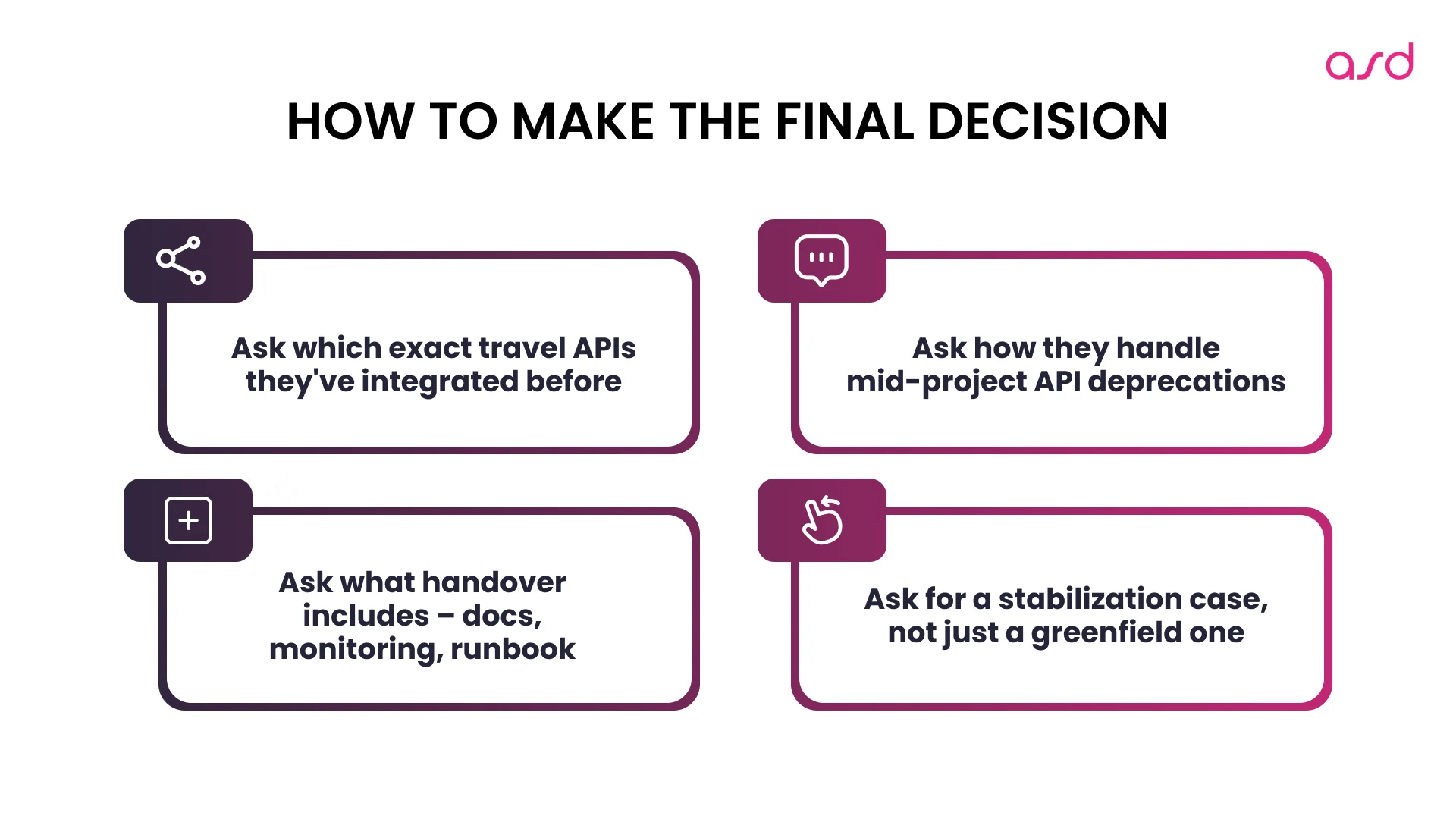
- Which exact travel APIs have you integrated before – and what problems did you run into?
- How do you handle a provider that changes its API or deprecates an endpoint mid-project?
- What does your handover include – documentation, monitoring setup, runbook for common failures?
- Can you show a case where you stabilized an existing integration rather than built from scratch?
The answers will tell you more than any case study page.
If your product already has integrations that are unstable, pricing that goes out of sync, or releases that keep breaking booking flows – start with an [integration audit] before committing to a full development engagement. It gives you a clear picture of what needs fixing and what can stay as-is.
ASD Team is a travel API integration company specializing in booking platforms, OTA connections, and multi-API stabilization for travel and hospitality products.
Integration breaking things? We review your travel API setup, identify what's unstable, and define the safest path to fix it, without breaking what already works.
 Pavlo Boiko
CEO
Pavlo Boiko
CEO
What should I look for in a travel API integration company?
Look for proven experience with the specific APIs your product uses – OTAs, GDS, channel managers, PMS systems. Check whether they understand travel-specific logic: real-time availability, dynamic pricing, booking state flows, and cancellation handling. A generalist dev shop will underestimate this complexity and build something that works in demo but breaks under real traffic.
How long does travel API integration typically take?
A single travel API integration takes 2–6 weeks, depending on API complexity and your existing architecture. Multi-API setups with real-time sync – connecting a PMS to multiple OTAs with live availability – typically take 2–4 months for a stable, production-ready result.
How do I know if my current travel API integration is unstable?
Common signals: availability shows incorrectly, pricing doesn’t match what providers return, bookings fail silently, or releases keep breaking flows that worked before. If any of these recur, the integration layer needs a structural review – not just a bug fix.
Should I rebuild my travel integrations or stabilize what I have?
Stabilization is almost always faster and cheaper. Most travel platforms have salvageable integration logic – the problem is usually architecture, not the integrations themselves. A rebuild makes sense only when the existing codebase genuinely cannot support the business requirements going forward.
What is the difference between a GDS integration and an OTA integration?
A GDS – Amadeus, Sabre, Travelport – gives access to aggregated inventory from airlines, hotels, and car rentals through one connection. An OTA integration connects directly to a specific platform like Booking.com or Expedia. GDS integrations are more complex and typically require certification. OTA integrations are more common for hospitality-focused products.
How much does travel API integration cost?
A single integration typically starts at $5,000 (more or less). Multi-API projects with full middleware architecture range from $10,000+ (if you partnered with ASD Team, the price would include not only a dev team, but also project/product managers, and QAs).
Cost depends on the number of APIs, the complexity of booking flows, real-time sync requirements, and whether stabilization work is needed. A scoped audit before full engagement helps define the exact effort.
Can a travel API integration company take over from a previous team?
Yes – and this is one of the most common scenarios. The key is finding a company with experience in project takeovers: reading unfamiliar codebases, mapping existing integration logic, identifying what is salvageable, and stabilizing before adding anything new. Not all companies do this – many prefer greenfield work only.
Show more


Related Articles:
Middleware vs In-Core Integrations: How to Build APIs That Actually Scale
9 mins
•
13 Apr 2026
How Long Does an API Integration Take? The Complete Guide
12 mins
•
13 Apr 2025

Guide to Travel Payment Integration for Tech Startups
17 mins
•
05 Mar 2025

How to Choose a Development Partner for Your Travel Tech Project
9 mins
•
02 Mar 2025
We use cookies to personalize our services and improve your experience on this website. We may use certain personal data for analytics and marketing purposes.
Let’s Talk
Fill out the form to schedule a 30-minute call, where we’ll discuss your project requirements and explore the best solutions for your needs.
Free Consultation