
Two things to check before starting: your product’s readiness and the API’s actual behavior. Most teams only check the second one – and discover the first one in production, so, based on our experience, we decided to share with you how to prepare your product for travel API integration.
Why Pre-Integration Checks Matter More for Travel APIs Than Regular APIs
Most API integration guides treat the pre-integration phase as a brief formality – check the documentation, confirm authentication, set up credentials, start building. For most API categories, that’s roughly sufficient.
But travel APIs are different. The cost of a wrong assumption before integration starts isn’t just a broken feature or an interface bug. It’s a booking that confirms on your side but doesn’t register with the supplier. Its availability is showing as open when it isn’t. It’s a cancellation that triggers in your product but doesn’t propagate to the channel manager or PMS. It’s a payment that settles incorrectly because currency handling wasn’t checked against the API’s actual behavior. So basically it’s just a huge amount of money, potential legal liability, and reputation troubles – of course, it’s a worst-case scenario, but you still have to consider it.
Anyway, travel APIs carry layers that most API integrations don’t:
- Live inventory that changes between the moment a user searches and the moment they confirm – and your product has to handle that gap
- Booking state machines where confirmed, pending, cancelled, and modified states have specific transitions that vary by provider and must propagate correctly through your existing system
- PMS and channel manager sync that your existing product may or may not be built to handle
- Compliance requirements – PCI DSS for payment flows, data handling rules for passenger information – that don’t appear in standard API checklists
- Certification and partner approval processes for GDS and major OTA connections that add weeks to your timeline if discovered late
The pre-integration phase for a travel API isn’t a formality you can easily skip. It’s where you find out whether your existing product is actually ready for what the API will do to it.
Checklist Before Travel API Integration – Your Product Side
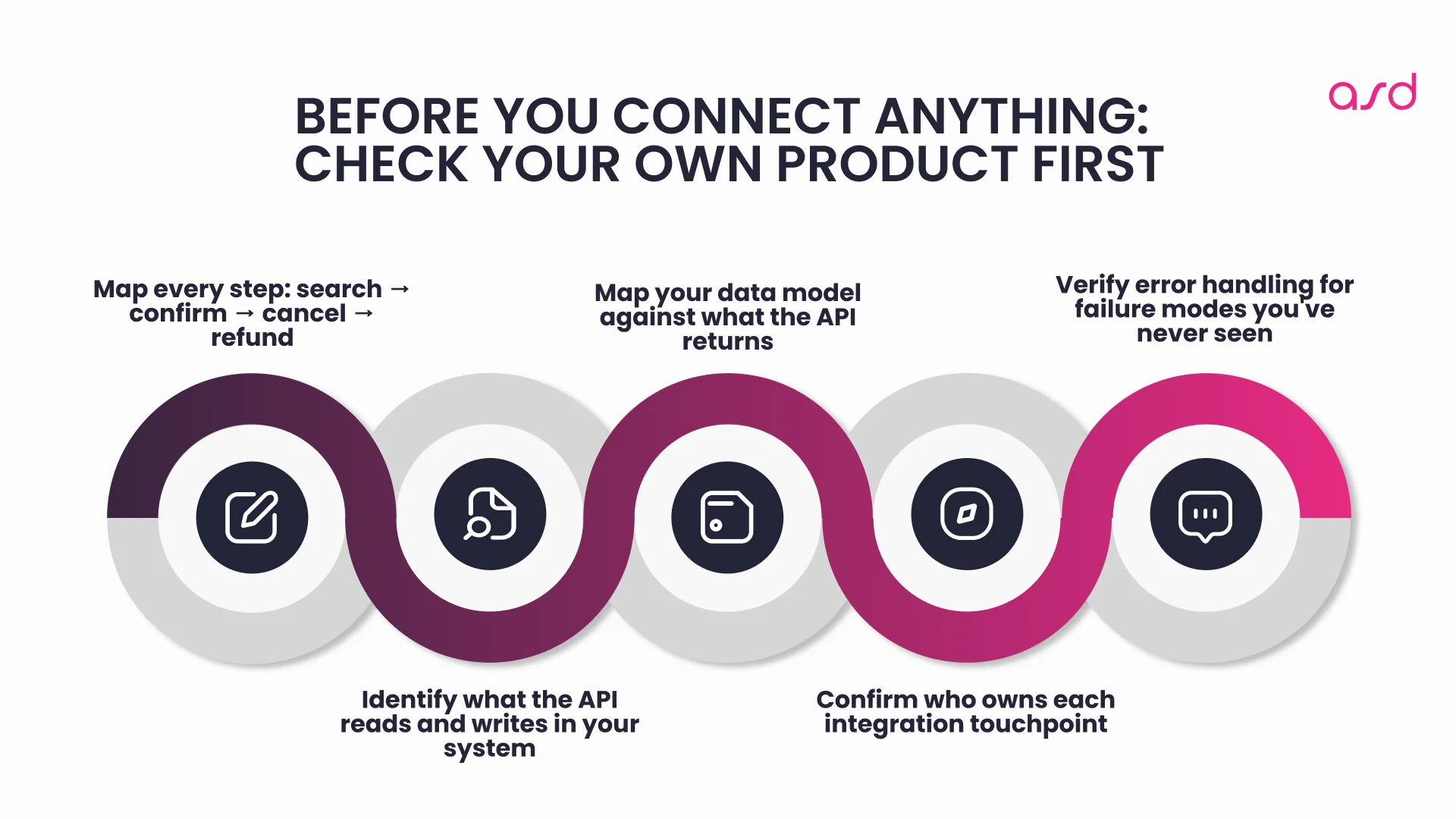
Before evaluating any specific API, audit your own product. These are the checks that prevent the failures that only surface in production.
Map Your Existing Booking Flow End-to-End First
Before a new API touches your product, you need a complete picture of how bookings currently move through it – from search to confirmation to cancellation to refund. Every step. Every system involved.
This isn’t documentation for its own sake. It’s how you identify where the new API data needs to enter, what it needs to interact with, and what existing logic it might break. Without this map, you’re integrating blind.
What to do:
- Trace a booking from search query to confirmed reservation to cancellation – document every step and every system it touches
- Identify where booking status currently updates and how that propagates to inventory, admin, and customer-facing views
- Note every place where availability data is read, written, or cached in the existing product
- Identify any manual steps currently sitting inside what should be an automated flow
Identify Which Data the API Will Need to Read and Write
A new API doesn’t just add data – it interacts with data that already exists in your product. Before integration starts, map exactly what the API will need to read from your system and what it will write back.
What to check:
- What existing records will the API need to read – property data, user records, booking history, pricing rules?
- What will the API write back – booking confirmations, status updates, availability changes, pricing updates?
- Are there conflicts between what the API expects to own and what your product currently manages directly?
- If the API writes booking status, what happens to the existing logic that currently handles booking status?
Check Your Data Model Against What the API Returns
Every travel API returns data in its own format. Your product has its own internal data model. These two things rarely match cleanly – and the gap between them is where silent failures live.
What to check:
- Pull the API’s response schema and map it field by field against your internal data model
- Identify field name mismatches – an API returning “check_in_date” when your model uses “arrival” seems trivial until it causes a booking to fail silently
- Check data type differences – strings vs. integers, date formats, currency representations, null handling
- Identify fields your product requires that the API doesn’t return – and decide what happens when they’re missing
- Check whether the API’s concept of a “booking” or “reservation” maps cleanly to yours, or whether there’s a structural mismatch that requires a translation layer
Confirm Who Owns Each Integration Touchpoint
In an existing product, different parts of the system often have implicit owners – developers who built specific flows, logic that was added for specific reasons, areas of the codebase that have dependencies nobody has fully documented. Before a new API integration starts, these ownership questions need explicit answers.
What to confirm:
- Who owns the booking flow logic that the new API will interact with?
- Who owns the data model that the API will read from and write to?
- If the API changes behavior or breaks, who is responsible for detecting and responding to that?
- Are there parts of the existing codebase that only one person understands – and does that person need to be involved in the integration planning?
Verify Your Error Handling and Fallback Behavior
Your existing product has error handling built for the failures it has already encountered. A new travel API introduces new failure modes – and your existing error handling may not be built for them.
What to check:
- How does your product currently handle a timeout on an external API call? Is it built to handle this gracefully or does it propagate the failure directly to the user?
- What happens in your product if a booking confirmation never arrives? Does it fail safely or leave the booking in an ambiguous state?
- If the API returns an error code your product has never seen before, what happens?
- Does your product have monitoring in place to detect silent failures – cases where the API returns a success response but the data is wrong or missing?
- What is the fallback when the API is unavailable? Does your product have defined behavior or does it simply stop working?
Integration breaking things in production?
We find where travel API failures originate, without touching what works.
Let’s talk
Checklist Before API Integration – The API Side
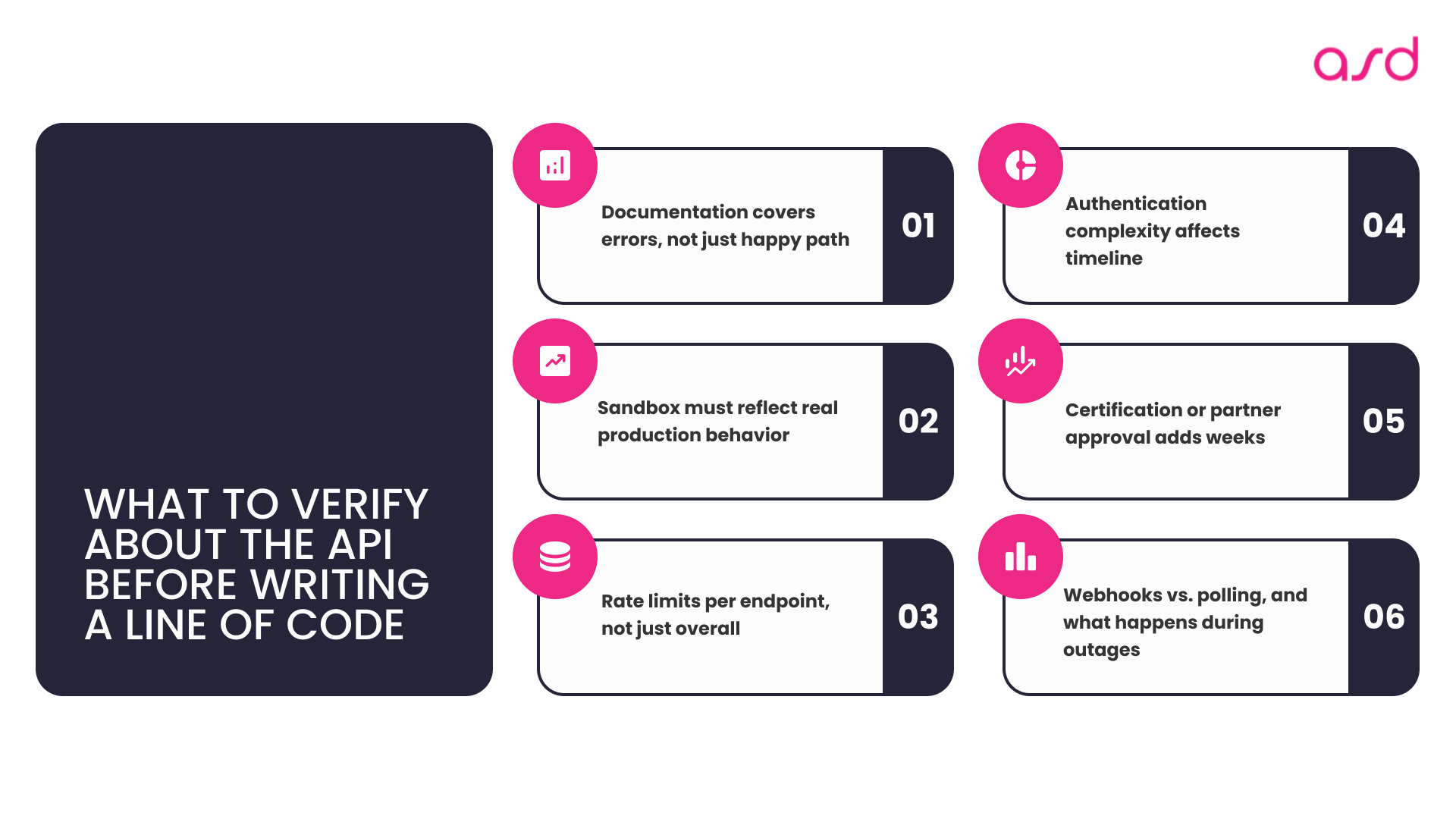
Once your product is mapped and ready, evaluate the API itself – not just its feature list, but its actual behavior under the conditions your product will encounter.
Documentation Quality and Completeness
Documentation quality is one of the strongest predictors of how long will API integration take. Poor documentation doesn’t just slow you down – it introduces risk, because the gaps in documentation are usually gaps in your understanding of how the API actually behaves.
What to check:
- Is the documentation current and version-controlled, or does it appear to lag behind the actual API behavior?
- Does it cover error codes and error handling – not just the happy path?
- Are there real request and response examples, or only field descriptions?
- Does the documentation describe edge cases – what happens when availability changes between search and booking, what happens when a cancellation fails, what happens at rate limit boundaries?
- Is there a changelog or versioning history so you can track what has changed and when?
Sandbox Behavior vs. Production Behavior
A sandbox that doesn’t reflect production behavior is one of the most expensive problems in travel API integration – because you build against one thing and discover another. Sandbox behavior frequently bears little resemblance to production in travel APIs, and discovering this after weeks of development is significantly more costly than discovering it before.
What to check:
- Does the sandbox include realistic test data – or only simplified scenarios that don’t reflect production edge cases?
- Can you test the full booking lifecycle in the sandbox – search, hold, confirm, modify, cancel – or only parts of it?
- Does the sandbox enforce the same rate limits as production?
- Are there known differences between sandbox and production behavior documented by the provider?
- If possible, speak to another team that has integrated this API and ask specifically what surprised them when they moved from sandbox to production
Rate Limits at Your Actual Expected Volume
Rate limits are aggressive in many travel APIs – particularly for availability search, which is called far more frequently than booking endpoints. A rate limit that looks acceptable in a sandbox environment can become a production bottleneck within days of launch.
What to check:
- What are the rate limits per endpoint – search, availability, booking, cancellation – not just an overall limit?
- What happens when you exceed the limit – hard failure, throttling, or silent degradation?
- Model your expected search-to-booking ratio against the rate limits. Travel platforms typically generate far more search requests than bookings – check whether your search volume will hit limits before your booking volume does
- Is there a cost associated with rate limit increases, and how long does approval take?
Authentication Requirements and Credential Management
Authentication in travel APIs is more complex than a single API key. GDS connections, OTA partner APIs, and channel managers often have layered authentication requirements that affect both development time and ongoing operations.
What to check:
- What authentication method does the API use – API key, OAuth, certificate-based, session tokens?
- How often do credentials expire and what is the refresh process?
- Are there separate credentials for sandbox and production, and what is the process for obtaining production credentials?
- If the API uses session-based authentication, what happens to in-flight booking requests if a session expires mid-flow?
- Where will credentials be stored and who has access – this is a security question as much as a technical one
Certification or Partnership Requirements
Some travel API providers require certification to verify endpoint usage, booking validity, and that travelers receive required information. GDS providers require testing and approval before production access. Major OTA partner APIs have tiered partner programs with different levels of access. Discovering these requirements after development has started is one of the most common causes of unexpected timeline overruns.
What to check:
- Does this API require a formal certification or partner approval process before production access?
- If so, what does the certification process involve – technical review, booking volume commitments, compliance documentation?
- How long does certification typically take, and is there a queue?
- Are there contractual commitments – minimum booking volumes, revenue share, exclusivity clauses – that affect your business model?
- What support is available during the certification process, and what happens if you fail certification?
Data Format and Normalization Requirements
Travel APIs rarely return data in a format that maps cleanly to your internal model. The normalization work required before data enters your product is often underestimated – particularly when adding multiple APIs that need to feed the same booking engine.
What to check:
- What data format does the API use – REST/JSON, XML, SOAP? If XML or SOAP, assess the additional parsing complexity
- How does the API represent dates, times, currencies, and timezone information? These are common sources of silent errors
- How does the API handle multilingual content – property names, descriptions, location data?
- If you are integrating multiple providers into the same booking engine, map how each provider’s data model will normalize to your internal schema before starting development on any of them
- What fields are required vs. optional in the API response, and what does your product do when an optional field that you depend on is absent?
Webhook and Real-Time Sync Support
Travel products depend on real-time accuracy. If a booking status changes on the provider’s side – a cancellation, a modification, an availability update – your product needs to know immediately. How the API communicates these changes directly affects how reliable your product will be in production.
What to check:
- Does the API support webhooks for real-time status updates, or does your product need to poll for changes?
- If webhooks are supported, what events trigger them – booking confirmation, cancellation, modification, payment status?
- What is the webhook delivery guarantee – at-least-once, exactly-once, or best-effort?
- How does your product handle a webhook that arrives out of order or is delivered twice?
- If the API uses polling rather than webhooks, what is the minimum polling interval and how does that interact with your rate limits?
- What happens to bookings made during an API outage – is there a reconciliation mechanism when the connection is restored?
Travel and Booking APIs: Сonnectivity Landscape

How Preparation for a Travel API Differs From a Regular API
If you have integrated non-travel APIs before, the checklists above will feel longer and more complex than what you are used to. That’s not incidental – it reflects a genuine difference in what travel API integration requires.
A standard API pre-integration checklist covers authentication, rate limits, documentation, and basic data mapping. Those checks apply to travel APIs too. But travel adds a layer that doesn’t exist in most other categories. Before you start, it also helps to know how to choose travel APIs that actually fit your product – because the right API eliminates a significant portion of this pre-integration complexity before it starts.
Booking state machines. A booking in a travel product isn’t a simple record – it’s an object with a lifecycle. Confirmed, pending, on-hold, cancelled, modified, refunded. Each state has rules about which transitions are valid, and those rules vary by provider. Your existing product needs to be able to handle state transitions it may never have encountered before.
Cancellation and modification logic. In most API categories, deleting or updating a record is straightforward. In travel, cancellation has financial implications – refund windows, penalty fees, non-refundable rates – that vary by provider and must be handled explicitly. Your product’s cancellation flow needs to be mapped against what the API actually supports before integration starts.
PCI DSS compliance. Any travel API that touches payment card data requires your product to meet PCI DSS requirements. This isn’t optional and it isn’t something you add afterward. If your product isn’t already PCI compliant, that work needs to happen before the payment API integration – not during it.
PMS and channel manager sync. In hospitality travel products, a booking doesn’t just update your database – it needs to propagate to the property management system and potentially to channel managers so that availability updates correctly across all distribution channels. If your existing product wasn’t built with this propagation in mind, it needs to be addressed before a new API integration adds another source of bookings to the system.
Channel conflicts. When multiple systems can create or modify bookings – your product, the API, a channel manager, a PMS – the potential for conflicting state increases with each new connection. Pre-integration work includes mapping how conflicts will be detected and resolved, not just how data will flow when everything works correctly.
None of these concerns appear in a standard API integration checklist. All of them can cause production failures if they’re not addressed before integration work begins.
Get a Free Pre-Integration Checklist
Everything to check on your product and API side before development starts.
We diagnose why your integration layer is fragile, what's creating business risk, and what to fix first. You get a clear map and roadmap – not a list of opinions.
Special Offer · Integration Stability Review
$2,500 → Free
Your integrations are live,
but you don't trust them
5–10 working days
Fixed scope
No commitment
Free integrations stability Audit
Tell us what's breaking.
We'll get back within 1 working day with next steps and a calendar slot.
Request received
Thanks — we've got it.
What Happens When You Skip the Pre-Integration Checks
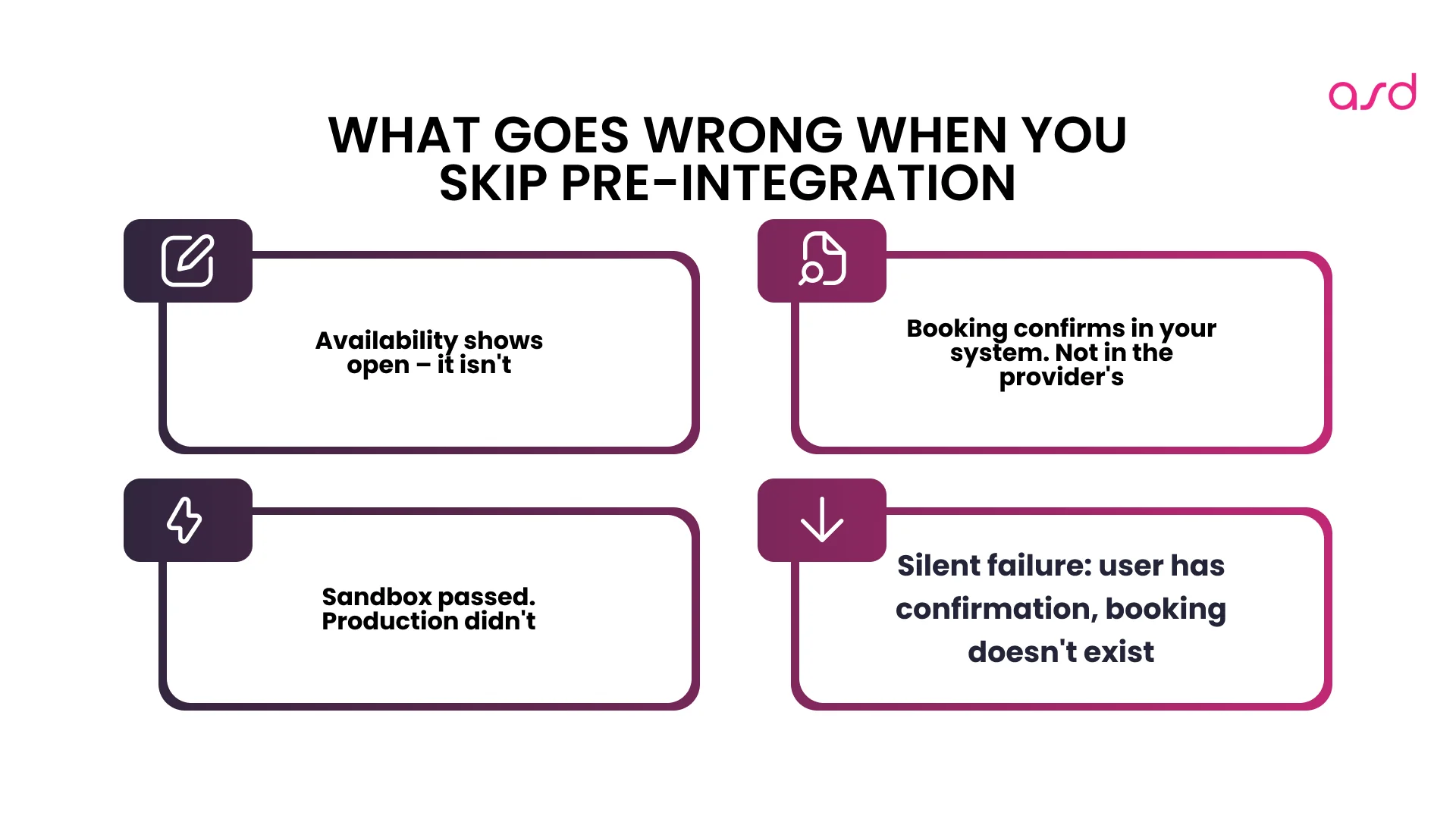
The consequences of skipping the pre-integration audit are consistent across travel products. The specific failures vary – but the pattern is the same: problems that could have been found in an hour of structured pre-integration review surface weeks or months into development, at a point when fixing them is far more expensive.
Availability mismatches. Your product shows inventory as available. The API’s actual inventory doesn’t agree. Users book things that aren’t bookable, or can’t book things that are. This is almost always a data model or sync architecture problem that was present before integration started – and invisible until the API made it visible.
Booking failures in production that didn’t occur in sandbox. The sandbox worked. Production doesn’t. The booking flow that passed every test breaks under real conditions – real rate limits, real authentication flows, real provider behavior that the sandbox didn’t replicate. The pre-integration sandbox check is what catches this before it reaches users.
Wrong booking statuses. A booking confirms in your product. The provider shows it as pending. Or cancelled. Or it doesn’t appear at all. Status propagation failures are among the most common travel API integration problems – and they are almost always caused by a mismatch between what the API returns and what the product’s existing booking logic expects to receive.
Silent failures. The worst category. The API returns a success response. Your product records the booking. But something in the normalization layer, the state transition logic, or the PMS sync silently failed. The user has a confirmation. The booking doesn’t exist where it needs to exist. The first sign of the problem is a customer arriving somewhere that has no record of their reservation.
These aren’t theoretical scenarios. They are the recurring production failures in travel platforms that skipped structured pre-integration work – and they are the reason the checklists above exist.
How ASD Team Handles API Integration
As we stated at the beginning, this article was born from our experience. Specifically, one case, which you can find in the next paragraph.
But, for now, let us show you step-by-step how we are preparing for integration, and, well, integrating the API into our client’s product.
Step 1: Map the existing flow before touching anything
The first thing we check when joining an existing product is how the current integrations work – not just what they do, but how data flows between them. On EasyOTA, this meant understanding how parallel API calls were structured, how availability data was being requested and stored, and how different providers were expected to work together inside the same booking engine. Without this map, any new integration risks breaking what’s already running.
Step 2: Build a connector per provider – never a generic solution
For each new provider, we write a dedicated connector that handles only that provider’s data. When one provider changes their API – and they do, often without warning – only that connector needs updating. Nothing else breaks. On EasyOTA, this approach meant that when Respad released a new API version, the impact was isolated to their connector alone.
Step 3: Verify sandbox behavior against production before considering integration complete
Sandbox environments in travel APIs frequently differ from production – different data formats, different response structures, occasionally endpoints that behave entirely differently. We treat integration as complete only when live data from a real client is flowing correctly through the system – not when sandbox tests pass.
Step 4: Build a normalization layer, not a data patch
Every provider returns data differently. Rather than patching data differences across the codebase, we build a manager per provider that converts their data format into our internal model. Where provider data is incomplete – missing location, missing contact details, missing descriptions – we give users the ability to fill that data manually in the system, and we preserve it across future syncs.
Step 5: Define fallback behavior before integration goes live
When a provider doesn’t respond, the system needs defined behavior – not silence. On EasyOTA, if a live availability call fails, the system falls back to the most recently synchronized data and shows what was available. Users see something meaningful. The booking flow continues. The failure is logged, not passed directly to the user.
Step 6: Separate what syncs in advance from what must be live
Not all data needs to be fetched in real time. Property data, room descriptions, photos, seasons, and pricing structures can be synchronized in advance via scheduled jobs. Live availability – whether a specific room is actually bookable on a specific date – must always be called at the moment of search. Mixing these two categories is one of the most common causes of slow search responses and stale availability data.
API failing in production? We review your travel API setup, find where failures originate, and define the fix – without breaking what already works.
 Pavlo Boiko
CEO
Pavlo Boiko
CEO
What is the most important thing to check before integrating a travel API into an existing product?
Map your existing booking flow end-to-end before evaluating any API. You need to know how data currently moves through your product – where booking status updates, where availability is read and written, and what breaks if a new source of data enters the system – before connecting anything new.
How do I know if my product is ready for a new travel API integration?
Your product is ready when you can answer three questions: what will the API read from your system, what will it write back, and what happens if it fails. If any of these answers are unclear, the pre-integration work isn’t done yet.
What should I check in a travel API’s documentation before starting integration?
Check whether it covers error codes and failure scenarios – not just the happy path. Check whether the sandbox includes realistic test data for the full booking lifecycle. Check whether there’s a changelog showing what has changed and when. Documentation that only describes what the API does when everything works is documentation you can’t fully trust.
How do I handle different data formats from multiple travel API providers?
Build a separate connector for each provider that converts their data format into your internal model. Never pass raw provider responses directly into your product logic. When you need to update or replace a provider, you update only their connector – nothing else in the product changes.
What happens if a travel API’s sandbox behaves differently from production?
It’s common. Sandbox environments in travel APIs frequently use different data structures, simplified responses, or relaxed rate limits compared to production. Treat integration as complete only when live data from a real environment is flowing correctly – not when sandbox tests pass.
How do I protect my existing product when adding a new travel API?
Isolate the new integration behind its own connector layer so that any failure or change in the new API doesn’t affect existing flows. Define fallback behavior before the integration goes live. And avoid synchronizing everything during search requests – pre-sync what can be pre-synced, and call the API live only for what must be real-time, like availability.
How long does pre-integration work typically take for a travel API?
It depends on the complexity of your existing product and the API itself. For a well-documented API integrating into a product with clear architecture, pre-integration mapping and sandbox validation typically takes one to two weeks. For niche or poorly documented APIs, or products with unclear existing architecture, allow significantly more time before development begins.
Show more


